Department of Global Health and Population, Harvard T H Chan School of Public Health, Boston, MA, USA.
Department of Global Health and Population, Harvard T H Chan School of Public Health, Boston, MA, USA.
Lancet. 2018 Nov 17;392(10160):2203-2212. doi: 10.1016/S0140-6736(18)31668-4. Epub 2018 Sep 5.
Universal health coverage has been proposed as a strategy to improve health in low-income and middle-income countries (LMICs). However, this is contingent on the provision of good-quality health care. We estimate the excess mortality for conditions targeted in the Sustainable Development Goals (SDG) that are amenable to health care and the portion of this excess mortality due to poor-quality care in 137 LMICs, in which excess mortality refers to deaths that could have been averted in settings with strong health systems.
Using data from the 2016 Global Burden of Disease study, we calculated mortality amenable to personal health care for 61 SDG conditions by comparing case fatality between each LMIC with corresponding numbers from 23 high-income reference countries with strong health systems. We used data on health-care utilisation from population surveys to separately estimate the portion of amenable mortality attributable to non-utilisation of health care versus that attributable to receipt of poor-quality care.
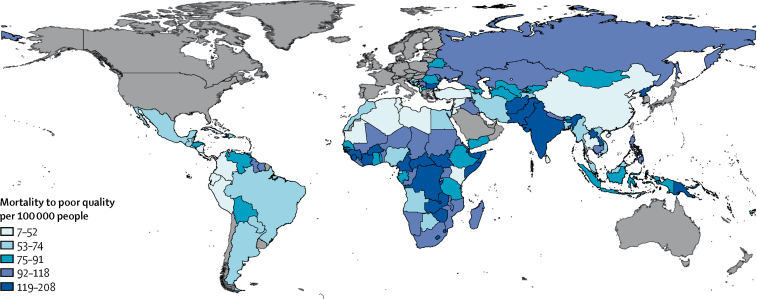
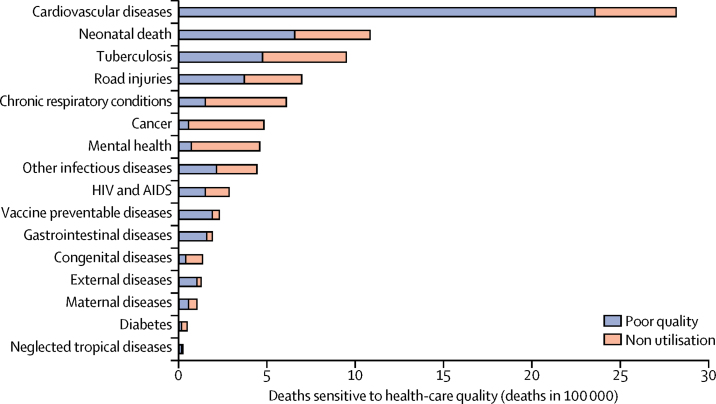
15·6 million excess deaths from 61 conditions occurred in LMICs in 2016. After excluding deaths that could be prevented through public health measures, 8·6 million excess deaths were amenable to health care of which 5·0 million were estimated to be due to receipt of poor-quality care and 3·6 million were due to non-utilisation of health care. Poor quality of health care was a major driver of excess mortality across conditions, from cardiovascular disease and injuries to neonatal and communicable disorders.
Universal health coverage for SDG conditions could avert 8·6 million deaths per year but only if expansion of service coverage is accompanied by investments into high-quality health systems.
Bill & Melinda Gates Foundation.
全民健康覆盖被提议作为改善中低收入国家(LMICs)卫生状况的一项策略。然而,这取决于提供高质量的医疗保健。我们估计了在 137 个 LMIC 中,可持续发展目标(SDG)所针对的、可通过医疗保健解决的疾病的超额死亡率,以及这部分超额死亡率中因医疗质量差导致的部分,其中超额死亡率是指在拥有强大卫生系统的环境中本可避免的死亡。
利用 2016 年全球疾病负担研究的数据,我们通过比较每个 LMIC 与 23 个拥有强大卫生系统的高收入参考国家的病例死亡率,计算了 61 个 SDG 疾病中个人医疗保健可解决的死亡率。我们利用来自人口调查的医疗保健利用数据,分别估计可归因于未利用医疗保健和接受低质量医疗保健的可归因死亡率部分。
2016 年,137 个 LMIC 中有 1560 万人死于 61 种疾病。在排除通过公共卫生措施可预防的死亡后,有 860 万人的死亡可归因于医疗保健,其中 500 万人估计是由于接受低质量的医疗保健,360 万人是由于未利用医疗保健。医疗保健质量差是导致各种疾病超额死亡率的主要因素,包括心血管疾病和伤害、新生儿和传染病。
全民健康覆盖可以避免每年 860 万人死亡,但前提是服务覆盖范围的扩大伴随着对高质量卫生系统的投资。
比尔及梅琳达·盖茨基金会。