Destouni Maria, Lazaris Andreas C, Tzelepi Vasiliki
Department of Cytopathology, Hippokrateion General Hospital of Athens, 11527 Athens, Greece.
First Department of Pathology, School of Medicine, The National and Kapodistrian University of Athens, 11527 Athens, Greece.
Cancers (Basel). 2022 Jun 21;14(13):3041. doi: 10.3390/cancers14133041.
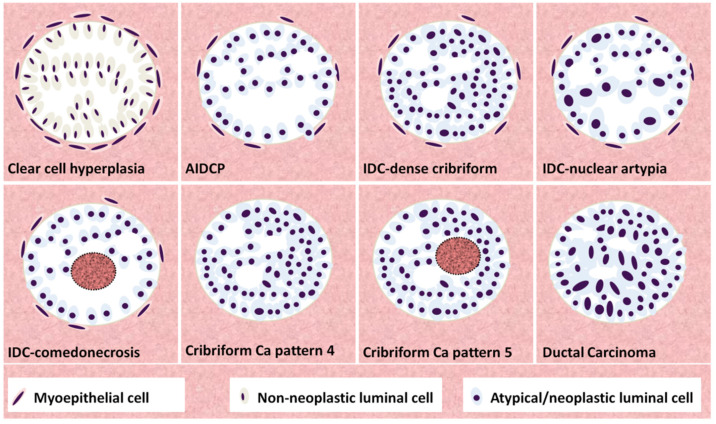
Cribriform glandular formations are characterized by a continuous proliferation of cells with intermingled lumina and can constitute a major or minor part of physiologic (normal central zone glands), benign (clear cell cribriform hyperplasia and basal cell hyperplasia), premalignant (high-grade prostatic intraepithelial neoplasia), borderline (atypical intraductal cribriform proliferation) or clearly malignant (intraductal, acinar, ductal and basal cell carcinoma) lesions. Each displays a different clinical course and variability in clinical management and prognosis. The aim of this review is to summarize the current knowledge regarding the morphological features, differential diagnosis, molecular profile and clinical significance of the cribriform-patterned entities of the prostate gland. Areas of controversy regarding their management, i.e., the grading of Intaductal Carcinoma, will also be discussed. Understanding the distinct nature of each cribriform lesion leads to the correct diagnosis and ensures accuracy in clinical decision-making, prognosis prediction and personalized risk stratification of patients.
筛状腺性结构的特征是细胞持续增殖,管腔相互交织,可构成生理性(正常中央区腺体)、良性(透明细胞筛状增生和基底细胞增生)、癌前病变(高级别前列腺上皮内瘤变)、交界性(非典型导管内筛状增生)或明确恶性(导管内、腺泡、导管和基底细胞癌)病变的主要或次要部分。每种病变都有不同的临床病程以及临床管理和预后的差异。本综述的目的是总结目前关于前列腺筛状结构实体的形态特征、鉴别诊断、分子特征和临床意义的知识。还将讨论其管理方面存在争议的领域,即导管内癌的分级。了解每种筛状病变的独特性质有助于正确诊断,并确保临床决策、预后预测和患者个性化风险分层的准确性。