Steenhuis Eline G M, Schoenaker Ivonne J H, De Groot Jan Willem B, Stigt Jos A, Reerink Onne, De Vos Tot Nederveen Cappel Wouter H, Van Westreenen Henderik L, Brohet Richard M
Department of Gastroenterology and Hepatology, Isala Zwolle, Dokter van Heesweg 2, 8025 AB Zwolle, The Netherlands.
Isala Oncology Center, Isala, Dokter van Heesweg 2, 8025 AB Zwolle, The Netherlands.
J Clin Med. 2022 Jul 1;11(13):3828. doi: 10.3390/jcm11133828.
Worldwide, colorectal carcinoma (CRC) has a high incidence and a substantial cancer-related mortality. The recurrence risk is 30-50% and lung metastases are common. Treatment of lung metastases with stereotactic ablative radiotherapy (SABR) or metastasectomy may increase survival. The best modality for thoracic screening in the follow-up, however, remains controversial. In this study, we aimed to unravel the additional value of routine chest X-ray (CXR) for detecting lung metastases during the follow-up of CRC patients treated with curative surgery.
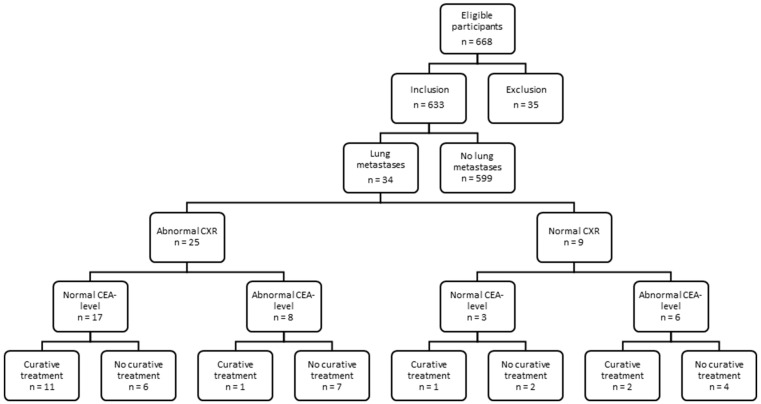
Between 2013 and 2017, 668 CRC patients were treated with curative intent, of whom 633 patients were included in follow-up, which consisted of CXR, serum Carcino-Embryonic Antigen (CEA) and ultrasound of the liver. Patients who developed lung metastases, diagnosed with CXR and characterised by a normal concomitant serum CEA level, were identified. Number, size and treatment of lung metastases were described.
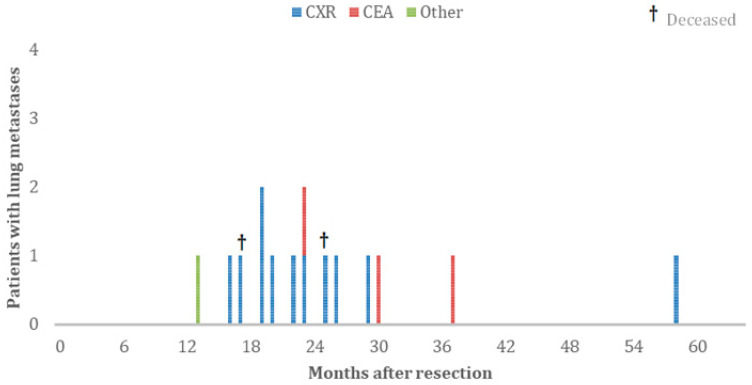
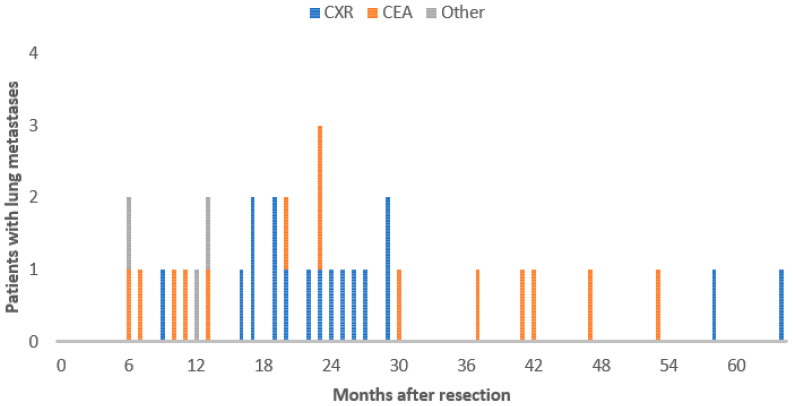
Thirty-four (5.4%) patients developed lung metastases. Seventeen (50%) were detected by CXR without pathological CEA levels. Eleven (65%) of these patients were treated with curative intent, whereas 21% of patients with lung metastases and elevated CEA levels were treated with curative intent ( = 0.049). Higher numbers of lung metastases were associated with a lower chance of curative treatment.
More than 50% of patients with lung metastases on CXR in the follow-up would not have been detected with CEA-triggered imaging only. In addition, patients with colorectal lung metastases without elevated CEA levels were often suitable for curative treatment and, therefore, CXR seems to have additional value within the follow-up of CRC.
在全球范围内,结直肠癌(CRC)发病率高,癌症相关死亡率可观。复发风险为30%-50%,肺转移很常见。采用立体定向消融放疗(SABR)或转移灶切除术治疗肺转移可能会提高生存率。然而,随访中胸部筛查的最佳方式仍存在争议。在本研究中,我们旨在阐明在接受根治性手术的CRC患者随访期间,常规胸部X线(CXR)检测肺转移的附加价值。
2013年至2017年期间,668例CRC患者接受了根治性治疗,其中633例患者纳入随访,随访包括CXR、血清癌胚抗原(CEA)和肝脏超声检查。识别出通过CXR诊断出肺转移且伴随血清CEA水平正常的患者。描述了肺转移灶的数量、大小和治疗情况。
34例(5.4%)患者发生肺转移。17例(50%)通过CXR检测到,且CEA水平无异常。其中11例(65%)患者接受了根治性治疗,而CEA水平升高的肺转移患者中21%接受了根治性治疗(P = 0.049)。肺转移灶数量越多,根治性治疗的机会越低。
随访中胸部X线显示有肺转移的患者中,超过50%仅通过CEA触发成像无法检测到。此外,CEA水平未升高的结直肠癌肺转移患者通常适合根治性治疗,因此,CXR在CRC随访中似乎具有附加价值。