
一种用于部分重叠点云配准的两阶段无对应算法。
A Two-Stage Correspondence-Free Algorithm for Partially Overlapping Point Cloud Registration.
作者信息
Zhang Wenhao, Zhang Yu, Li Jinlong
机构信息
School of Physical Science and Technology, Southwest Jiaotong University, Chengdu 610036, China.
出版信息
Sensors (Basel). 2022 Jul 3;22(13):5023. doi: 10.3390/s22135023.
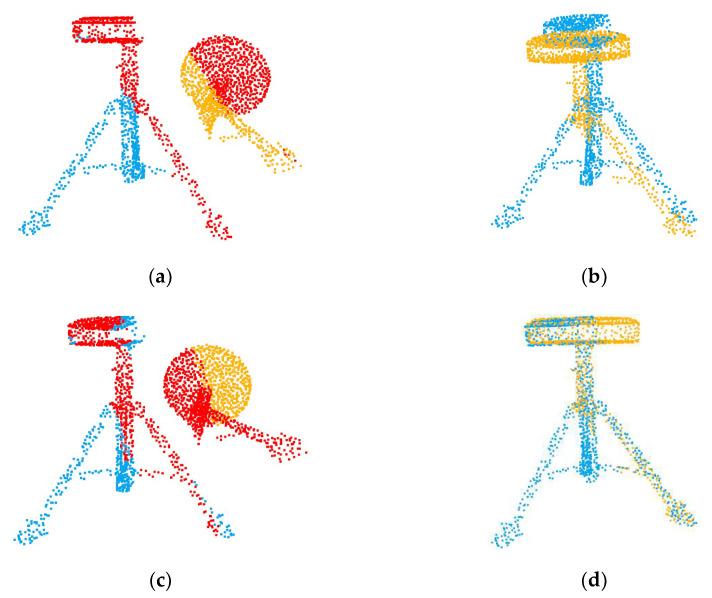
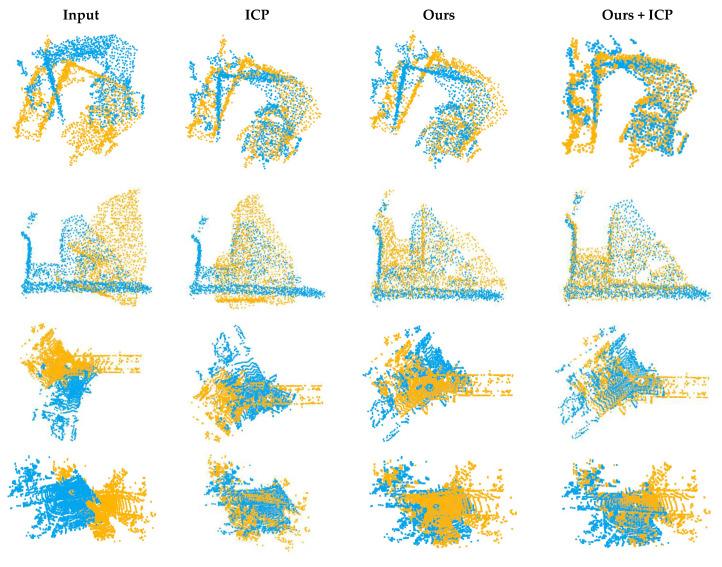
Point cloud registration is a key task in the fields of 3D reconstruction and automatic driving. In recent years, many learning-based registration methods have been proposed and have higher precision and robustness compared to traditional methods. Correspondence-based learning methods often require that the source point cloud and the target point cloud have homogeneous density, the aim of which is to extract reliable key points. However, the sparsity, low overlap rate and random distribution of real data make it more difficult to establish accurate and stable correspondences. Global feature-based methods do not rely on the selection of key points and are highly robust to noise. However, these methods are often easily disturbed by non-overlapping regions. To solve this problem, we propose a two-stage partially overlapping point cloud registration method. Specifically, we first utilize the structural information and feature information interaction of point clouds to predict the overlapping regions, which can weaken the impact of non-overlapping regions in global features. Then, we combine PointNet and the self-attention mechanism and connect features at different levels to efficiently capture global information. The experimental results show that the proposed method has higher accuracy and robustness than similar existing methods.
点云配准是三维重建和自动驾驶领域的一项关键任务。近年来,许多基于学习的配准方法被提出,与传统方法相比具有更高的精度和鲁棒性。基于对应关系的学习方法通常要求源点云和目标点云具有均匀的密度,其目的是提取可靠的关键点。然而,实际数据的稀疏性、低重叠率和随机分布使得建立准确稳定的对应关系更加困难。基于全局特征的方法不依赖于关键点的选择,对噪声具有高度鲁棒性。然而,这些方法往往容易受到非重叠区域的干扰。为了解决这个问题,我们提出了一种两阶段部分重叠点云配准方法。具体来说,我们首先利用点云的结构信息和特征信息交互来预测重叠区域,这可以减弱非重叠区域在全局特征中的影响。然后,我们结合PointNet和自注意力机制,并在不同层次连接特征以有效捕获全局信息。实验结果表明,所提出的方法比现有的类似方法具有更高的精度和鲁棒性。


 Zotero 插件