Qian Jiangbo, Yan Shimi, Li Zhenyu, Yu Ling, Wang Xinlei, Zhang Zhijie, Sun Junze, Han Xu
Department of Power Engineering, North China Electric Power University, Baoding 071003, China.
Hebei Key Laboratory of Low Carbon and High Efficiency Power Generation Technology, North China Electric Power University, Baoding 071003, China.
Polymers (Basel). 2022 Jul 5;14(13):2743. doi: 10.3390/polym14132743.
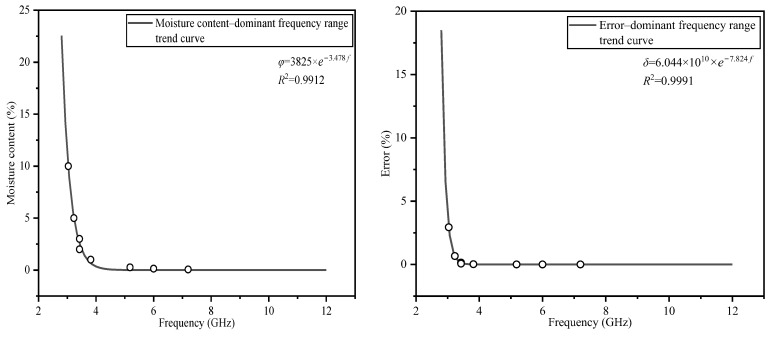
In heterogeneous polymers and emulsions, the volume fraction of the discrete phase and the frequency of electromagnetic waves affect the accuracy of the dielectric model. The integral method was used to modify the Maxwell-Wagner (M-W) heterogeneous dielectric theory, and a new model for the complex dielectric constant of polymers and emulsions was established. The experimental data were compared with the results of the M-W heterogeneous dielectric integral modification model and other theoretical models for different frequencies and volume fractions of the discrete phase. We discovered that with a decreasing volume fraction of the discrete phase, the dominant frequency range of the integral modification model expanded. When the volume fraction of the discrete phase is 10%, the dominant frequency range reaches 3 GHz. When the volume fraction of the discrete phase is 1%, the dominant frequency range reaches 4 GHz. When the volume fraction of the discrete phase is 0.06%, the dominant frequency range of the real part reaches 9.6 GHz, and the dominant frequency range of the imaginary part reaches 7.2 GHz. These results verify the advantages of the M-W modification model, which provides a theoretical basis to study the dielectric properties of polymers and emulsions, as well as for microwave measurement.
在非均相聚合物和乳液中,分散相的体积分数和电磁波频率会影响介电模型的准确性。采用积分方法对麦克斯韦 - 瓦格纳(M - W)非均相介电理论进行修正,建立了聚合物和乳液复介电常数的新模型。将不同频率和分散相体积分数下的实验数据与M - W非均相介电积分修正模型及其他理论模型的结果进行了比较。我们发现,随着分散相体积分数的降低,积分修正模型的主导频率范围扩大。当分散相体积分数为10%时,主导频率范围达到3 GHz。当分散相体积分数为1%时,主导频率范围达到4 GHz。当分散相体积分数为0.06%时,实部的主导频率范围达到9.6 GHz,虚部的主导频率范围达到7.2 GHz。这些结果验证了M - W修正模型的优势,为研究聚合物和乳液的介电性能以及微波测量提供了理论依据。