Department of Respiratory Medicine, Graduate School of Medicine, Osaka City University, Osaka, Japan.
Department of Clinical Oncology, Graduate School of Medicine, Osaka Metropolitan University, Osaka, Japan.
Thorac Cancer. 2022 Aug;13(16):2309-2317. doi: 10.1111/1759-7714.14560. Epub 2022 Jul 8.
We aimed to identify the relationship between thyroid transcription factor-1 (TTF-1) expression of lung adenocarcinoma and the efficacy of immune-checkpoint inhibitor (ICI) therapy.
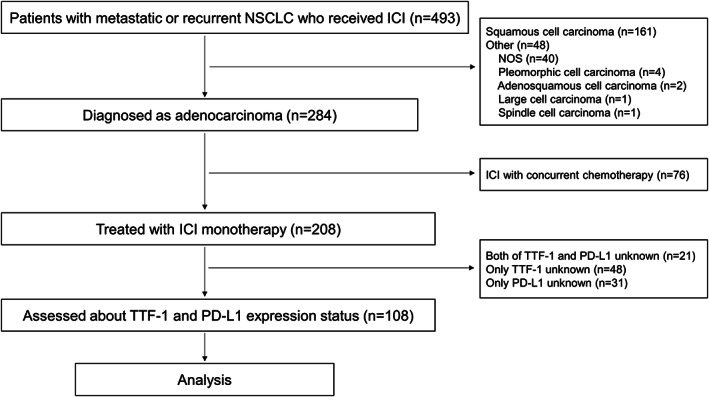
This retrospective multicenter study comprised patients with advanced lung adenocarcinoma treated with ICI monotherapy. We collected clinical medical records including data on TTF-1 expression and analyzed the relationship between TTF-1 expression and programmed death-ligand 1 tumor proportion score (PD-L1 TPS), objective response rate (ORR), progression-free survival (PFS), and overall survival (OS).
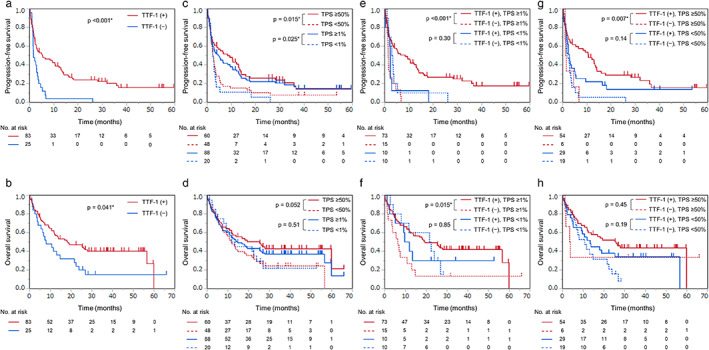
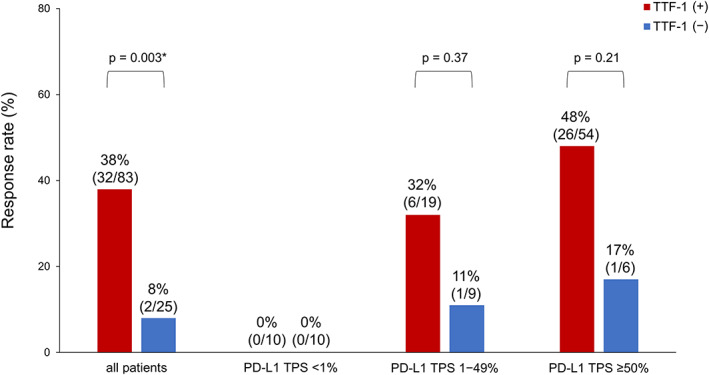
In total, 108 patients with lung adenocarcinoma were analyzed. The rate of TPS ≥1% and ≥50% in patients with positive TTF-1 expression was significantly higher than that in patients with negative TTF-1 expression (88% vs. 60%, p < 0.001; 65% vs. 24%, p < 0.001). The ORR was significantly higher in TTF-1 positive patients than in TTF-1-negative patients (38% vs. 8%, p = 0.003). Among patients with TPS ≥50% and 1%-49%, the ORR in TTF-1 positive and negative patients was 48% (26/54) versus 17% (1/6) (p = 0.21), and 32% (6/19) versus 11% (1/9) (p = 0.37), respectively. The ORR for patients with TPS <1% was 0% in both the TTF-1 negative and positive cases. The median PFS and OS was significantly longer in TTF-1-positive patients than in TTF-1-negative patients (5.4 vs. 1.6 months, p < 0.001; 18.2 vs. 8.0 months, p = 0.041). Multivariate analysis revealed that TTF-1-negative status was an independent unfavorable prognostic factor for PFS.
Patients with TTF-1-positive status receiving ICI monotherapy showed better outcomes than those with TTF-1-negative lung adenocarcinoma.
我们旨在确定肺腺癌中甲状腺转录因子-1(TTF-1)表达与免疫检查点抑制剂(ICI)治疗效果之间的关系。
本回顾性多中心研究纳入了接受 ICI 单药治疗的晚期肺腺癌患者。我们收集了临床病历资料,包括 TTF-1 表达数据,并分析了 TTF-1 表达与程序性死亡配体 1 肿瘤比例评分(PD-L1 TPS)、客观缓解率(ORR)、无进展生存期(PFS)和总生存期(OS)之间的关系。
共分析了 108 例肺腺癌患者。TTF-1 表达阳性患者的 TPS≥1%和≥50%的比例明显高于 TTF-1 表达阴性患者(88%比 60%,p<0.001;65%比 24%,p<0.001)。TTF-1 阳性患者的 ORR 明显高于 TTF-1 阴性患者(38%比 8%,p=0.003)。在 TPS≥50%和 1%-49%的患者中,TTF-1 阳性和阴性患者的 ORR 分别为 48%(26/54)比 17%(1/6)(p=0.21)和 32%(6/19)比 11%(1/9)(p=0.37)。TPS<1%的患者中,TTF-1 阴性和阳性病例的 ORR 均为 0%。TTF-1 阳性患者的中位 PFS 和 OS 明显长于 TTF-1 阴性患者(5.4 与 1.6 个月,p<0.001;18.2 与 8.0 个月,p=0.041)。多变量分析显示,TTF-1 阴性状态是 PFS 的独立不良预后因素。
接受 ICI 单药治疗的 TTF-1 阳性患者比 TTF-1 阴性肺腺癌患者的疗效更好。