Anwer Md Khalid, Fatima Farhat, Ahmed Mohammed Muqtader, Aldawsari Mohammed F, Alali Amer S, Kalam Mohd Abul, Alshamsan Aws, Alkholief Musaed, Malik Abdul, Az Alanazi, Al-Shdefat Ramadan
Department of Pharmaceutics, College of Pharmacy, Prince Sattam Bin Abdulaziz University, P.O. Box 173, Al-Kharj 11942, Saudi Arabia.
Department of Pharmaceutics, College of Pharmacy, King Saud University, P.O. Box 2457, Riyadh 11451, Saudi Arabia.
Saudi Pharm J. 2022 Jun;30(6):726-734. doi: 10.1016/j.jsps.2022.03.019. Epub 2022 Apr 6.
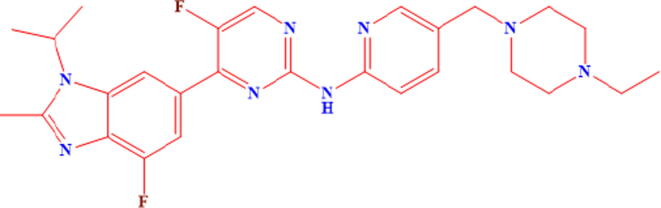
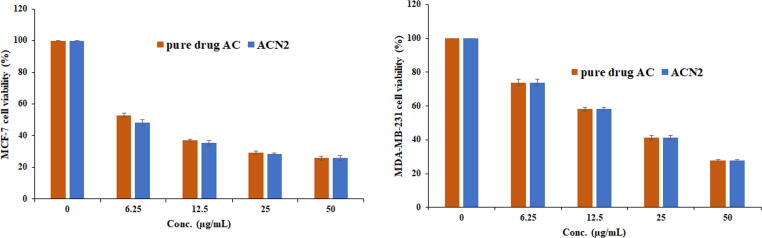
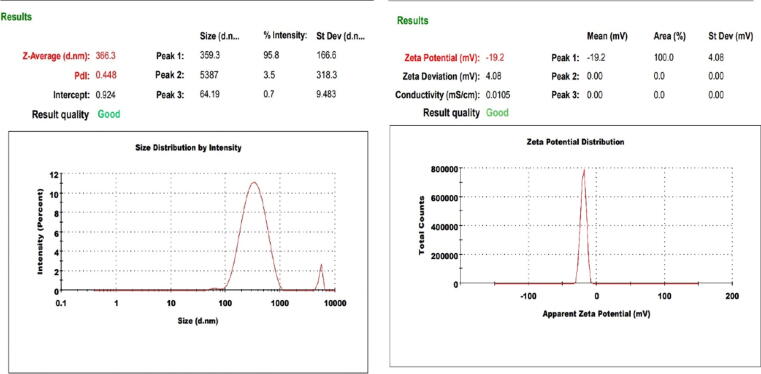
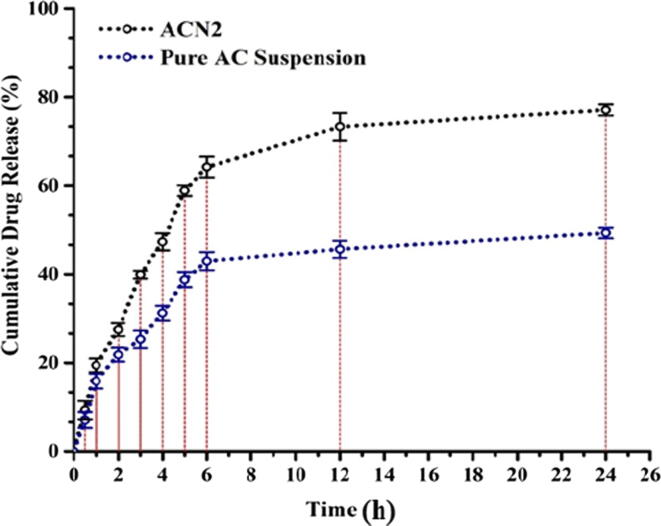
Abemaciclib (AC) is a novel, orally available drug molecule approved for the treatment of breast cancer. Due to its low bioavailability, its administration frequency is two to three times a day that can decrease patient compliance. Sustained release formulation are needed for prolong the action and to reduce the adverse effects. The aim of current study was to develop sustained release NSs of AC. Nanosponges (NSs) was prepared by emulsion-solvent diffusion method using ethyl-cellulose (EC) and Kolliphor P-188 (KP-188) as sustained-release polymer and surfactant, respectively. Effects of varying surfactant concentration and drug: polymer proportions on the particle size (PS), polydispersity index (PDI), zeta potential (ζP), entrapment efficiency (%EE), and drug loading (%DL) were investigated. The results of AC loaded NSs (ACN1-ACN5) exhibited PS (366.3-842.2 nm), PDI (0.448-0.853), ζP (-8.21 to -19.7 mV), %EE (48.45-79.36%) and %DL (7.69-19.17%), respectively. Moreover, ACN2 showed sustained release of Abemaciclib (77.12 ± 2.54%) in 24 h Higuchi matrix as best fit kinetics model. MTT assay signified ACN2 as potentials cytotoxic nanocarrier against MCF-7 and MDA-MB-231 human breast cancer cells. Further, ACN2 displayed drug release property without variation in the % release after exposing the product at 25 °C, 5 °C, and 45 °C storage conditions for six months. This investigation proved that the developed NSs would be an efficient carrier to sustain the release of AC in order to improve efficacy against breast cancer.
阿贝西利(AC)是一种新型的口服可用药物分子,已被批准用于治疗乳腺癌。由于其生物利用度低,给药频率为每天两到三次,这可能会降低患者的依从性。需要缓释制剂来延长作用时间并减少不良反应。本研究的目的是开发阿贝西利的缓释纳米海绵(NSs)。采用乙基纤维素(EC)和聚氧乙烯蓖麻油(KP - 188)分别作为缓释聚合物和表面活性剂,通过乳液 - 溶剂扩散法制备纳米海绵。研究了不同表面活性剂浓度和药物与聚合物比例对粒径(PS)、多分散指数(PDI)、zeta电位(ζP)、包封率(%EE)和载药量(%DL)的影响。载阿贝西利的纳米海绵(ACN1 - ACN5)的结果分别显示PS为(366.3 - 842.2nm)、PDI为(0.448 - 0.853)、ζP为( - 8.21至 - 19.7mV)、%EE为(48.45 - 79.36%)和%DL为(7.69 - 19.17%)。此外,ACN2在24小时的Higuchi基质中显示阿贝西利的缓释(77.12 ± 2.54%),为最佳拟合动力学模型。MTT试验表明ACN2作为针对MCF - 7和MDA - MB - 231人乳腺癌细胞的潜在细胞毒性纳米载体。此外,将产品在25°C、5°C和45°C储存条件下放置六个月后,ACN2显示出药物释放特性,且%释放率无变化。该研究证明,所开发的纳米海绵将是一种有效的载体,可维持阿贝西利的释放,以提高对乳腺癌的疗效。