Ananthakrishnan Revathi, Lin Ruitao, He Chunsheng, Chen Yanping, Li Daniel, LaValley Michael
Bristol-Myers Squibb (BMS), 300 Connell Drive, Berkeley Heights, NJ, 07922, USA.
Department of Biostatistics, The University of Texas MD Anderson Cancer Center, Houston, TX, 77030, USA.
Contemp Clin Trials Commun. 2022 Jun 13;28:100943. doi: 10.1016/j.conctc.2022.100943. eCollection 2022 Aug.
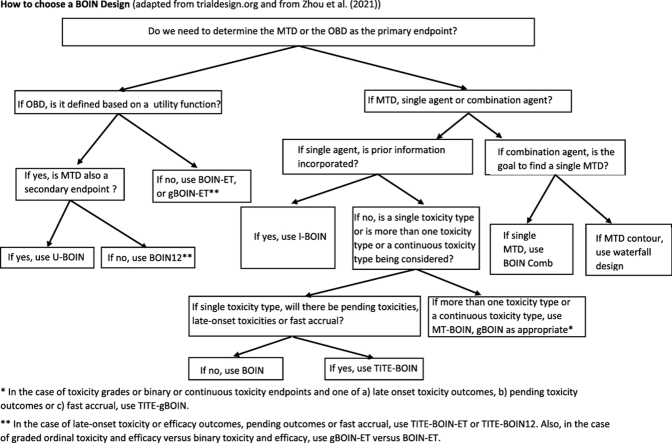
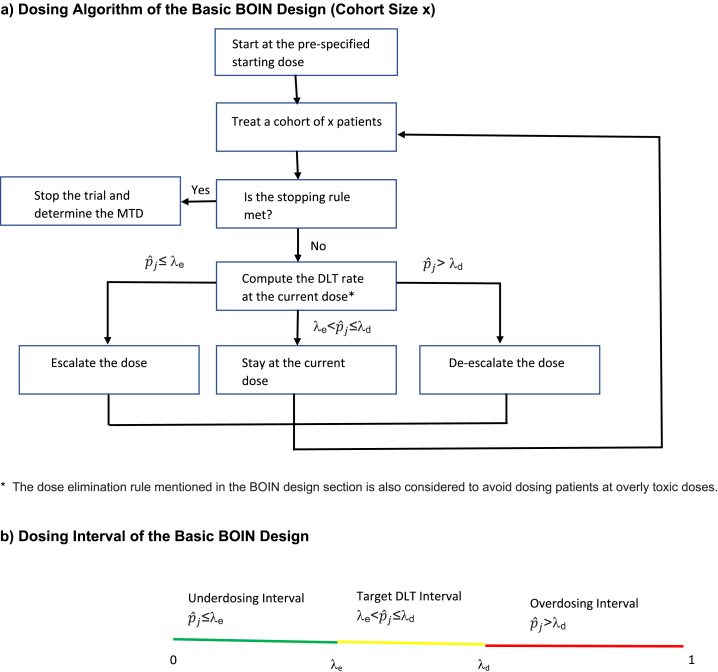
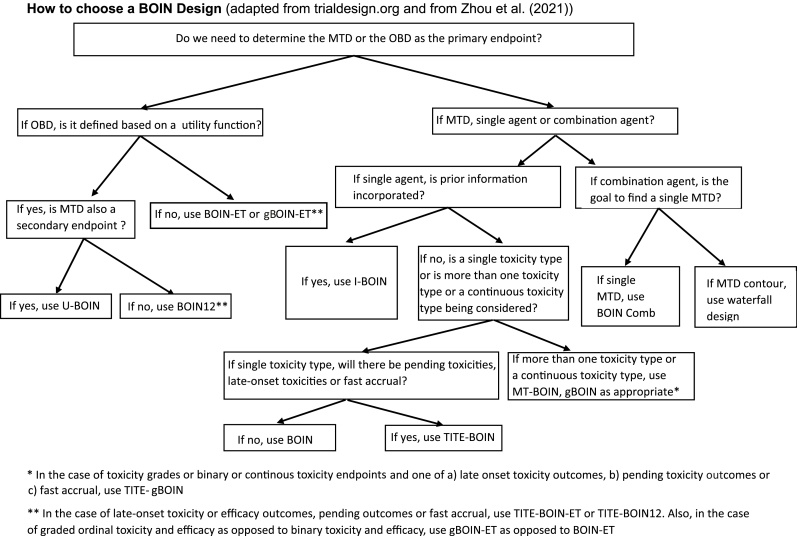
Bayesian Optimal Interval (BOIN) designs are a class of model-assisted dose-finding designs that can be used in oncology trials to determine the maximum tolerated dose (MTD) of a study drug based on safety or the optimal biological dose (OBD) based on safety and efficacy. BOIN designs provide a complete suite for dose finding in early phase trials, as well as a consistent way to explore different scenarios such as toxicity, efficacy, continuous outcomes, delayed toxicity or efficacy and drug combinations in a unified manner with easy access to software to implement most of these designs. Although built upon Bayesian probability models, BOIN designs are operationally simple in general and have good statistical operating characteristics compared to other dose-finding designs. This review paper describes the original BOIN design and its many extensions, their advantages and limitations, the software used to implement them, and the most suitable situation for use of each of these designs. Published examples of the implementation of BOIN designs are provided in the Appendix.
贝叶斯最优区间(BOIN)设计是一类模型辅助的剂量探索设计,可用于肿瘤学试验,以基于安全性确定研究药物的最大耐受剂量(MTD),或基于安全性和有效性确定最优生物学剂量(OBD)。BOIN设计为早期试验中的剂量探索提供了一套完整的方法,同时也提供了一种一致的方式,以统一的方式探索不同的情况,如毒性、疗效、连续结局、延迟毒性或疗效以及药物组合,并且可以方便地使用软件来实施大多数这些设计。尽管BOIN设计基于贝叶斯概率模型构建,但总体上操作简单,与其他剂量探索设计相比具有良好的统计操作特性。本文综述描述了原始的BOIN设计及其众多扩展、它们的优点和局限性、用于实施这些设计的软件,以及每种设计最适合使用的情况。附录中提供了BOIN设计实施的已发表示例。