Fang Zhou-Tao, Jin Jing, Ye Ying, He Wei-Zhong, Shu Zai-Fa, Shao Jing-Na, Fu Zhu-Sheng, Lu Jian-Liang, Ye Jian-Hui
Tea Research Institute, Zhejiang University, Hangzhou, China.
Zhejiang Agricultural Technical Extension Center, Hangzhou, China.
Front Plant Sci. 2022 Jun 24;13:909765. doi: 10.3389/fpls.2022.909765. eCollection 2022.
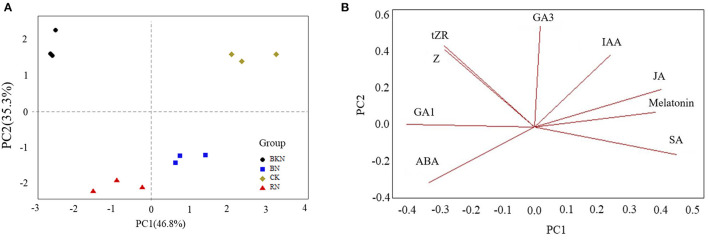
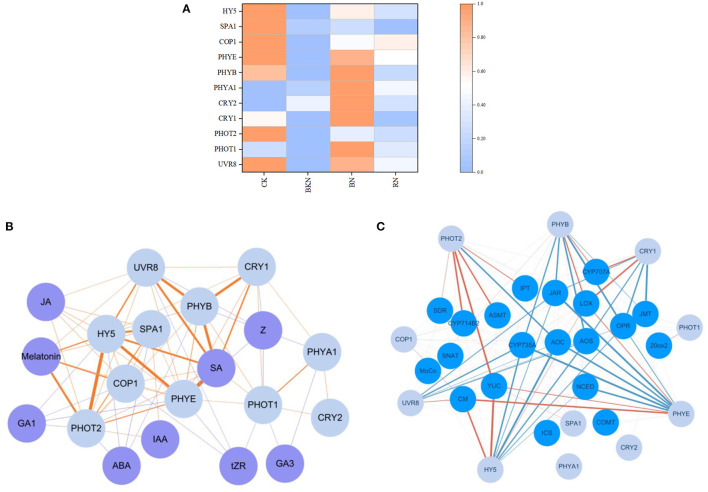
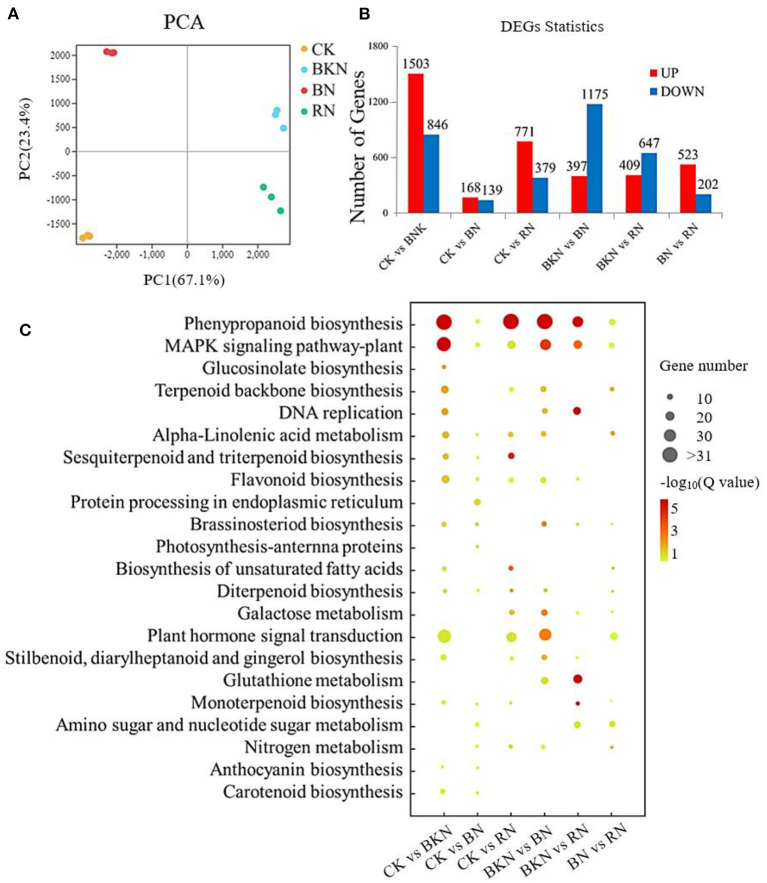
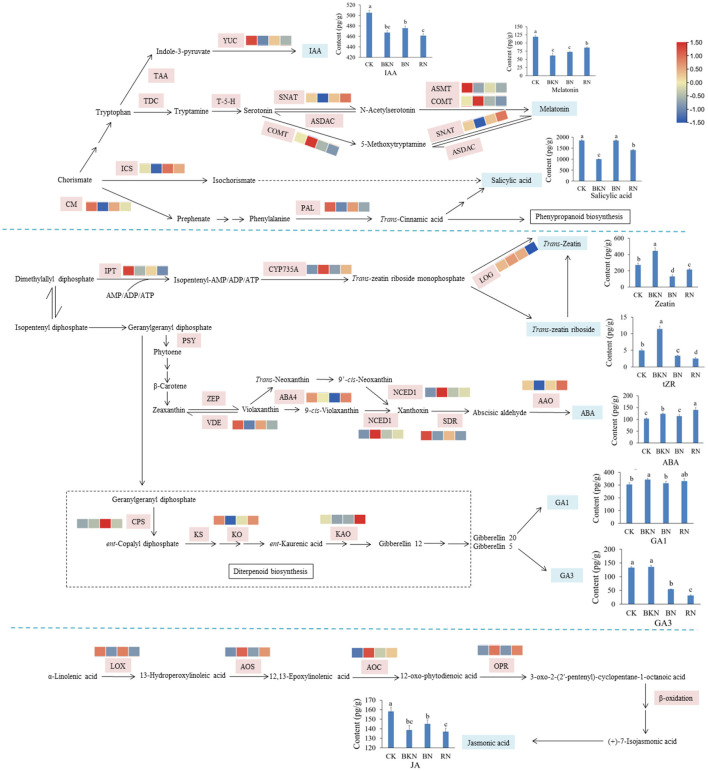
Our previous study showed that colored net shading treatments had comparable effects on the reduction of bitter and astringent compounds such as flavonol glycosides in tea leaves, compared with black net shading treatment, whereas the effects on the biomass and phytohormones are still unclear. In this study, we investigated the phytohormone and transcriptome profiles of tea leaves under different shading treatments, using black, blue, and red nets with the same shade percentages. The bud density, fresh weight of 100 buds, and yield under blue net shading treatments were greatly elevated by 2.00-fold, 1.24-fold, and 2.48-fold, compared with black net shading treatment, while their effects on flavonoid composition were comparable with black net shading treatment. The transcriptome profiles of different shade net-treated samples were well resolved and discriminated from control. The KEGG result indicated that the pathways of phenylpropanoid biosynthesis, MAPK signaling pathways, and plant hormone signal transduction were differentially regulated by different shading treatments. The co-expression analysis showed that the contents of salicylic acid and melatonin were closely correlated with certain light signal perception and signaling genes ( < 0.05), and UVR8, PHYE, CRY1, PHYB, PHOT2, and HY5 had more close interactions with phytohormone biosynthetic genes ( < 0.05). Our results suggest that different shading treatments can mediate the growth of tea plants, which could be attributed to the regulatory effect on phytohormones levels, providing an instruction for the production of summer/autumn tea and matcha.
我们之前的研究表明,与黑色遮阳网处理相比,彩色遮阳网处理在降低茶叶中黄酮醇苷等苦涩化合物方面具有类似的效果,然而其对生物量和植物激素的影响仍不清楚。在本研究中,我们使用相同遮荫百分比的黑色、蓝色和红色遮阳网,研究了不同遮荫处理下茶叶的植物激素和转录组图谱。与黑色遮阳网处理相比,蓝色遮阳网处理下的芽密度、100个芽的鲜重和产量大幅提高,分别提高了2.00倍、1.24倍和2.48倍,而它们对黄酮类化合物组成的影响与黑色遮阳网处理相当。不同遮阳网处理样品的转录组图谱得到了很好的解析,并与对照区分开来。KEGG结果表明,不同的遮荫处理对苯丙烷生物合成途径、丝裂原活化蛋白激酶(MAPK)信号通路和植物激素信号转导途径有不同的调控作用。共表达分析表明,水杨酸和褪黑素的含量与某些光信号感知和信号基因密切相关(<0.05),紫外线抗性8(UVR8)基因、光敏色素E(PHYE)基因、隐花色素1(CRY1)基因、光敏色素B(PHYB)基因、向光素2(PHOT2)基因和伸长因子HY5与植物激素生物合成基因有更密切的相互作用(<0.05)。我们的结果表明,不同的遮荫处理可以调节茶树的生长,这可能归因于对植物激素水平的调控作用,为夏秋茶和抹茶的生产提供了指导。