Quesada Odayme, Van Hon Logan, Yildiz Mehmet, Madan Mina, Sanina Cristina, Davidson Laura, Htun Wah Wah, Saw Jacqueline, Garcia Santiago, Dehghani Payam, Stanberry Larissa, Bortnick Anna, Henry Timothy D, Grines Cindy L, Benziger Catherine
Women's Heart Center, The Christ Hospital Heart and Vascular Institute, Cincinnati, Ohio.
The Carl and Edyth Lindner Center for Research and Education, The Christ Hospital, Cincinnati, Ohio.
J Soc Cardiovasc Angiogr Interv. 2022 Jul-Aug;1(4):100360. doi: 10.1016/j.jscai.2022.100360. Epub 2022 May 19.
Women with ST-segment elevation myocardial infarction (STEMI) had worse outcomes than men prior to the COVID-19 pandemic. Although concomitant COVID-19 infection increases mortality risk in STEMI patients, no studies have evaluated sex differences in this context.
The North American COVID-19 STEMI registry is a prospective, multicenter registry of hospitalized STEMI patients with COVID-19 infection. We compared sex differences in clinical characteristics, presentation, management strategies, and in-hospital mortality.
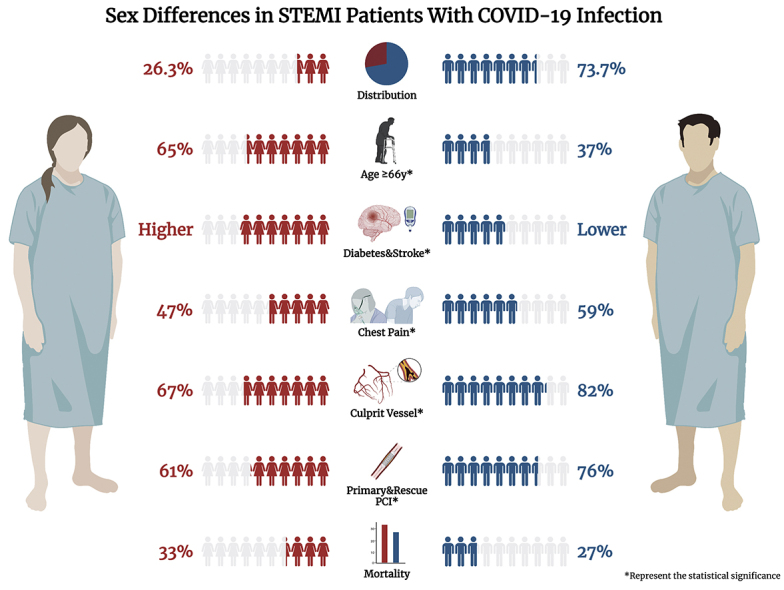
Among 585 patients with STEMI and COVID-19 infection, 154 (26.3%) were women. Compared to men, women were significantly older, had a higher prevalence of diabetes and stroke/transient ischemic attack, and were more likely to be on statins on presentation. Men more frequently presented with chest pain, whereas women presented with dyspnea. Women more often had STEMI without an identified culprit lesion than men (33% vs 18%, < .001). The use of percutaneous coronary intervention was significantly higher in men, whereas medical therapy was higher in women. In-hospital mortality was 33% for women and 27% for men ( = .22).
In patients presenting with STEMI in the context of COVID-19, the in-hospital mortality rate was 30% and similar for men and women. Lack of an identifiable culprit lesion was common in the setting of COVID-19 for both sexes but more likely in women (1/3 of women vs 1/5 of men). Evaluation of specific underlying etiologies is underway to better define the full impact of COVID-19 on STEMI outcomes and better understand the observed sex differences.
在2019冠状病毒病大流行之前,ST段抬高型心肌梗死(STEMI)女性患者的预后比男性差。尽管合并2019冠状病毒病感染会增加STEMI患者的死亡风险,但尚无研究评估这一背景下的性别差异。
北美2019冠状病毒病STEMI注册研究是一项对住院的合并2019冠状病毒病感染的STEMI患者进行的前瞻性多中心注册研究。我们比较了临床特征、临床表现、管理策略和院内死亡率方面的性别差异。
在585例合并2019冠状病毒病感染的STEMI患者中,154例(26.3%)为女性。与男性相比,女性年龄显著更大,糖尿病和中风/短暂性脑缺血发作的患病率更高,且就诊时更可能正在服用他汀类药物。男性更常表现为胸痛,而女性表现为呼吸困难。女性无明确罪犯病变的STEMI患者比男性更常见(33%对18%,P<0.001)。男性经皮冠状动脉介入治疗的使用率显著更高,而女性药物治疗的使用率更高。女性院内死亡率为33%,男性为27%(P = 0.22)。
在合并2019冠状病毒病的STEMI患者中,院内死亡率为30%,男性和女性相似。在2019冠状病毒病背景下,男女两性均常见缺乏可识别的罪犯病变的情况,但女性更可能出现(女性的1/3对男性的1/5)。正在对特定潜在病因进行评估,以更好地界定2019冠状病毒病对STEMI预后的全面影响,并更好地理解观察到的性别差异。