Kebalo Abbul H, Gizaw Solomon T, Gnanasekaran Natesan, Areda Bilisuma G
Department Medical Biochemistry, Madda Walabu University, Goba, Ethiopia.
Department of Medical Biochemistry, Addis Ababa University, Addis Ababa, Ethiopia.
J Blood Med. 2022 Jul 4;13:385-394. doi: 10.2147/JBM.S367990. eCollection 2022.
Blood banks have been suffering a shortage of blood worldwide due to limited donations. By and large, it is widely believed that blood donation has multiple health benefits. However, there are limited studies that support it. As a result, assessing the biochemical profiles of the regular blood donors is indispensable to evaluating an individual's risk for chronic inflammation.
We strived to compare lipid and haematological profiles of the regular and first-time blood donors in the National Blood Bank Service of Ethiopia.
A comparative cross-sectional study, involving 104 blood samples (52 each of regular and first-time donors), was designed to analyze lipid and haematological profiles and anthropometric parameters were measured. Data were analyzed using SPSS version 25, Chi-square ( ) was used to compare the relationship between categorical variables and an independent Student's -test was used to compare the mean of the two groups. A p-value <0.05 was considered statistically significant.
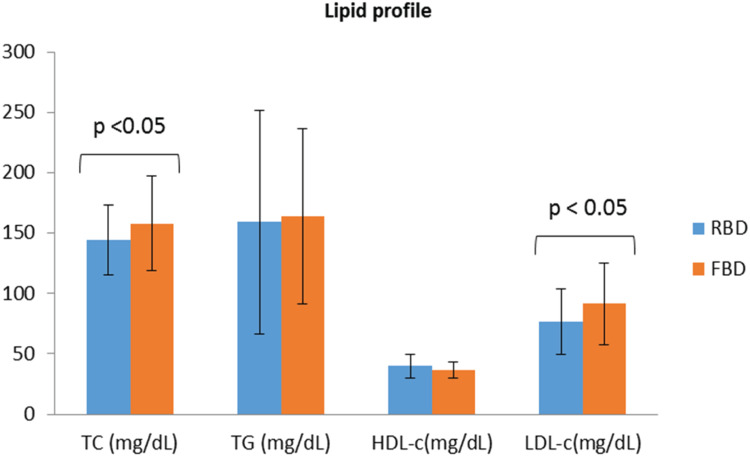
Regular blood donors had lower mean TC (144.3 ± 28 mg/dL), TG (159.3 ± 88.2 mg/dL), LDL-c (75.9 ± 25.9 mg/dL) than the first-time blood donors with values of TC (158.1 ± 38.94 mg/dL), TG (163.9 ± 82.7 mg/dL), LDL-c (93.1 ± 31.5 mg/dL), respectively. The ratio of LDL-c/HDL-c and TC/HDL-c was found to be lower in regular blood donors when compared to the first-time donors (P < 0.05). Even though the level of HDL-c was higher (39.8 ± 8.8 mg/dL) in regular blood donors compared to first-time blood donors (36.8 ± 7.7 mg/dL), it was not statistically significant. The mean of some haematologic parameters like a platelet, RDW, lymphocyte, and MCH was significantly lower in regular blood donors than in first-time blood donors. BMI and WHR in regular donors were less than the first-time donors, albeit statistically insignificant.
Interestingly, blood donation has a significant health benefit by lowering TC, TG and LDL-c, which have the potential risk of developing chronic inflammation.
由于献血有限,全球血库一直面临血液短缺的问题。总体而言,人们普遍认为献血对健康有诸多益处。然而,支持这一观点的研究有限。因此,评估定期献血者的生化指标对于评估个体患慢性炎症的风险至关重要。
我们致力于比较埃塞俄比亚国家血液中心定期献血者和首次献血者的血脂和血液学指标。
设计了一项比较性横断面研究,纳入104份血样(定期献血者和首次献血者各52份),以分析血脂和血液学指标,并测量人体测量参数。使用SPSS 25版软件进行数据分析,卡方检验用于比较分类变量之间的关系,独立样本t检验用于比较两组的均值。p值<0.05被认为具有统计学意义。
定期献血者的平均总胆固醇(TC)(144.3±28mg/dL)、甘油三酯(TG)(159.3±88.2mg/dL)、低密度脂蛋白胆固醇(LDL-c)(75.9±25.9mg/dL)低于首次献血者,首次献血者的TC为(158.1±38.94mg/dL)、TG为(163.9±82.7mg/dL)、LDL-c为(93.1±31.5mg/dL)。与首次献血者相比,定期献血者的LDL-c/HDL-c和TC/HDL-c比值更低(P<0.05)。尽管定期献血者的高密度脂蛋白胆固醇(HDL-c)水平(39.8±8.8mg/dL)高于首次献血者(36.8±7.7mg/dL),但差异无统计学意义。一些血液学参数如血小板、红细胞分布宽度、淋巴细胞和平均红细胞血红蛋白含量的均值在定期献血者中显著低于首次献血者。定期献血者的体重指数(BMI)和腰臀比(WHR)低于首次献血者,尽管差异无统计学意义。
有趣的是,献血通过降低具有引发慢性炎症潜在风险的TC、TG和LDL-c,对健康有显著益处。