Lekdamrongkul Pichitra, Pongthavornkamol Kanaungnit, Molassiotis Alex, Dechpichai Porntip, Pinsuntorn Pimchan
Department of Medical Nursing, Faculty of Nursing, Mahidol University, Bangkok, Thailand.
School of Nursing, The Hong Kong Polytechnic University, Hong Kong Special Administrative Region, China.
Asia Pac J Oncol Nurs. 2022 May 18;9(9):100083. doi: 10.1016/j.apjon.2022.100083. eCollection 2022 Sep.
To evaluate the psychometric properties of the Thai version of the Cancer Survivors' Unmet needs (CaSUN-TH) scale among Thai cancer survivors after completion of primary treatment.
Standardized translation procedures developed the Cancer Survivors' Unmet Needs into a Thai version (CaSUN-TH). Face validity was evaluated by a group of experts, and a pilot test on 10 cancer patients was conducted to evaluate its readability. A total of 236 cancer survivors who were attending follow-up visits at a cancer hospital in Thailand completed the CaSUN-TH. The internal consistency of the instrument was examined using Cronbach's α. The association of the CaSUN-TH and its subscales with physical symptoms, QoL, age, gender, and type of cancer were examined for criterion validity and known-group validity. Construct validity was evaluated using confirmatory factor analysis.
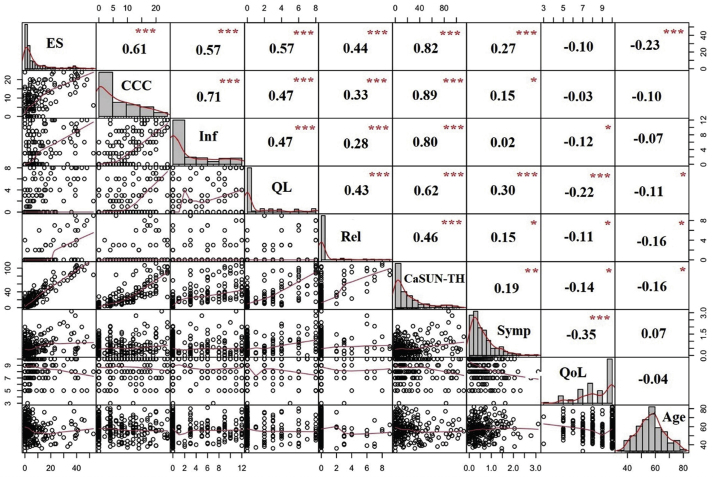
The CaSUN-TH showed good readability and high content validity for use as an instrument to assess unmet needs among Thai cancer survivors. Cronbach's for the entire scale was 0.95. Confirmatory factor analysis indicated that the five-factor structure of the CaSUN-TH was good fit to the data (CFI = 0.901, SRMR = 0.074, RMSEA = 0.076 [90% confidence interval, 0.066-0.085]). In terms of construct validity, CaSUN-TH scores significantly correlated to other variables hypothesized to influence the level of need, including higher physical symptoms prevalence was related to poor quality of life, and poorer QOL and younger age were associated with a higher level of unmet needs. In addition, the scale was able to differentiate scores between groups, including gender, age, and type of primary cancer, with theoretically hypothesized differences.
The CaSUN-TH demonstrated appropriate psychometric properties for assessing unmet needs in different cancer survivor groups in Thailand. Using the CaSUN-TH can help health professionals in targeting individual survivor needs, bridging the gap between patients' experiences and their expectations, and improving the quality of cancer survivorship care.
评估泰国癌症幸存者在完成初始治疗后,泰语版癌症幸存者未满足需求量表(CaSUN-TH)的心理测量学特性。
采用标准化翻译程序将癌症幸存者未满足需求量表翻译成泰语版(CaSUN-TH)。由一组专家评估其表面效度,并对10名癌症患者进行预试验以评估其可读性。共有236名在泰国一家癌症医院接受随访的癌症幸存者完成了CaSUN-TH量表。使用克朗巴哈系数(Cronbach's α)检验该量表的内部一致性。检验CaSUN-TH及其子量表与身体症状、生活质量、年龄、性别和癌症类型之间的关联,以评估效标效度和已知群组效度。采用验证性因子分析评估结构效度。
CaSUN-TH量表具有良好的可读性和较高的内容效度,可作为评估泰国癌症幸存者未满足需求的工具。整个量表的克朗巴哈系数为0.95。验证性因子分析表明,CaSUN-TH的五因素结构与数据拟合良好(CFI = 0.901,SRMR = 0.074,RMSEA = 0.076 [90%置信区间,0.066 - 0.085])。在结构效度方面,CaSUN-TH得分与其他假设影响需求水平的变量显著相关,包括较高的身体症状发生率与较差的生活质量相关,较差的生活质量和较年轻的年龄与较高水平的未满足需求相关。此外,该量表能够区分不同组之间的得分,包括性别、年龄和原发性癌症类型,且具有理论上假设的差异。
CaSUN-TH量表在评估泰国不同癌症幸存者群体未满足需求方面表现出适当的心理测量学特性。使用CaSUN-TH量表有助于卫生专业人员针对个体幸存者的需求,弥合患者经历与期望之间的差距,并提高癌症 survivorship care的质量。