Singh Maninder, James P S, Paul Happy, Bolar Kartikeya
Manipal Academy of Higher Education and Faculty Associate, T A Pai Management Institute, India.
Department of HRM & OB, Jagdish Sheth School of Management, Bangalore, India.
Heliyon. 2022 Jul 3;8(7):e09843. doi: 10.1016/j.heliyon.2022.e09843. eCollection 2022 Jul.
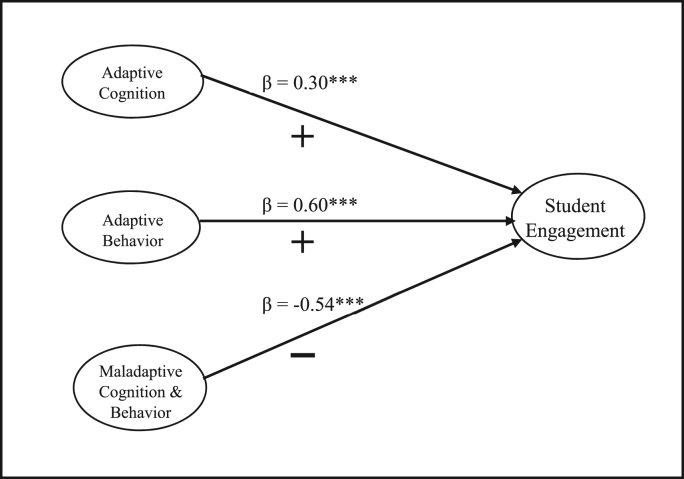
This study explores the relationship between student motivation and student engagement. The study, which is rooted in the self-determination (SDT) and engagement (JD-R) theories, responds to the contemporary call for studying this relationship. A bipartite construct of motivation measures both positive and negative components of motivation and structural equation modeling (SEM) by using data from 693 undergraduate and graduate students. In doing so, the study finds that student motivation is an antecedent of engagement. Adaptive cognition and behavior are positively related to engagement (β = 0.30, β = 0.60); maladaptive cognitions and behavior are negatively related to engagement (β = -0.54). The study advances SDT and JD-R. Implications for educationists and possible interventions to enhance motivation and, consequently, engagement are discussed. The study brings clarity to the student motivation-engagement relationship.
本研究探讨了学生动机与学生参与度之间的关系。该研究以自我决定理论(SDT)和工作要求-资源理论(JD-R)为基础,回应了当下对研究这种关系的呼吁。通过对693名本科生和研究生的数据进行分析,动机的二分结构测量了动机的积极和消极成分,并采用了结构方程模型(SEM)。在此过程中,研究发现学生动机是参与度的一个前提条件。适应性认知和行为与参与度呈正相关(β = 0.30,β = 0.60);适应不良的认知和行为与参与度呈负相关(β = -0.54)。该研究推进了自我决定理论和工作要求-资源理论。文中讨论了对教育工作者的启示以及可能提高动机从而提高参与度的干预措施。该研究明确了学生动机与参与度之间的关系。