Vereecke Nick, Kvisgaard Lise Kirstine, Baele Guy, Boone Carine, Kunze Marius, Larsen Lars Erik, Theuns Sebastiaan, Nauwynck Hans
Laboratory of Virology, Faculty of Veterinary Medicine, Ghent University, Merelbeke 9280, Belgium.
Veterinary Clinical Microbiology, Department of Veterinary and Animal Sciences, University of Copenhagen, Copenhagen 1050, Denmark.
Virus Evol. 2022 Jun 16;8(1):veac053. doi: 10.1093/ve/veac053. eCollection 2022.
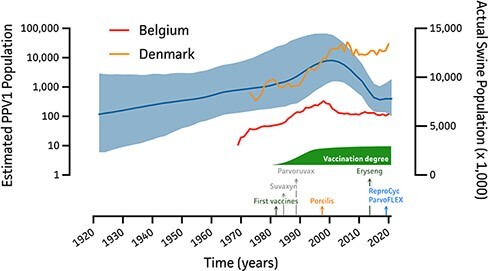
Porcine Parvovirus Type 1 (PPV1) contributes to important losses in the swine industry worldwide. During a PPV1 infection, embryos and fetuses are targeted, resulting in stillbirth, mummification, embryonic death, and infertility (SMEDI syndrome). Even though vaccination is common in gilts and sows, strains mainly belonging to the 27a-like group have been spreading in Europe since early 2000s, resulting in SMEDI problems and requiring in-depth studies into the molecular epidemiology and vaccination efficacy of commercial vaccines. Here, we show that PPV1 has evolved since 1855 [1737, 1933] at a rate of 4.71 × 10 nucleotide substitutions per site per year. Extensive sequencing allowed evaluating and reassessing the current PPV1 VP1-based classifications, providing evidence for the existence of four relevant phylogenetic groups. While most European strains belong to the PPV1a (G1) or PPV1b (G2 or 27a-like) group, most Asian and American G2 strains and some European strains were divided into virulent PPV1c (e.g. NADL-8) and attenuated PPV1d (e.g. NADL-2) groups. The increase in the swine population, vaccination degree, and health management (vaccination and biosafety) influenced the spread of PPV1. The reactivity of anti-PPV1 antibodies from sows vaccinated with Porcilis Parvo, Eryseng Parvo, or ReproCyc ParvoFLEX against different PPV1 field strains was the highest upon vaccination with ReproCyc ParvoFLEX, followed by Eryseng Parvo, and Porcilis Parvo. Our findings contribute to the evaluation of the immunogenicity of existing vaccines and support the development of new vaccine candidates. Finally, the potential roles of cluster-specific hallmark amino acids in elevated pathogenicity and viral entry are discussed.
1型猪细小病毒(PPV1)给全球养猪业造成了重大损失。在PPV1感染期间,胚胎和胎儿是主要感染对象,会导致死胎、木乃伊化、胚胎死亡和不育(SMEDI综合征)。尽管在后备母猪和母猪中普遍进行疫苗接种,但自21世纪初以来,主要属于27a样组的毒株在欧洲不断传播,导致出现SMEDI问题,因此需要深入研究商业疫苗的分子流行病学和疫苗接种效果。在此,我们表明PPV1自1855年以来[1737, 1933]以每年每个位点4.71×10个核苷酸替换的速率进化。广泛的测序使得能够评估和重新评估当前基于PPV1 VP1的分类,为四个相关系统发育组的存在提供了证据。虽然大多数欧洲毒株属于PPV1a(G1)或PPV1b(G2或27a样)组,但大多数亚洲和美洲的G2毒株以及一些欧洲毒株被分为强毒株PPV1c(如NADL - 8)和弱毒株PPV1d(如NADL - 2)组。猪群数量、疫苗接种程度和健康管理(疫苗接种和生物安全)的增加影响了PPV1的传播。用Porcilis Parvo、Eryseng Parvo或ReproCyc ParvoFLEX疫苗接种的母猪所产生的抗PPV1抗体,在接种ReproCyc ParvoFLEX后对不同PPV1野毒株的反应性最高,其次是Eryseng Parvo,然后是Porcilis Parvo。我们的研究结果有助于评估现有疫苗的免疫原性,并支持开发新的候选疫苗。最后,讨论了簇特异性标志性氨基酸在提高致病性和病毒进入方面的潜在作用。