Department of Social Psychology and Methodology, Autonomous University of Madrid, Madrid, Spain.
Department of Social and Organizational Psychology, National University of Distance Education, Madrid, Spain.
Psych J. 2022 Dec;11(6):885-894. doi: 10.1002/pchj.566. Epub 2022 Jul 11.
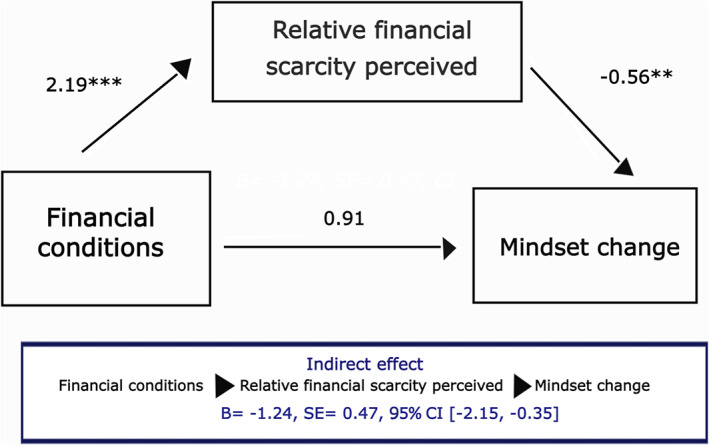
In the present research, we examined the links among relative financial scarcity, thinking style, fatalism, and well-being and their roles in predicting protective behaviors against COVID-19. Study 1 (N = 120) revealed that after an experimental manipulation to induce the perception of relative financial scarcity (versus financial abundance), people who perceived higher relative financial scarcity changed their thinking style to a more concrete mindset. In Study 2 (N = 873), the relative financial abundance-scarcity situation was measured, and the results showed that the greater the perceived relative financial scarcity was, the more concrete the mindset and the lower the sense of well-being. Importantly, we found that individuals who felt poorer but maintained an abstract thinking style reported higher well-being. Study 3 (N = 501) examined the influence of a concrete thinking style in people who perceived that their economic situation had worsened with the pandemic. The results showed that when this vulnerable population presented a more concrete mindset, they reported lower well-being, higher fatalism, and lower protective behavior against COVID-19. Thus, maintaining an abstract mindset promotes higher well-being, lower fatalism, and greater protective behaviors against COVID-19, even under economic difficulties. Because thinking style can be modified, our results encourage the development of new social intervention programs to promote an abstract mindset when people face important challenges.
在本研究中,我们考察了相对财务匮乏、思维方式、宿命论与幸福感之间的联系,以及它们在预测新冠疫情保护行为方面的作用。研究 1(N=120)表明,在通过实验操作诱发相对财务匮乏感(相对于财务充裕感)后,那些感知到相对财务匮乏感更高的人会改变思维方式,变得更加具体。在研究 2(N=873)中,我们测量了相对财务丰裕-匮乏情况,结果表明,感知到的相对财务匮乏感越强,思维方式就越具体,幸福感越低。重要的是,我们发现那些感觉自己更贫穷但保持抽象思维方式的人报告的幸福感更高。研究 3(N=501)考察了在那些认为自己的经济状况因疫情而恶化的人中,具体思维方式的影响。结果表明,当这一弱势群体表现出更具体的思维方式时,他们报告的幸福感较低、宿命论较高、对新冠疫情的保护行为较少。因此,保持抽象思维方式可以促进更高的幸福感、更低的宿命论和更多的新冠疫情保护行为,即使在经济困难的情况下也是如此。由于思维方式是可以改变的,我们的研究结果鼓励开发新的社会干预项目,以在人们面临重要挑战时促进抽象思维方式的发展。