Yu Chuigong, Fan Yu, Zhang Yu, Liu Lupeng, Guo Gang
Department of Urology, The Third Medical Center, Chinese People's Liberation Army General Hospital, No. 69, Yongding Road, Haidian District, Beijing, 100039, China.
Cancer Cell Int. 2022 Jul 10;22(1):228. doi: 10.1186/s12935-022-02637-4.
Prostate cancer (PCa) is one of the most common malignant tumors in the male urinary system. In recent years, the morbidity and mortality of PCa have been increasing due to the limited effects of existing treatment strategies. Long non-coding RNA (lncRNA) LINC00893 was reported to inhibit the proliferation and metastasis of papillary thyroid cancer cells, but its role in PCa has not been reported. This study aims to investigate the role and underlying mechanism of LINC00893 in regulating the progression of PCa cells.
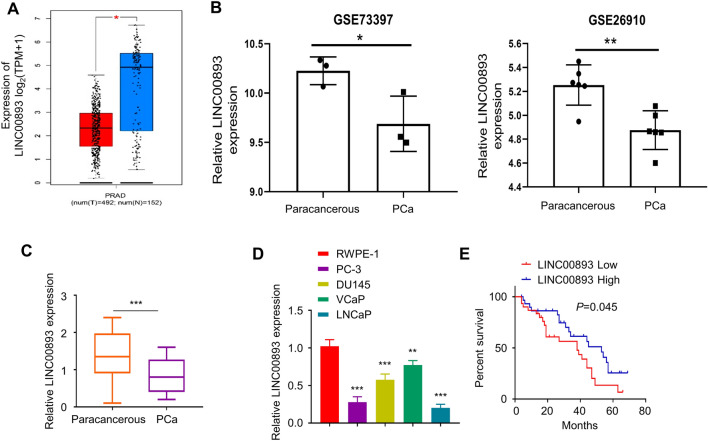
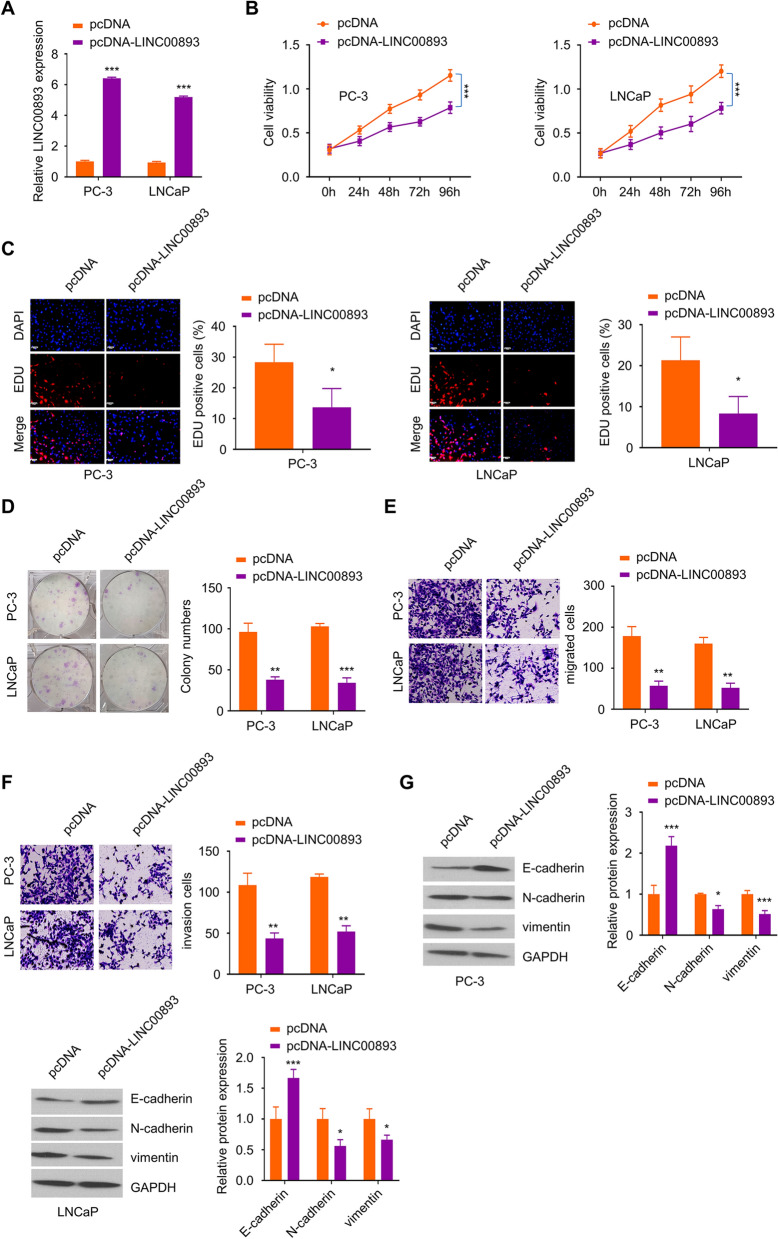
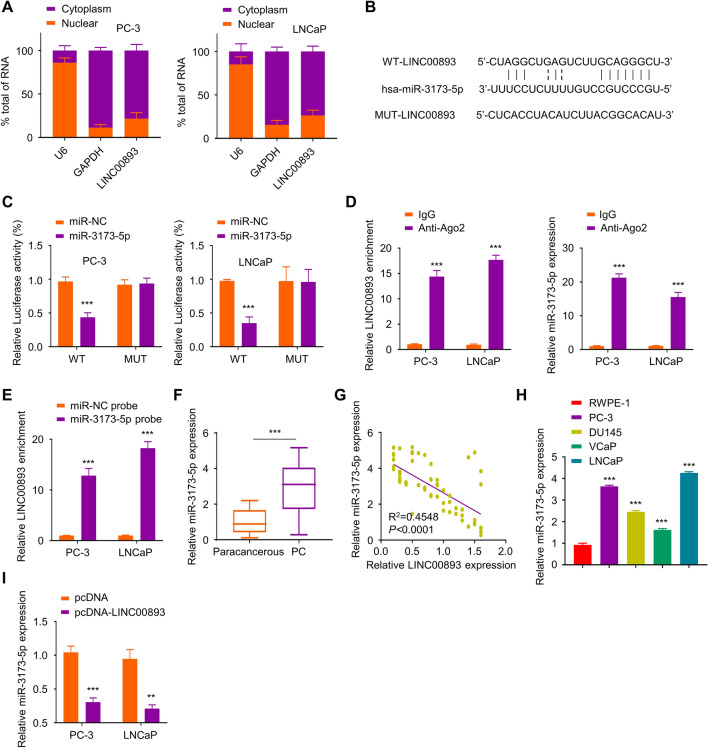
We first compared LINC00893 expression levels between PCa tissues and normal prostate tissues through TCGA database. The relative LINC00893 expression levels were further validated in 66 pairs of PCa tissues and para-cancerous normal tissues, as well as in PCa cell lines. Gain-of-function experiment was performed by transfecting PCa cell with LINC00893 expression vector, and CCK (Cell count kit)-8, 5-Ethynyl-2'-deoxyuridine (EdU) incorporation, colony information and transwell assays were conducted to assess the functional phenotypes. Dual-luciferase reporter, RNA-binding protein immunoprecipitation (RIP) and RNA pull-down assays were performed to evaluate the molecular interactions.
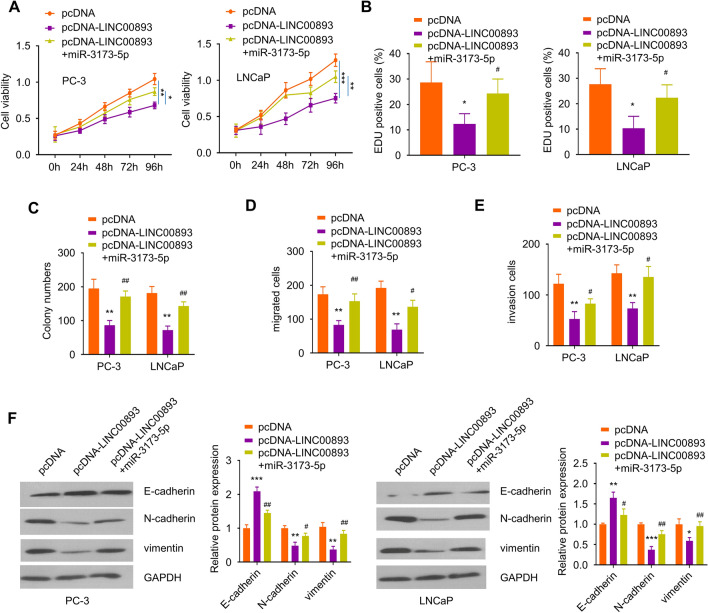
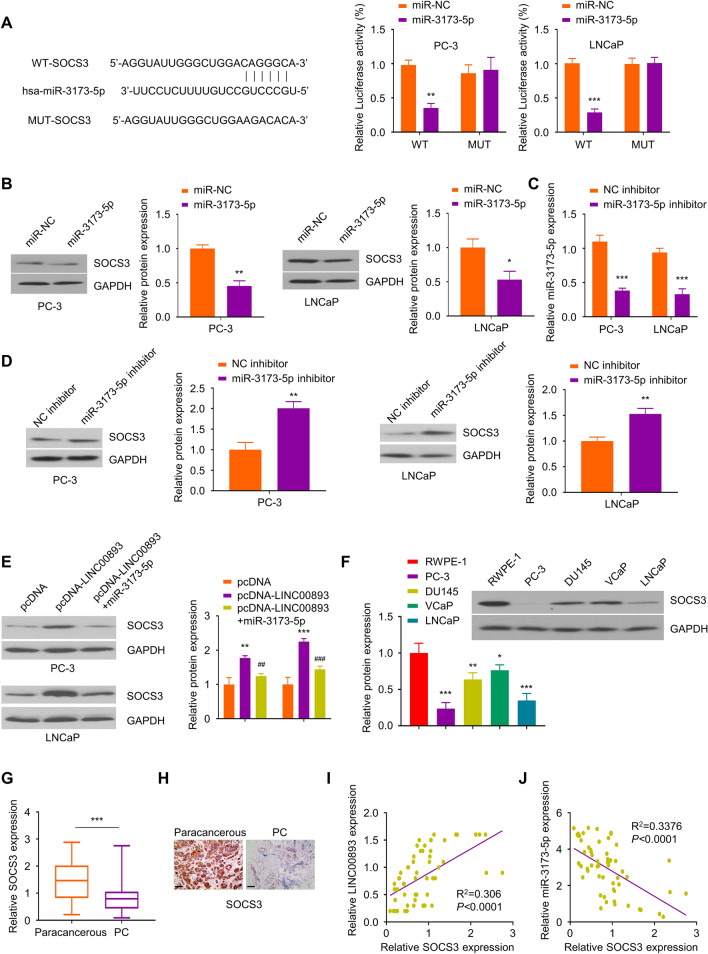
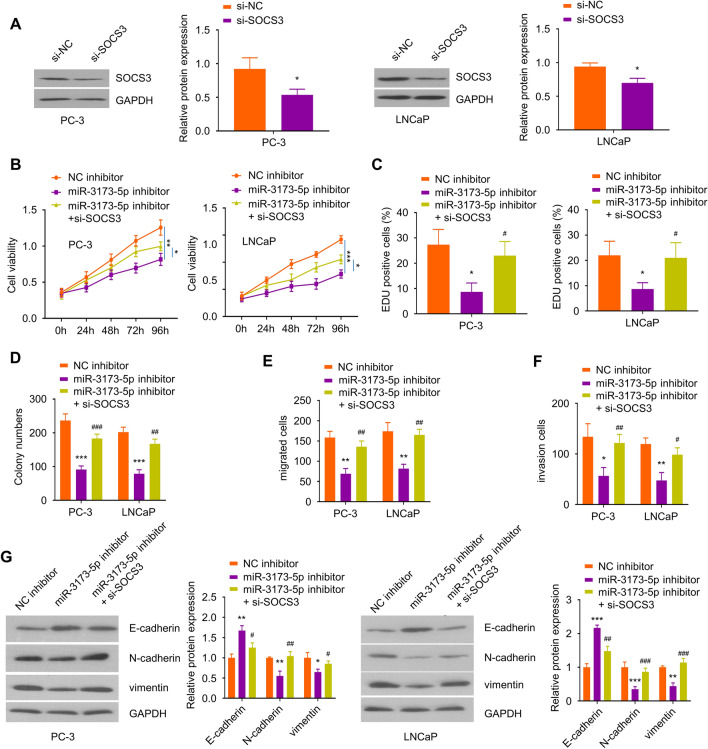
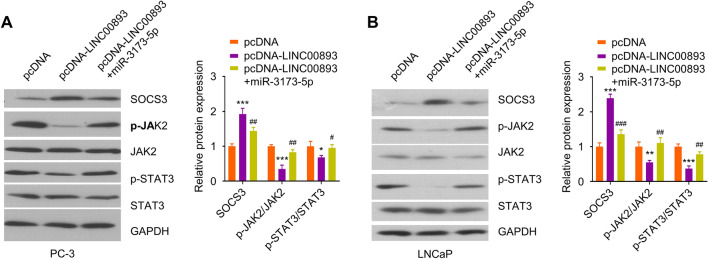
LINC00893 was downregulated in PCa tissues and cell lines, and patients with low expression of LINC00893 were associated with a poorer overall survival rate. LINC00893 overexpression hindered the proliferation, epithelial-mesenchymal transition (EMT) as well as the migratory ability of PCa cells, and suppressed the tumorigenesis of PCa cells in nude mice. We further demonstrated that LINC00893 acted as a sponge for miR-3173-5p and inhibited its activity, which in turn regulated the suppressor of cytokine signaling 3 (SOCS3)/Janus Kinase 2 (JAK2)/signal transducer and activator of transcription 3 (STAT3) signaling axis.
Our study demonstrated that LINC00893 suppresses the progression of PCa cells through targeting miR-3173-5p/SOCS3/JAK2/STAT3 axis. Our data uncovers a novel tumor-suppressor role of LINC00893 in PCa, which may serve as a potential strategy for targeted therapy in PCa.
前列腺癌(PCa)是男性泌尿系统最常见的恶性肿瘤之一。近年来,由于现有治疗策略效果有限,PCa的发病率和死亡率一直在上升。据报道,长链非编码RNA(lncRNA)LINC00893可抑制甲状腺乳头状癌细胞的增殖和转移,但其在PCa中的作用尚未见报道。本研究旨在探讨LINC00893在调控PCa细胞进展中的作用及潜在机制。
我们首先通过TCGA数据库比较了PCa组织和正常前列腺组织中LINC00893的表达水平。在66对PCa组织和癌旁正常组织以及PCa细胞系中进一步验证了LINC00893的相对表达水平。通过用LINC00893表达载体转染PCa细胞进行功能获得实验,并进行CCK(细胞计数试剂盒)-8、5-乙炔基-2'-脱氧尿苷(EdU)掺入、集落形成和Transwell实验来评估功能表型。进行双荧光素酶报告基因、RNA结合蛋白免疫沉淀(RIP)和RNA下拉实验以评估分子相互作用。
LINC00893在PCa组织和细胞系中表达下调,LINC00893低表达的患者总生存率较差。LINC00893过表达阻碍了PCa细胞的增殖、上皮-间质转化(EMT)以及迁移能力,并抑制了PCa细胞在裸鼠中的肿瘤发生。我们进一步证明,LINC00893作为miR-3173-5p的海绵并抑制其活性,进而调节细胞因子信号传导抑制因子3(SOCS3)/Janus激酶2(JAK2)/信号转导和转录激活因子3(STAT3)信号轴。
我们的研究表明,LINC00893通过靶向miR-3173-5p/SOCS3/JAK2/STAT3轴抑制PCa细胞的进展。我们的数据揭示了LINC00893在PCa中的一种新的肿瘤抑制作用,这可能作为PCa靶向治疗的潜在策略。