Dowd Brendan, Hein Kaiden, Diez Stephanie L, Prokofieva Maria, Kannis-Dymand Lee, Stavropoulos Vasileios
College of Health and Biomedicine, Victoria University, Footscray, Australia.
Edinboro University, Edinboro, PA USA.
Int J Ment Health Addict. 2022 Jul 6:1-24. doi: 10.1007/s11469-022-00862-6.
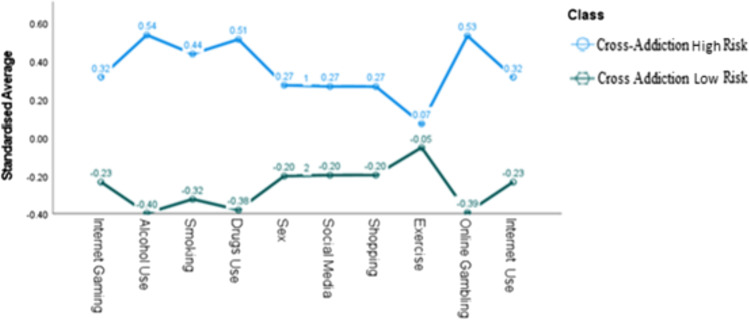
"Cross-addiction" involves a person substituting one form of addictive behaviour for another. Indeed, cross-additive presentations have been frequently described (e.g. from drugs to alcohol, gambling to sex), and risk profiles have been assumed. Nevertheless, there has been a dearth of evidence considering the occurrence of cross-addiction risk profiles in the community. This research is imperative for informing effective prevention/intervention policies, especially under anxiety-provoking conditions, such as the current coronavirus pandemic. To address this need, a cross-sectional exploratory research design was utilized, with quantitative survey data obtained from 968 respondents (18-64; = 29.5 years, = 9.36), who completed an online survey regarding a range of addictive behaviours (i.e. abuse of alcohol, drug, smoking, online gaming, shopping, internet, exercise, online gambling, sex, and social media) and their anxiety about the coronavirus. Latent class/profiling analyses were implemented to (a) explore profiles of cross-addiction risk, (b) describe the characteristics and the proportions of these profiles, and (c) identify their differential associations with the pandemic precipitated anxiety. Findings revealed two distinct profiles/types, the "cross-addiction low risk" (57.4%) and the "cross-addiction high risk" (42.6%). Those in the latter scored consistently higher across all behaviours assessed, were more likely to suffer from concurrent addictive problems, and reported significantly higher levels of pandemic-related anxiety. Implications for prevention, assessment, and treatment and future research are discussed.
“交叉成瘾”指的是一个人用一种成瘾行为替代另一种成瘾行为。事实上,交叉成瘾的表现形式已被频繁描述(例如从毒品到酒精、从赌博到性),并且人们也假定了其风险特征。然而,关于社区中交叉成瘾风险特征的发生情况,一直缺乏证据。这项研究对于制定有效的预防/干预政策至关重要,尤其是在当前冠状病毒大流行这种引发焦虑的情况下。为满足这一需求,采用了横断面探索性研究设计,从968名受访者(年龄在18 - 64岁之间;平均年龄 = 29.5岁,标准差 = 9.36)获取定量调查数据,这些受访者完成了一项关于一系列成瘾行为(即酒精滥用、药物滥用、吸烟、网络游戏、购物、上网、运动、网络赌博、性和社交媒体)以及他们对冠状病毒焦虑程度的在线调查。进行了潜在类别/特征分析,以(a)探索交叉成瘾风险特征,(b)描述这些特征的特点和比例,以及(c)确定它们与大流行引发的焦虑之间的差异关联。研究结果揭示了两种不同的特征/类型,即“交叉成瘾低风险”(57.4%)和“交叉成瘾高风险”(42.6%)。后者在所有评估行为中的得分始终更高,更有可能同时存在成瘾问题,并且报告的与大流行相关的焦虑水平显著更高。文中还讨论了对预防、评估、治疗以及未来研究的启示。