• 文献检索
  • 文档翻译
  • 深度研究
  • 学术资讯
  • Suppr Zotero 插件Zotero 插件
  • 邀请有礼
  • 套餐&价格
  • 历史记录
应用&插件
Suppr Zotero 插件Zotero 插件浏览器插件Mac 客户端Windows 客户端微信小程序
定价
高级版会员购买积分包购买API积分包
服务
文献检索文档翻译深度研究API 文档MCP 服务
关于我们
关于 Suppr公司介绍联系我们用户协议隐私条款
关注我们

Suppr 超能文献

核心技术专利:CN118964589B侵权必究
粤ICP备2023148730 号-1Suppr @ 2026

文献检索

告别复杂PubMed语法,用中文像聊天一样搜索,搜遍4000万医学文献。AI智能推荐,让科研检索更轻松。

立即免费搜索

文件翻译

保留排版,准确专业,支持PDF/Word/PPT等文件格式,支持 12+语言互译。

免费翻译文档

深度研究

AI帮你快速写综述,25分钟生成高质量综述,智能提取关键信息,辅助科研写作。

立即免费体验

隐匿性心房颤动在不明原因性卒中及短暂性脑缺血发作患者中的预测:PROACTIA 研究。

Prediction of occult atrial fibrillation in patients after cryptogenic stroke and transient ischaemic attack: PROACTIA.

机构信息

Akershus University Hospital, Lørenskog, Norway.

University of Oslo, Oslo, Norway.

出版信息

Europace. 2022 Dec 9;24(12):1881-1888. doi: 10.1093/europace/euac092.

DOI:10.1093/europace/euac092
PMID:35819199
原文链接:https://pmc.ncbi.nlm.nih.gov/articles/PMC9733955/
Abstract

AIMS

Studies with implantable cardiac monitors (ICMs) show that one-third of patients with cryptogenic stroke/transient ischaemic attack (TIA) have episodes of subclinical atrial fibrillation (SCAF) and benefit switching from antiplatelet- to anticoagulant therapy. However, ICMs are costly and resource demanding. We aimed to build a score based on participant's baseline characteristics that could assess individual risk of SCAF.

METHODS AND RESULTS

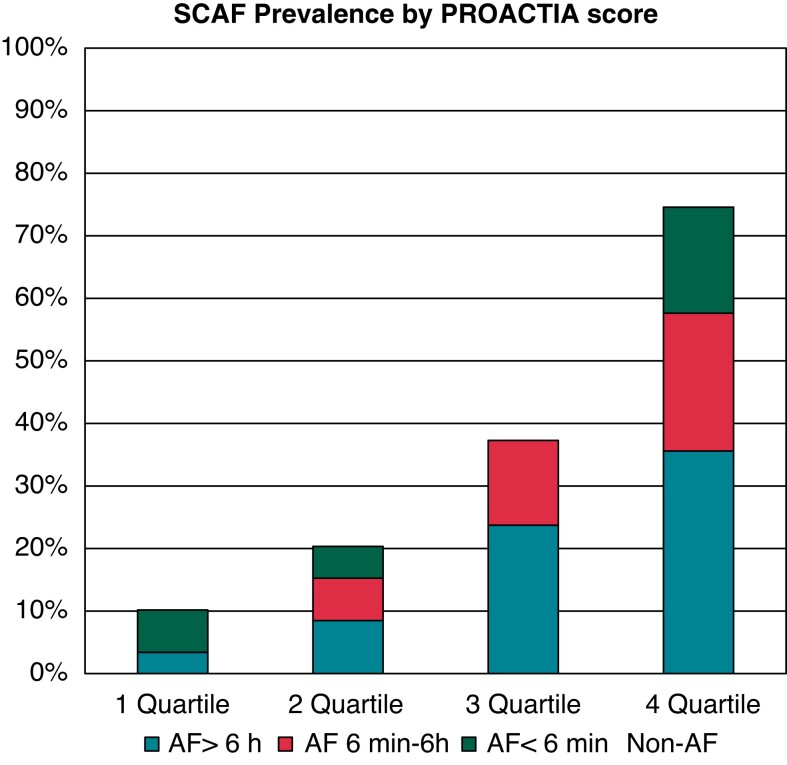
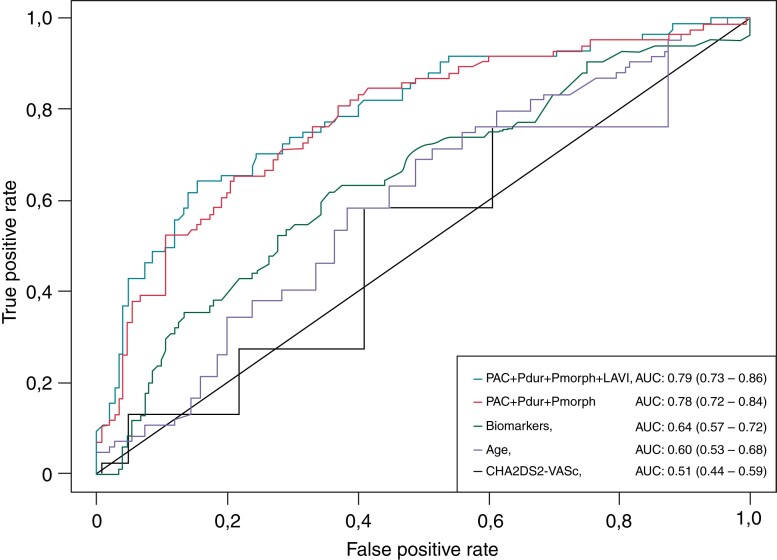
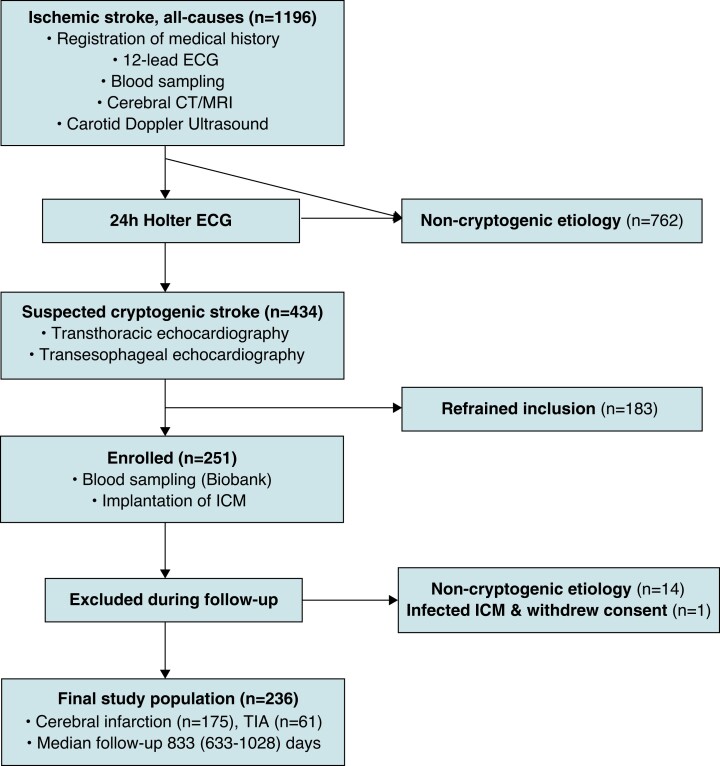
In a prospective study, 236 eligible patients with a final diagnosis of cryptogenic stroke/TIA had an ICM implantated during the index hospitalization. Pre-specified evaluated variables were: CHA2DS2-VASc, P-wave duration, P-wave morphology, premature atrial beats (PAC)/24 h, supraventricular tachycardia/24 h, left atrial end-systolic volume index (LAVI), Troponin-T, NT-proBNP, and D-dimer. SCAF was detected in 84 patients (36%). All pre-specified variables were significantly associated with SCAF detection in univariate analysis. P-wave duration, followed by PAC/24 h, NT-proBNP, and LAVI, had the largest ratio of SCAF prevalence between its upper and lower quartiles (3.3, vs. 3.2, vs. 3.1 vs. 2.8, respectively). However, in a multivariate analysis, only PAC/24t, P-wave duration, P-wave morphology, and LAVIs remained significant predictors and were included in the PROACTIA score. Subclinical atrial fibrillation prevalence was 75% in the highest vs. 10% in the lowest quartile of the PROACTIA score with a 10-fold higher number of patients with an atrial fibrillation burden >6 h in the highest vs. the lowest quartile.

CONCLUSION

The PROACTIA score can identify patients with cryptogenic stroke/TIA at risk of subsequent SCAF detection. The large difference in SCAF prevalence between groups may provide a basis for future tailored therapy.

CLINICAL TRIAL REGISTRATION

Clinical Trial Registration: ClinicalTrials.gov; NCT02725944.

摘要

目的

植入式心脏监测器(ICM)的研究表明,三分之一的隐源性卒中/短暂性脑缺血发作(TIA)患者有亚临床房颤(SCAF)发作,并从抗血小板治疗转为抗凝治疗中获益。然而,ICM 成本高且资源需求大。我们旨在构建一个基于参与者基线特征的评分,以评估个体发生 SCAF 的风险。

方法和结果

在一项前瞻性研究中,236 名最终诊断为隐源性卒中/TIA 的合格患者在住院期间植入了 ICM。预先指定评估的变量为:CHA2DS2-VASc、P 波持续时间、P 波形态、房性期前收缩(PAC)/24 小时、室上性心动过速/24 小时、左心房收缩末期容积指数(LAVI)、肌钙蛋白-T、NT-proBNP 和 D-二聚体。84 例(36%)患者检测到 SCAF。所有预先指定的变量在单变量分析中均与 SCAF 检测显著相关。P 波持续时间、其次是 PAC/24 小时、NT-proBNP 和 LAVI,其上下四分位数之间 SCAF 发生率的比值最大(3.3 比 3.2、3.1 比 2.8)。然而,在多变量分析中,只有 PAC/24 小时、P 波持续时间、P 波形态和 LAVI 仍然是显著的预测因子,并被纳入 PROACTIA 评分。PROACTIA 评分最高四分位组的 SCAF 发生率为 75%,而最低四分位组为 10%,且最高四分位组的心房颤动负荷>6 小时的患者数量是最低四分位组的 10 倍。

结论

PROACTIA 评分可以识别隐源性卒中/TIA 患者发生 SCAF 的风险。两组之间 SCAF 发生率的巨大差异可能为未来的个体化治疗提供依据。

临床试验注册

临床试验注册:ClinicalTrials.gov;NCT02725944。
https://cdn.ncbi.nlm.nih.gov/pmc/blobs/e145/9733955/4e7e3e007630/euac092f3.jpg
https://cdn.ncbi.nlm.nih.gov/pmc/blobs/e145/9733955/65174b30cf33/euac092f1.jpg
https://cdn.ncbi.nlm.nih.gov/pmc/blobs/e145/9733955/3d53acc9c903/euac092f2.jpg
https://cdn.ncbi.nlm.nih.gov/pmc/blobs/e145/9733955/4e7e3e007630/euac092f3.jpg
https://cdn.ncbi.nlm.nih.gov/pmc/blobs/e145/9733955/65174b30cf33/euac092f1.jpg
https://cdn.ncbi.nlm.nih.gov/pmc/blobs/e145/9733955/3d53acc9c903/euac092f2.jpg
https://cdn.ncbi.nlm.nih.gov/pmc/blobs/e145/9733955/4e7e3e007630/euac092f3.jpg

相似文献

1
Prediction of occult atrial fibrillation in patients after cryptogenic stroke and transient ischaemic attack: PROACTIA.隐匿性心房颤动在不明原因性卒中及短暂性脑缺血发作患者中的预测:PROACTIA 研究。
Europace. 2022 Dec 9;24(12):1881-1888. doi: 10.1093/europace/euac092.
2
Long-Term Detection of Subclinical Atrial Fibrillation in Cryptogenic Stroke Patients With Insertable Cardiac Monitors.使用植入式心脏监测器对隐源性卒中患者进行亚临床房颤的长期检测
Eur J Neurol. 2025 Jun;32(6):e70251. doi: 10.1111/ene.70251.
3
Atrial premature complex burden as a risk stratification predictor of paroxysmal atrial fibrillation and embolic stroke.房性早搏负荷作为阵发性心房颤动和栓塞性卒中的风险分层预测指标。
J Stroke Cerebrovasc Dis. 2025 Aug;34(8):108369. doi: 10.1016/j.jstrokecerebrovasdis.2025.108369. Epub 2025 Jun 6.
4
Diagnosis of atrial fibrillation after stroke and transient ischaemic attack: a systematic review and meta-analysis.卒中与短暂性脑缺血发作后心房颤动的诊断:系统评价和荟萃分析。
Lancet Neurol. 2015 Apr;14(4):377-87. doi: 10.1016/S1474-4422(15)70027-X. Epub 2015 Mar 4.
5
Closure versus medical therapy for preventing recurrent stroke in patients with patent foramen ovale and a history of cryptogenic stroke or transient ischemic attack.卵圆孔未闭且有隐源性卒中或短暂性脑缺血发作病史患者预防复发性卒中的封堵治疗与药物治疗对比
Cochrane Database Syst Rev. 2015 Sep 8;2015(9):CD009938. doi: 10.1002/14651858.CD009938.pub2.
6
Factor Xa inhibitors versus vitamin K antagonists for preventing cerebral or systemic embolism in patients with atrial fibrillation.在心房颤动患者中,Xa因子抑制剂与维生素K拮抗剂预防脑栓塞或全身性栓塞的比较
Cochrane Database Syst Rev. 2013 Aug 8(8):CD008980. doi: 10.1002/14651858.CD008980.pub2.
7
Higher Frequency of Premature Atrial Contractions Correlates With Atrial Fibrillation Detection after Cryptogenic Stroke.频发房性期前收缩与不明原因脑卒中后房颤检出相关。
Stroke. 2024 Apr;55(4):946-953. doi: 10.1161/STROKEAHA.123.044813. Epub 2024 Mar 4.
8
Routine echocardiography in the management of stroke and transient ischaemic attack: a systematic review and economic evaluation.常规超声心动图在脑卒中与短暂性脑缺血发作管理中的应用:一项系统评价和经济评估。
Health Technol Assess. 2014 Mar;18(16):1-176. doi: 10.3310/hta18160.
9
Anticoagulants versus antiplatelet therapy for preventing stroke in patients with nonrheumatic atrial fibrillation and a history of stroke or transient ischemic attack.抗凝剂与抗血小板治疗对预防非风湿性心房颤动且有卒中或短暂性脑缺血发作病史患者的卒中作用比较
Cochrane Database Syst Rev. 2004 Oct 18(4):CD000187. doi: 10.1002/14651858.CD000187.pub2.
10
Intravenous magnesium sulphate and sotalol for prevention of atrial fibrillation after coronary artery bypass surgery: a systematic review and economic evaluation.静脉注射硫酸镁和索他洛尔预防冠状动脉搭桥术后房颤:系统评价与经济学评估
Health Technol Assess. 2008 Jun;12(28):iii-iv, ix-95. doi: 10.3310/hta12280.

引用本文的文献

1
Continuing evaluation of atrial fibrillation detection after cryptogenic stroke: 2-year findings from a multicentre study with Confirm Rx ICM.隐源性卒中后房颤检测的持续评估:来自使用Confirm Rx ICM的多中心研究的2年结果
Open Heart. 2025 Jun 12;12(1):e003242. doi: 10.1136/openhrt-2025-003242.
2
Left atrial appendage function by strain and structure is associated with thromboembolic risk in patients with cryptogenic stroke and TIA.通过应变和结构评估的左心耳功能与不明原因卒中及短暂性脑缺血发作患者的血栓栓塞风险相关。
Open Heart. 2025 May 27;12(1):e003287. doi: 10.1136/openhrt-2025-003287.
3
Computer-Assisted Electrocardiogram Analysis Improves Risk Assessment of Underlying Atrial Fibrillation in Cryptogenic Stroke.

本文引用的文献

1
2021 Guideline for the Prevention of Stroke in Patients With Stroke and Transient Ischemic Attack: A Guideline From the American Heart Association/American Stroke Association.《2021年卒中与短暂性脑缺血发作患者卒中预防指南:美国心脏协会/美国卒中协会指南》
Stroke. 2021 Jul;52(7):e364-e467. doi: 10.1161/STR.0000000000000375. Epub 2021 May 24.
2
Implantable Cardiac Monitoring in the Secondary Prevention of Cryptogenic Stroke.心脏植入式循环监测在不明原因卒中二级预防中的应用。
Ann Neurol. 2020 Nov;88(5):946-955. doi: 10.1002/ana.25886. Epub 2020 Sep 4.
3
Predictors of atrial fibrillation detection and features of recurrent strokes in patients after cryptogenic stroke.
计算机辅助心电图分析可改善隐源性卒中潜在房颤的风险评估。
Cardiol Res. 2025 Apr;16(2):120-129. doi: 10.14740/cr2016. Epub 2025 Feb 6.
4
Diagnostic Utility of N-Terminal Pro-B-Type Natriuretic Peptide in Identifying Atrial Fibrillation Post-Cryptogenic Stroke: A Systematic Review and Meta-Analysis.N端前B型利钠肽在隐匿性卒中后房颤识别中的诊断效用:一项系统评价和荟萃分析
Pathophysiology. 2024 Jun 30;31(3):331-349. doi: 10.3390/pathophysiology31030024.
5
Predictors of atrial fibrillation after embolic stroke of undetermined source in patients with implantable loop recorders.植入式环路记录器患者不明来源栓塞性卒中后心房颤动的预测因素。
Neurol Sci. 2024 Oct;45(10):4903-4912. doi: 10.1007/s10072-024-07548-y. Epub 2024 Apr 25.
6
Impact of an expanded reimbursement policy on utilization of implantable loop recorders in patients with cryptogenic stroke in Korea.韩国扩大报销政策对不明原因卒中患者植入式循环记录仪使用的影响。
Korean J Intern Med. 2024 May;39(3):469-476. doi: 10.3904/kjim.2023.479. Epub 2024 Apr 18.
7
Cardiac Blood-Based Biomarkers of Myocardial Stress as Predictors of Atrial Fibrillation Development in Patients With Embolic Stroke of Undetermined Source/Cryptogenic Stroke: A Systematic Review and Meta-Analysis.基于心脏血液的心肌应激生物标志物作为不明来源栓塞性卒中/隐源性卒中患者房颤发生的预测指标:一项系统评价和荟萃分析
J Clin Neurol. 2024 May;20(3):256-264. doi: 10.3988/jcn.2023.0068. Epub 2024 Jan 1.
8
Diagnosis and Management of Atrial Fibrillation in Acute Ischemic Stroke in the Setting of Reperfusion Therapy: Insights and Strategies for Optimized Care.再灌注治疗背景下急性缺血性卒中合并心房颤动的诊断与管理:优化治疗的见解与策略
J Cardiovasc Dev Dis. 2023 Nov 12;10(11):458. doi: 10.3390/jcdd10110458.
9
Future Perspectives to Improve CHADSVASc Score: The Role of Left Atrium Remodelling, Inflammation and Genetics in Anticoagulation of Atrial Fibrillation.改善 CHADSVASc 评分的未来展望:左心房重构、炎症和遗传学在心房颤动抗凝中的作用。
Clin Interv Aging. 2023 Oct 18;18:1737-1748. doi: 10.2147/CIA.S427748. eCollection 2023.
10
Risk Stratification Tools to Guide a Personalized Approach for Cardiac Monitoring in Embolic Stroke of Undetermined Source.用于指导不明来源栓塞性卒中患者心脏监测的个体化方法的风险分层工具。
J Am Heart Assoc. 2023 Sep 19;12(18):e030479. doi: 10.1161/JAHA.123.030479. Epub 2023 Sep 8.
不明原因卒中后患者心房颤动检出的预测因素及复发性卒中的特征。
J Stroke Cerebrovasc Dis. 2020 Sep;29(9):104934. doi: 10.1016/j.jstrokecerebrovasdis.2020.104934. Epub 2020 Jun 25.
4
Duration of Implantable Cardiac Monitoring and Detection of Atrial Fibrillation in Ischemic Stroke Patients: A Systematic Review and Meta-Analysis.缺血性中风患者植入式心脏监测的持续时间与房颤检测:一项系统评价和荟萃分析
J Stroke. 2019 Sep;21(3):302-311. doi: 10.5853/jos.2019.01067. Epub 2019 Sep 30.
5
Prolonged Cardiac Rhythm Monitoring and Secondary Stroke Prevention in Patients With Cryptogenic Cerebral Ischemia.不明原因性脑缺血患者的延长心脏节律监测和二级卒中预防。
Stroke. 2019 Aug;50(8):2175-2180. doi: 10.1161/STROKEAHA.119.025169. Epub 2019 Jun 20.
6
Incidence and Predictive Factors of Hidden Atrial Fibrillation Detected by Implantable Loop Recorder After an Embolic Stroke of Undetermined Source.不明来源栓塞性卒中后植入式循环记录仪检测到的隐匿性心房颤动的发生率及预测因素
J Atr Fibrillation. 2018 Oct 31;11(3):2078. doi: 10.4022/jafib.2078. eCollection 2018 Oct-Nov.
7
Dabigatran for Prevention of Stroke after Embolic Stroke of Undetermined Source.达比加群酯预防来源不明的栓塞性卒中后卒中
N Engl J Med. 2019 May 16;380(20):1906-1917. doi: 10.1056/NEJMoa1813959.
8
Evaluation of a clinical score for predicting atrial fibrillation in cryptogenic stroke patients with insertable cardiac monitors: results from the CRYSTAL AF study.应用可植入式心脏监测仪评估隐源性卒中患者房颤预测临床评分:CRYSTAL AF研究结果
Ther Adv Neurol Disord. 2019 Apr 11;12:1756286419842698. doi: 10.1177/1756286419842698. eCollection 2019.
9
Recurrent Stroke With Rivaroxaban Compared With Aspirin According to Predictors of Atrial Fibrillation: Secondary Analysis of the NAVIGATE ESUS Randomized Clinical Trial.依房颤预测因子评估,利伐沙班与阿司匹林比较用于复发性卒中: NAVIGATE ESUS 随机临床试验的二次分析。
JAMA Neurol. 2019 Jul 1;76(7):764-773. doi: 10.1001/jamaneurol.2019.0617.
10
Electrocardiographic Predictors of Silent Atrial Fibrillation in Cryptogenic Stroke.心电图预测隐匿性心房颤动在不明原因脑卒中中的作用。
Heart Lung Circ. 2019 Nov;28(11):1664-1669. doi: 10.1016/j.hlc.2018.10.020. Epub 2018 Nov 16.