Department of Psychiatry, Dalhousie University, Halifax, Nova Scotia, Canada.
Nova Scotia Health, Halifax, Nova Scotia, Canada.
JAMA Netw Open. 2022 Jul 1;5(7):e2220919. doi: 10.1001/jamanetworkopen.2022.20919.
Although anxiety disorders are known to run in families, the relative contribution of genes and environment is unclear. Patterns of sex-specific transmission of anxiety may point to different pathways in how parents pass anxiety disorders down to their children; however, the association of parent and offspring sex with the transmission of anxiety disorders has not been previously studied.
To examine whether the transmission of anxiety from parents to children is sex specific.
DESIGN, SETTING, AND PARTICIPANTS: This cross-sectional family study recruited participants from the general population (enriched for familial risk of mood disorders) in Nova Scotia, Canada, from February 1, 2013, to January 31, 2020.
Anxiety disorder in the same-sex or opposite-sex parent.
Semistructured interviews were used to establish lifetime diagnoses of anxiety disorder in parents and offspring. The association between anxiety disorder in the same-sex or opposite-sex parent and anxiety disorders in the offspring was tested with logistic regression.
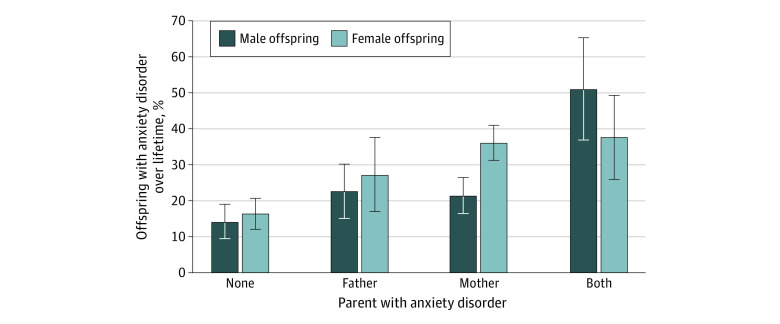
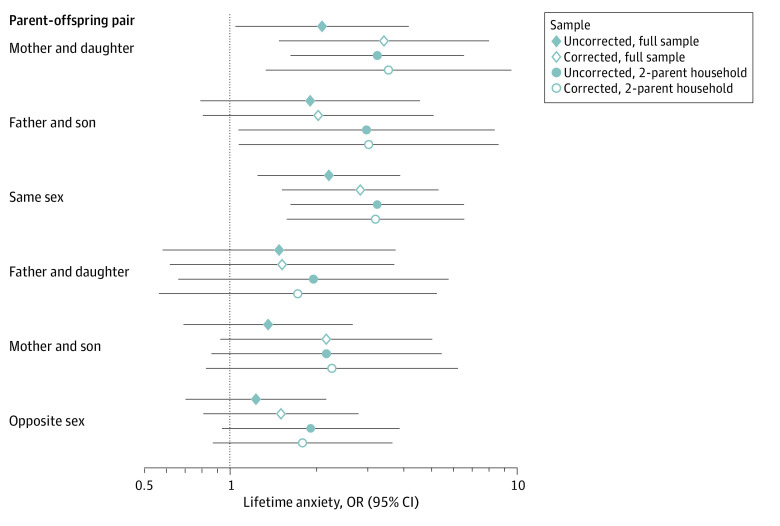
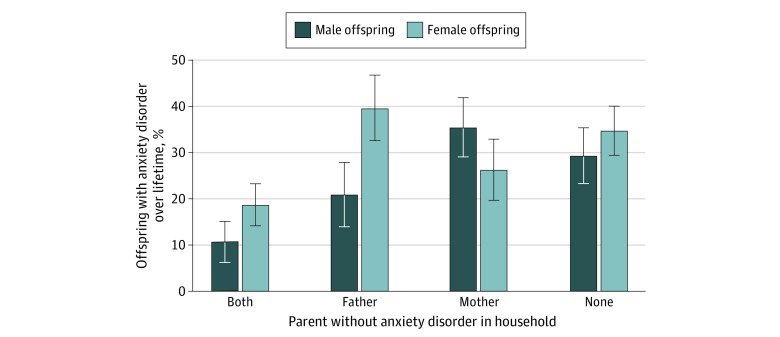
A total of 398 offspring (203 female offspring with a mean [SD] age of 11.1 [3.7] years and 195 male offspring with a mean [SD] age of 10.6 [3.1] years) of 221 mothers and 237 fathers participated in the study. Anxiety disorders in the same-sex parent (odds ratio [OR], 2.85; 95% CI, 1.52-5.34; P = .001) were associated with increased rates of anxiety disorders in the offspring, whereas anxiety disorders in the opposite-sex parent (OR, 1.51; 95% CI, 0.81-2.81; P = .20) were not. Sharing a household with a same-sex parent without anxiety was associated with lower rates of offspring anxiety (OR, 0.38; 95% CI, 0.22-0.67; P = .001), but the presence of an opposite-sex parent without anxiety was not (OR, 0.96; 95% CI, 0.56-1.63; P = .88).
In this cross-sectional study of families, an association between the same-sex parent's anxiety disorder and anxiety disorders in offspring suggests an environmental mechanism, such as modeling. Future studies should establish whether treating parents' anxiety may protect their children from developing an anxiety disorder.
尽管焦虑症已知具有家族遗传性,但基因和环境的相对贡献尚不清楚。焦虑症的性别特异性传递模式可能表明父母将焦虑症遗传给子女的途径不同;然而,父母和子女的性别与焦虑症传递之间的关联尚未被研究过。
研究父母向子女传递焦虑症是否具有性别特异性。
设计、设置和参与者:这项横断面家族研究于 2013 年 2 月 1 日至 2020 年 1 月 31 日在加拿大新斯科舍省从一般人群(情绪障碍家族风险丰富)中招募参与者。
同性别或异性别父母的焦虑症。
使用半结构式访谈确定父母和子女的焦虑症终生诊断。使用逻辑回归检验同性别或异性别父母的焦虑症与子女的焦虑症之间的关联。
共有 398 名子女(203 名女性子女,平均年龄[标准差]为 11.1[3.7]岁,195 名男性子女,平均年龄[标准差]为 10.6[3.1]岁)的 221 名母亲和 237 名父亲参加了这项研究。同性别父母的焦虑症(比值比[OR],2.85;95%置信区间[CI],1.52-5.34;P = .001)与子女焦虑症的发生率增加相关,而异性别父母的焦虑症(OR,1.51;95%CI,0.81-2.81;P = .20)则不然。与同性别父母同住但无焦虑症的子女焦虑症发生率较低(OR,0.38;95%CI,0.22-0.67;P = .001),但与无焦虑症的异性别父母同住则不然(OR,0.96;95%CI,0.56-1.63;P = .88)。
在这项对家庭的横断面研究中,同性别父母的焦虑症与子女的焦虑症之间存在关联,这表明存在环境机制,例如模仿。未来的研究应确定治疗父母的焦虑症是否可以保护他们的孩子免于患上焦虑症。