Discipline of Physiology, School of Biomedicine, The University of Adelaide, Adelaide, Australia.
PLoS One. 2022 Jul 12;17(7):e0271311. doi: 10.1371/journal.pone.0271311. eCollection 2022.
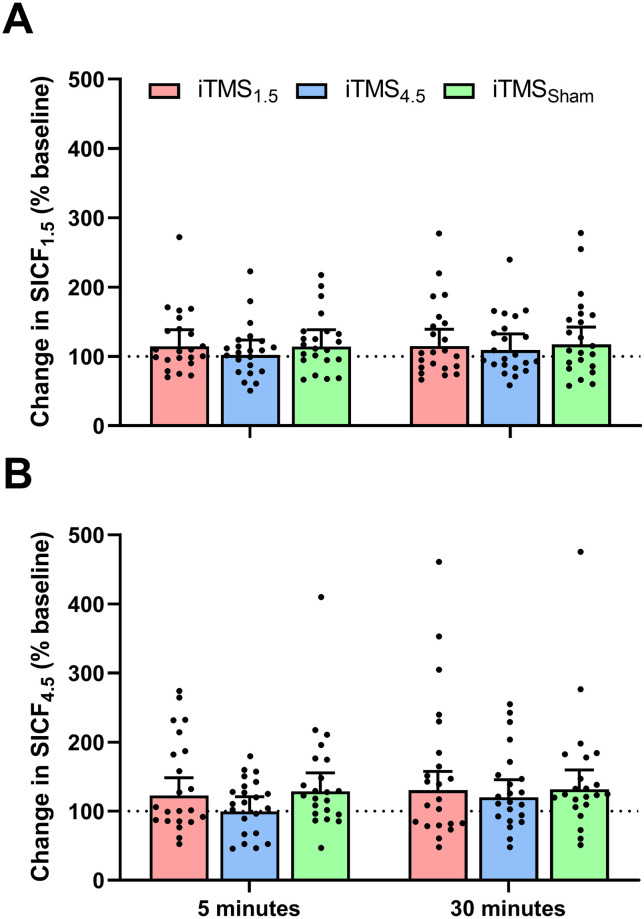
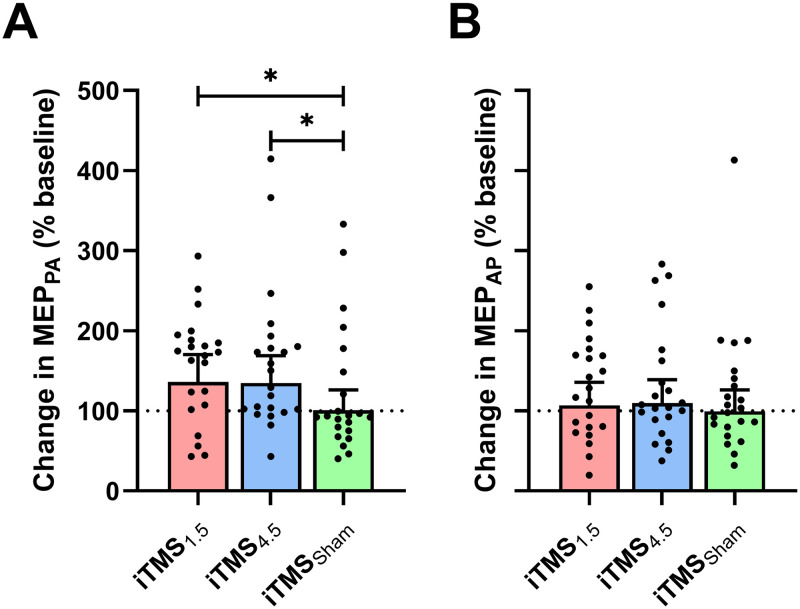
While previous research using transcranial magnetic stimulation (TMS) suggest that cerebellum (CB) influences the neuroplastic response of primary motor cortex (M1), the role of different indirect (I) wave inputs in M1 mediating this interaction remains unclear. The aim of this study was therefore to assess how CB influences neuroplasticity of early and late I-wave circuits. 22 young adults (22 ± 2.7 years) participated in 3 sessions in which I-wave periodicity repetitive transcranial magnetic stimulation (iTMS) was applied over M1 during concurrent application of cathodal transcranial direct current stimulation over CB (tDCSCB). In each session, iTMS either targeted early I-waves (1.5 ms interval; iTMS1.5), late I-waves (4.5 ms interval; iTMS4.5), or had no effect (variable interval; iTMSSham). Changes due to the intervention were examined with motor evoked potential (MEP) amplitude using TMS protocols measuring corticospinal excitability (MEP1mV) and the strength of CB-M1 connections (CBI). In addition, we indexed I-wave activity using short-interval intracortical facilitation (SICF) and low-intensity single-pulse TMS applied with posterior-anterior (MEPPA) and anterior-posterior (MEPAP) current directions. Following both active iTMS sessions, there was no change in MEP1mV, CBI or SICF (all P > 0.05), suggesting that tDCSCB broadly disrupted the excitatory response that is normally seen following iTMS. However, although MEPAP also failed to facilitate after the intervention (P > 0.05), MEPPA potentiated following both active iTMS sessions (both P < 0.05). This differential response between current directions could indicate a selective effect of CB on AP-sensitive circuits.
虽然先前使用经颅磁刺激 (TMS) 的研究表明小脑 (CB) 会影响初级运动皮层 (M1) 的神经可塑性反应,但不同的间接 (I) 波输入在介导这种相互作用中所起的作用尚不清楚。因此,本研究旨在评估 CB 如何影响早期和晚期 I 波回路的神经可塑性。22 名年轻成年人(22 ± 2.7 岁)参加了 3 次会议,在这些会议中,在 CB 上应用阴极经颅直流电刺激 (tDCSCB) 的同时,在 M1 上应用 I 波周期性重复经颅磁刺激 (iTMS)。在每次会议中,iTMS 要么针对早期 I 波(1.5ms 间隔;iTMS1.5),要么针对晚期 I 波(4.5ms 间隔;iTMS4.5),要么没有影响(间隔变化;iTMSSham)。使用 TMS 协议测量皮质脊髓兴奋性(MEP1mV)和 CB-M1 连接强度(CBI),通过测量运动诱发电位 (MEP) 幅度来检查干预引起的变化。此外,我们使用短间隔内皮层易化 (SICF) 和低强度单脉冲 TMS 来索引 I 波活动,这些 TMS 应用于后前 (MEPPA) 和前后 (MEPAP) 电流方向。在两次主动 iTMS 会议后,MEP1mV、CBI 或 SICF 均无变化(均 P>0.05),这表明 tDCSCB 广泛破坏了通常在 iTMS 后观察到的兴奋性反应。然而,尽管干预后 MEPAP 也没有促进(P>0.05),但 MEPPA 在两次主动 iTMS 会议后都增强了(均 P<0.05)。这种电流方向之间的差异反应可能表明 CB 对 AP 敏感电路有选择性影响。