Amandusson Å, Flink R, Axelson H W
Department of Clinical Neurophysiology, Uppsala University, Uppsala, Sweden.
Clin Neurophysiol Pract. 2017 Apr 10;2:91-97. doi: 10.1016/j.cnp.2017.04.001. eCollection 2017.
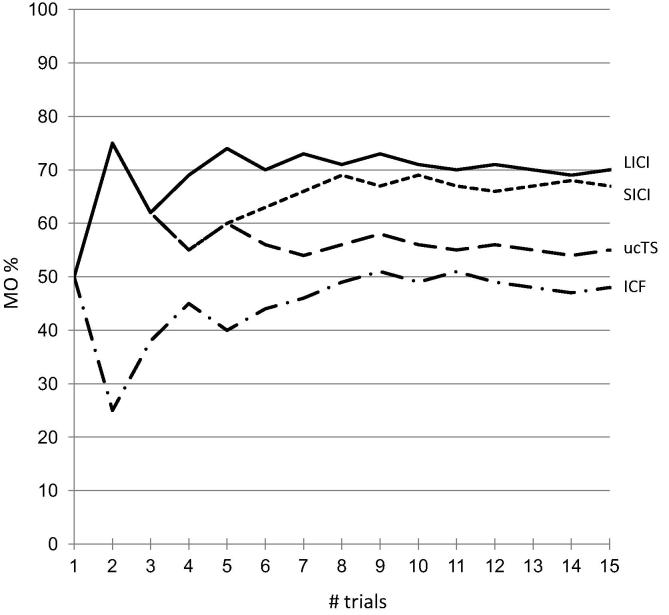
Paired-pulse TMS (ppTMS) examines cortical excitability but may require lengthy test procedures and fine tuning of stimulus parameters due to the inherent variability of the elicited motor evoked potentials (MEPs) and their tendency to exhibit a 'ceiling/floor effects' in inhibition trials. Aiming to overcome some of these limitations, we implemented an 'adaptive' ppTMS protocol and compared the obtained excitability indices with those from 'conventional' fixed-stimulus ppTMS.
Short- and long interval intracortical inhibition (SICI and LICI) as well as intracortical facilitation (ICF) were examined in 20 healthy subjects by adaptive ppTMS and fixed-stimulus ppTMS. The test stimulus intensity was either adapted to produce 500 μV MEPs (by a maximum likelihood strategy in combination with parameter estimation by sequential testing) or fixed to 120% of resting motor threshold (rMT). The conditioning stimulus was 80% rMT for SICI and ICF and 120% MT for LICI in both tests.
There were significant (p < 0.05) intraindividual correlations between the two methods for all excitability measures. There was a clustering of SICI and LICI indices near maximal inhibition ('ceiling effect') in fixed-stimulus ppTMS which was not observed for adaptive SICI and LICI.
Adaptive ppTMS excitability data correlates to those acquired from fixed-stimulus ppTMS.
Adaptive ppTMS is easy to implement and may serve as a more sensitive method to detect changes in cortical inhibition than fixed stimulus ppTMS. Whether equally confident data are produced by less stimuli with our adaptive approach (as already confirmed for motor threshold estimation) remains to be explored.
配对脉冲经颅磁刺激(ppTMS)用于检测皮质兴奋性,但由于诱发的运动诱发电位(MEP)存在内在变异性,且在抑制试验中易出现“天花板/地板效应”,可能需要冗长的测试程序和对刺激参数进行微调。为克服其中一些局限性,我们实施了一种“自适应”ppTMS方案,并将获得的兴奋性指标与“传统”固定刺激ppTMS的指标进行比较。
通过自适应ppTMS和固定刺激ppTMS对20名健康受试者进行短间隔和长间隔皮质内抑制(SICI和LICI)以及皮质内易化(ICF)检测。测试刺激强度要么进行调整以产生500μV的MEP(通过最大似然策略结合序贯测试进行参数估计),要么固定为静息运动阈值(rMT)的120%。在两种测试中,条件刺激对于SICI和ICF为80%rMT,对于LICI为120%MT。
两种方法在所有兴奋性测量指标上均存在显著的(p < 0.05)个体内相关性。在固定刺激ppTMS中,SICI和LICI指标在接近最大抑制(“天花板效应”)处聚集,而自适应SICI和LICI未观察到这种情况。
自适应ppTMS兴奋性数据与固定刺激ppTMS获得的数据相关。
自适应ppTMS易于实施,与固定刺激ppTMS相比,可能是一种检测皮质抑制变化更敏感的方法。采用我们的自适应方法,较少的刺激是否能产生同样可靠的数据(如运动阈值估计已得到证实)仍有待探索。