School of Biomedical Sciences and Pharmacy, University of Newcastle, Callaghan, New South Wales, Australia.
Department of Pharmacology, Vanderbilt University School of Medicine, Nashville, Tennessee, USA.
J Biol Chem. 2022 Aug;298(8):102248. doi: 10.1016/j.jbc.2022.102248. Epub 2022 Jul 9.
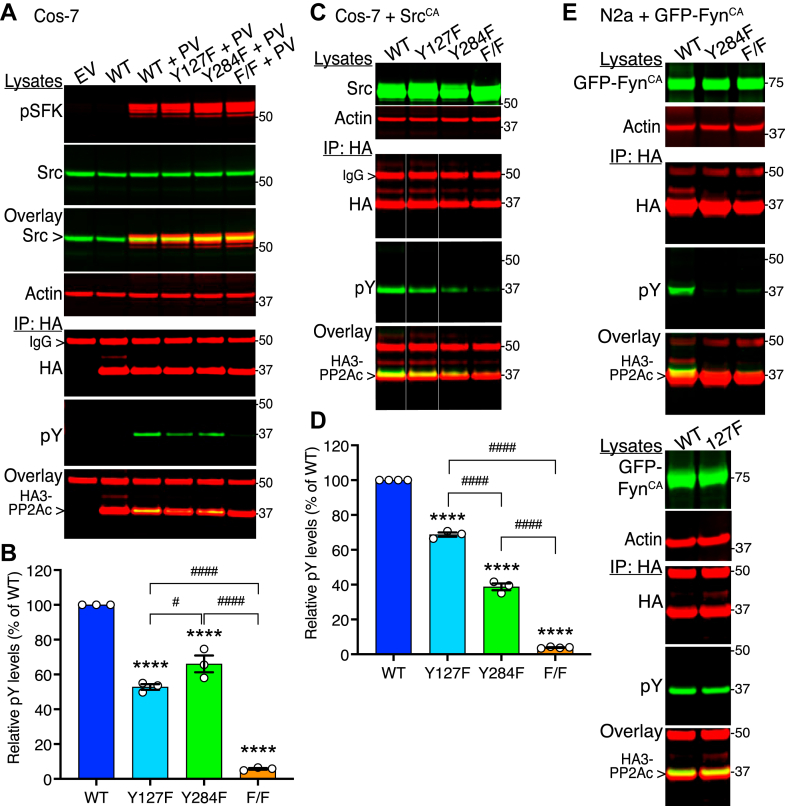
Protein phosphatase 2A (PP2A) is a major phospho-Ser/Thr phosphatase and a key regulator of cellular signal transduction pathways. While PP2A dysfunction has been linked to human cancer and neurodegenerative disorders such as Alzheimer's disease (AD), PP2A regulation remains relatively poorly understood. It has been reported that the PP2A catalytic subunit (PP2Ac) is inactivated by a single phosphorylation at the Tyr307 residue by tyrosine kinases such as v-Src. However, multiple mass spectrometry studies have revealed the existence of other putative PP2Ac phosphorylation sites in response to activation of Src and Fyn, two major Src family kinases (SFKs). Here, using PP2Ac phosphomutants and novel phosphosite-specific PP2Ac antibodies, we show that cellular pools of PP2Ac are instead phosphorylated on both Tyr127 and Tyr284 upon Src activation, and on Tyr284 following Fyn activation. We found these phosphorylation events enhanced the interaction of PP2Ac with SFKs. In addition, we reveal SFK-mediated phosphorylation of PP2Ac at Y284 promotes dissociation of the regulatory Bα subunit, altering PP2A substrate specificity; the phosphodeficient Y127/284F and Y284F PP2Ac mutants prevented SFK-mediated phosphorylation of Tau at the CP13 (pSer202) epitope, a pathological hallmark of AD, and SFK-dependent activation of ERK, a major growth regulatory kinase upregulated in many cancers. Our findings demonstrate a novel PP2A regulatory mechanism that challenges the existing dogma on the inhibition of PP2A catalytic activity by Tyr307 phosphorylation. We propose dysregulation of SFK signaling in cancer and AD can lead to alterations in PP2A phosphorylation and subsequent deregulation of key PP2A substrates, including ERK and Tau.
蛋白磷酸酶 2A(PP2A)是一种主要的磷酸化丝氨酸/苏氨酸磷酸酶,是细胞信号转导途径的关键调节剂。虽然 PP2A 功能障碍与人类癌症和神经退行性疾病(如阿尔茨海默病(AD))有关,但 PP2A 的调节仍知之甚少。据报道,酪氨酸激酶(如 v-Src)可使 PP2A 催化亚基(PP2Ac)在 Tyr307 残基上发生单一磷酸化而失活。然而,多项质谱研究表明,在 Src 和 Fyn(两种主要的Src 家族激酶(SFKs))激活时,PP2Ac 存在其他假定的磷酸化位点。在这里,我们使用 PP2Ac 磷酸突变体和新型磷酸化特异性 PP2Ac 抗体,表明在 Src 激活时,细胞内的 PP2Ac 池会在 Tyr127 和 Tyr284 上磷酸化,而在 Fyn 激活后在 Tyr284 上磷酸化。我们发现这些磷酸化事件增强了 PP2Ac 与 SFKs 的相互作用。此外,我们揭示了 SFK 介导的 PP2Ac 上 Y284 的磷酸化促进了调节 Bα 亚基的解离,改变了 PP2A 的底物特异性;磷酸缺陷的 Y127/284F 和 Y284F PP2Ac 突变体阻止了 SFK 介导的 Tau 在 CP13(pSer202)表位上的磷酸化,这是 AD 的病理标志,以及 SFK 依赖性 ERK 的激活,ERK 是许多癌症中上调的主要生长调节激酶。我们的研究结果表明了一种新的 PP2A 调节机制,挑战了现有关于 Tyr307 磷酸化抑制 PP2A 催化活性的教条。我们提出,癌症和 AD 中 SFK 信号的失调会导致 PP2A 磷酸化的改变,随后导致关键 PP2A 底物(包括 ERK 和 Tau)的失活。