Loeb Susan C, Winters Eric A
U.S. Forest Service Southern Research Station Clemson South Carolina USA.
Ecol Evol. 2022 Jul 6;12(7):e9045. doi: 10.1002/ece3.9045. eCollection 2022 Jul.
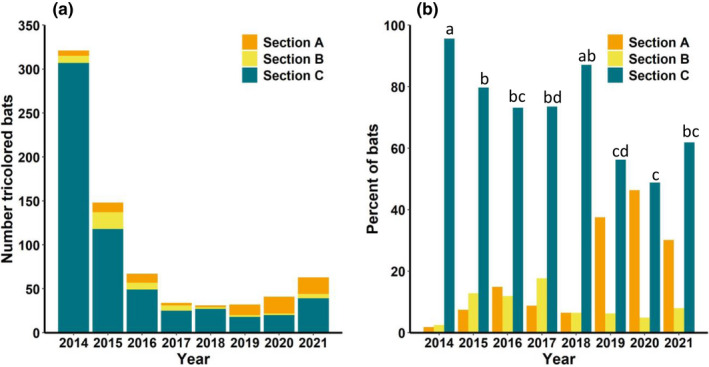
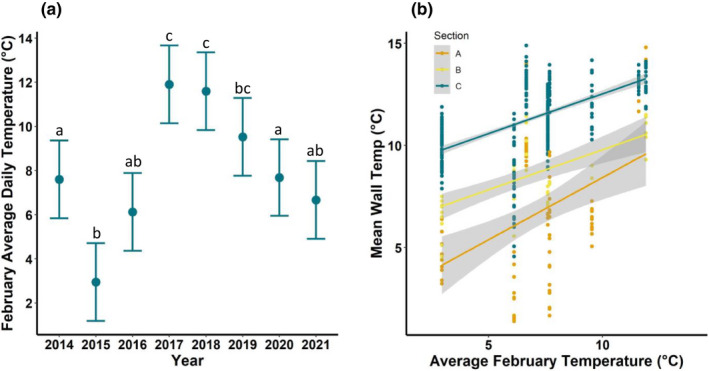
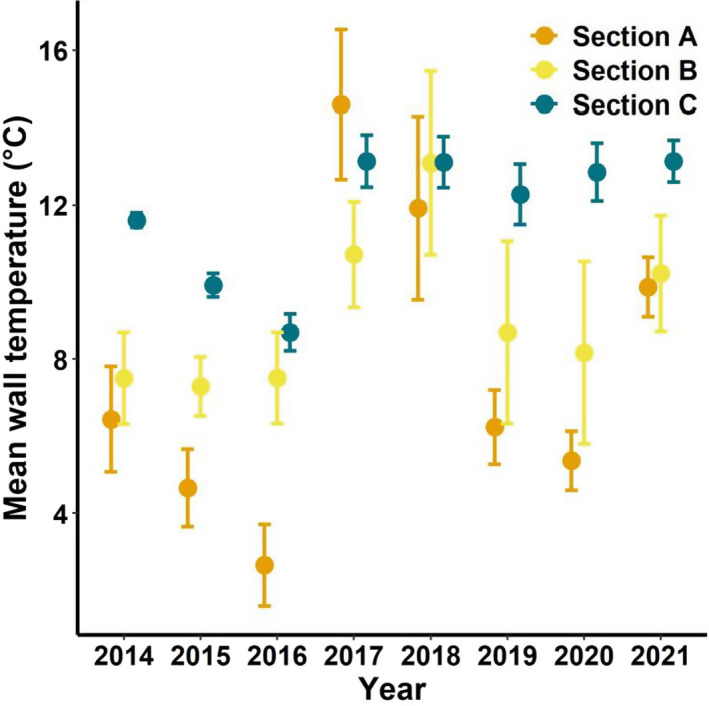
Understanding animals' behavioral and physiological responses to pathogenic diseases is critical for management and conservation. One such disease, white-nose syndrome (WNS), has greatly affected bat populations throughout eastern North America leading to significant population declines in several species. Although tricolored bat () populations have experienced significant declines, little research has been conducted on their responses to the disease, particularly in the southeastern United States. Our objective was to document changes in tricolored bat roost site use after the appearance of WNS in a hibernaculum in the southeastern U.S. and relate these to microsite temperatures, ambient conditions, and population trends. We censused a tricolored bat hibernaculum in northwestern South Carolina, USA, once each year between February 26 and March 2, 2014-2021, and recorded species, section of the tunnel, distance from the entrance, and wall temperature next to each bat. The number of tricolored bats in the hibernaculum dropped by 90.3% during the first 3 years after the arrival of WNS. However, numbers stabilized and slightly increased from 2018 to 2021. Prior to the arrival of WNS, 95.6% of tricolored bats roosted in the back portion of the tunnel that was the warmest. After the arrival of WNS, we observed a significant increase in the proportion of bats using the front, colder portions of the tunnel, particularly during the period of population stabilization and increase. Roost temperatures of bats were also positively associated with February external temperatures. Our results suggest that greater use of the colder sections of the tunnel by tricolored bats could have led to increased survival due to slower growth rates of the fungus that causes WNS in colder temperatures or decreased energetic costs associated with colder hibernation temperatures. Thus, management actions that provide cold hibernacula may be an option for long-term management of hibernacula, particularly in southern regions.
了解动物对致病疾病的行为和生理反应对于管理和保护工作至关重要。白鼻综合征(WNS)就是这样一种疾病,它对北美东部的蝙蝠种群造成了极大影响,导致多个物种的数量大幅下降。尽管三色蝙蝠()的数量已大幅减少,但针对它们对该疾病反应的研究却很少,尤其是在美国东南部。我们的目标是记录美国东南部一个冬眠洞穴中出现WNS后三色蝙蝠栖息地使用情况的变化,并将这些变化与微环境温度、环境条件和种群趋势联系起来。2014年至2021年期间,我们于每年2月26日至3月2日对美国南卡罗来纳州西北部的一个三色蝙蝠冬眠洞穴进行一次普查,记录物种、洞穴区域、距入口的距离以及每只蝙蝠旁边的壁温。在WNS出现后的头3年里,冬眠洞穴中三色蝙蝠的数量下降了90.3%。然而,从2018年到2021年,数量趋于稳定并略有增加。在WNS出现之前,95.6%的三色蝙蝠栖息在洞穴中最温暖的后部。WNS出现后,我们观察到使用洞穴前部较冷区域的蝙蝠比例显著增加,尤其是在种群稳定和增长期间。蝙蝠的栖息地温度也与2月的外部温度呈正相关。我们的结果表明,三色蝙蝠更多地使用洞穴较冷的区域可能导致了生存率的提高,这是因为在较低温度下导致WNS的真菌生长速度较慢,或者与较低冬眠温度相关的能量消耗减少。因此,提供寒冷冬眠洞穴的管理措施可能是冬眠洞穴长期管理的一个选择,特别是在南部地区。