CIBIO, Centro de Investigação em Biodiversidade e Recursos Genéticos, InBIO Laboratório Associado, Campus de Vairão, Universidade do Porto, Vairão, Portugal.
Department of Biology, Faculty of Sciences, University of Porto, Porto, Portugal.
Mol Ecol. 2022 Sep;31(18):4851-4865. doi: 10.1111/mec.16613. Epub 2022 Jul 29.
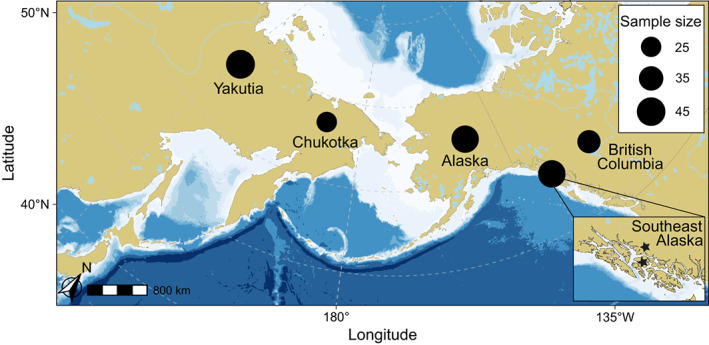
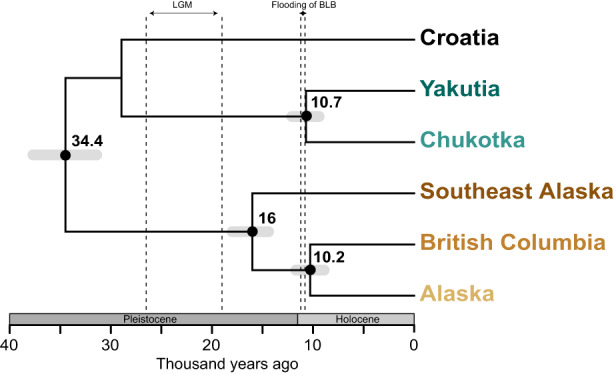
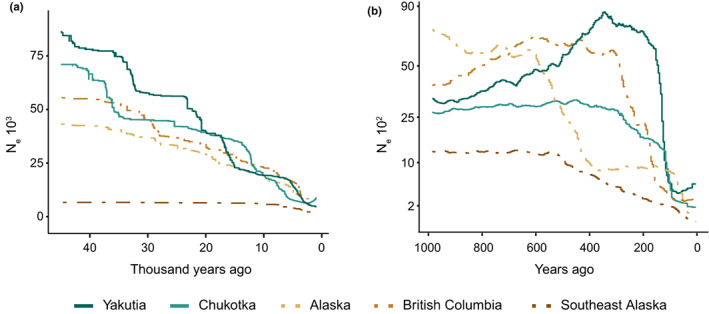
Glacial and interglacial periods throughout the Pleistocene have been substantial drivers of change in species distributions. Earlier analyses suggested that modern grey wolves (Canis lupus) trace their origin to a single Late Pleistocene Beringian population that expanded east and westwards, starting c. 25,000 years ago (ya). Here, we examined the demographic and phylogeographic histories of extant populations around the Bering Strait with wolves from two inland regions of the Russian Far East (RFE) and one coastal and two inland regions of North-western North America (NNA), genotyped for 91,327 single nucleotide polymorphisms. Our results indicated that RFE and NNA wolves had a common ancestry until c. 34,400 ya, suggesting that these populations started to diverge before the previously proposed expansion out of Beringia. Coastal and inland NNA populations diverged c. 16,000 ya, concordant with the minimum proposed date for the ecological viability of the migration route along the Pacific Northwest coast. Demographic reconstructions for inland RFE and NNA populations reveal spatial and temporal synchrony, with large historical effective population sizes that declined throughout the Pleistocene, possibly reflecting the influence of broadscale climatic changes across continents. In contrast, coastal NNA wolves displayed a consistently lower effective population size than the inland populations. Differences between the demographic history of inland and coastal wolves may have been driven by multiple ecological factors, including historical gene flow patterns, natural landscape fragmentation, and more recent anthropogenic disturbance.
更新世的冰期和间冰期是物种分布变化的重要驱动因素。早期的分析表明,现代灰狼(Canis lupus)起源于单一的更新世晚期白令海种群,该种群自大约 25000 年前开始向东西方向扩张。在这里,我们研究了白令海峡周围现存种群的人口统计学和系统地理学历史,这些种群包括来自俄罗斯远东地区(RFE)的两个内陆地区和北美洲西北部的一个沿海地区和两个内陆地区的狼,对 91327 个单核苷酸多态性进行了基因分型。我们的结果表明,RFE 和 NNA 的狼在大约 34400 年前有一个共同的祖先,这表明这些种群在之前提出的从白令海峡扩张之前就开始分化了。沿海和内陆 NNA 种群在大约 16000 年前分化,与沿北美西北太平洋海岸迁徙路线的生态可行性的最小提议日期一致。内陆 RFE 和 NNA 种群的人口重建揭示了空间和时间上的同步性,具有较大的历史有效种群大小,在整个更新世期间下降,这可能反映了大陆间广泛气候变化的影响。相比之下,沿海 NNA 的狼显示出比内陆种群更低的有效种群大小。内陆和沿海狼的种群历史差异可能是由多种生态因素驱动的,包括历史基因流动模式、自然景观破碎化以及最近的人为干扰。