Department of Medical and Surgical Sciences, Pharmacology Unit, University of Bologna, via Irnerio 48, Bologna, Italy.
Department of Diagnostics and Public Health, University of Verona, Verona, Italy.
Drug Saf. 2022 Aug;45(8):891-908. doi: 10.1007/s40264-022-01194-z. Epub 2022 Jul 12.
As chimeric antigen receptor T-cell therapies are becoming increasingly available in the armamentarium of the hematologist, there is an emerging need to monitor post-marketing safety.
We aimed to better characterize their safety profile by focusing on cytokine release syndrome and identifying emerging signals.
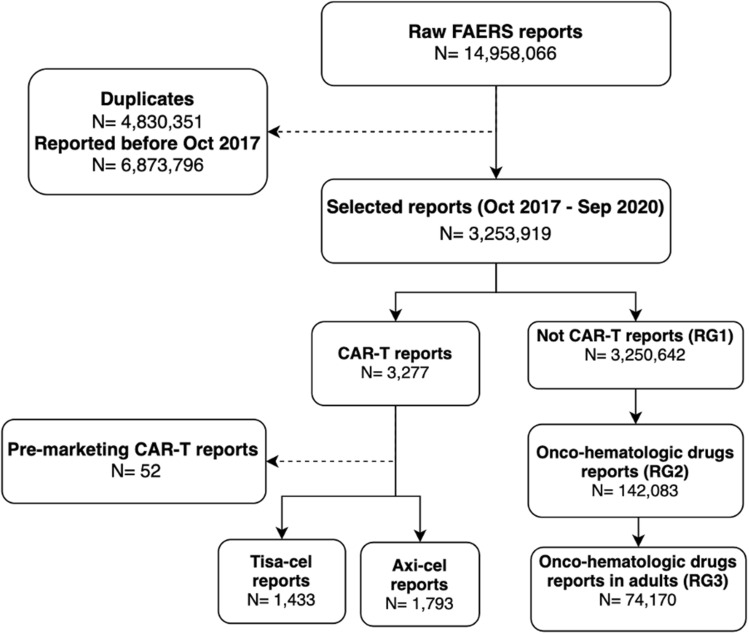
We queried the US Food and Drug Administration Adverse Event Reporting System (October 2017-September 2020) to analyze suspected adverse drug reactions to tisagenlecleucel (tisa-cel) and axicabtagene ciloleucel (axi-cel). Disproportionality analyses (reporting odds ratio) were performed by comparing chimeric antigen receptor T-cell therapies with (a) all other drugs (reference group 1) and (b) other onco-hematological drugs with a similar indication, irrespective of age (reference group 2), or (c) restricted to adults (reference group 3). Notoriety was assessed through package inserts and risk management plans. Adverse drug reaction time to onset and cytokine release syndrome features were investigated.
Overall, 3225 reports (1793 axi-cel; 1433 tisa-cel) were identified. The reported toxicities were mainly: cytokine release syndrome (52.2%), febrile disorders (27.7%), and neurotoxicity (27.2%). Cytokine release syndrome and neurotoxicity were often co-reported and 75% of the events occurred in the first 10 days. Disproportionalities confirmed known adverse drug reactions and showed unexpected associations: for example, axi-cel with cardiomyopathies (reporting odds ratio = 2.3; 95% confidence interval 1.2-4.4) and gastrointestinal perforations (2.9; 1.2-7.3), tisa-cel with hepatotoxicity (2.5; 1.1-5.7) and pupil disorders (15.3; 6-39.1).
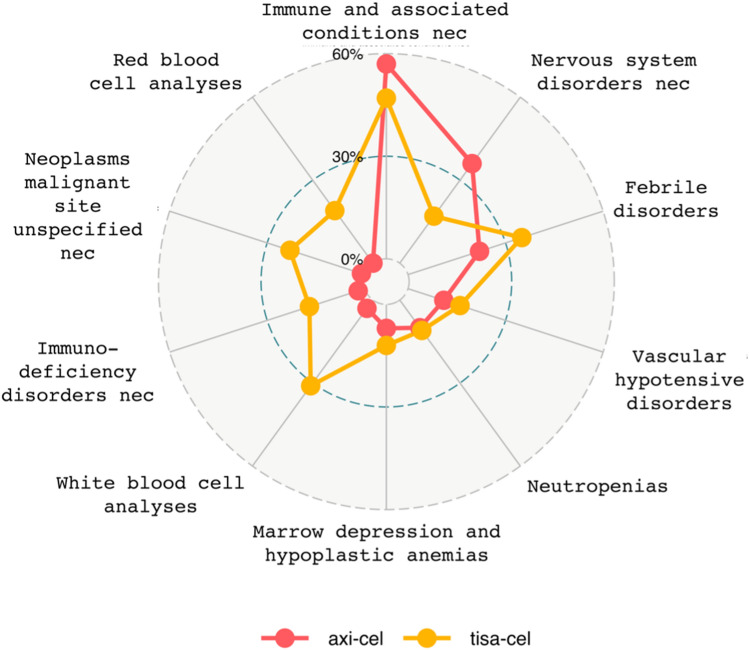
Our study confirms the well-known adverse drug reactions and detects potentially emerging safety issues specific for each chimeric antigen receptor T-cell therapy, also providing insights into a stronger role for tisa-cel in inducing some immunodeficiency-related events (e.g., hypogammaglobulinemia, infections) and coagulopathies, and for axi-cel in neurotoxicity.
随着嵌合抗原受体 T 细胞疗法在血液病学家的治疗武器库中变得越来越普及,人们越来越需要监测上市后的安全性。
我们旨在通过关注细胞因子释放综合征并识别新出现的信号,更好地描述其安全性概况。
我们查询了美国食品和药物管理局不良事件报告系统(2017 年 10 月至 2020 年 9 月),以分析 tisagenlecleucel(tisa-cel)和 axicabtagene ciloleucel(axi-cel)的疑似药物不良反应。通过比较嵌合抗原受体 T 细胞疗法与(a)所有其他药物(参考组 1)和(b)其他具有相似适应证的肿瘤血液学药物(无论年龄如何,参考组 2)或(c)仅限于成人(参考组 3),进行了比例失衡分析(报告比值比)。通过包装说明书和风险管理计划评估不良药物反应的知名度。研究了不良药物反应的发病时间和细胞因子释放综合征的特征。
总共确定了 3225 份报告(1793 份 axi-cel;1433 份 tisa-cel)。报告的毒性主要为:细胞因子释放综合征(52.2%)、发热性疾病(27.7%)和神经毒性(27.2%)。细胞因子释放综合征和神经毒性常同时报告,75%的事件发生在第 10 天内。比例失衡证实了已知的药物不良反应,并显示出意外的关联:例如,axi-cel 与心肌病(报告比值比=2.3;95%置信区间 1.2-4.4)和胃肠道穿孔(2.9;1.2-7.3),tisa-cel 与肝毒性(2.5;1.1-5.7)和瞳孔疾病(15.3;6-39.1)。
我们的研究证实了已知的药物不良反应,并发现了每种嵌合抗原受体 T 细胞疗法特有的潜在新的安全性问题,还为 tisa-cel 在诱导某些与免疫缺陷相关的事件(例如低丙种球蛋白血症、感染)和凝血障碍,以及 axi-cel 在神经毒性方面的作用提供了新的见解。