Department of Urology, University and Hospital Center of Coimbra, Praceta Prof. Mota Pinto, 3004-561, Coimbra, Portugal.
Faculty of Medicine, University of Coimbra, Coimbra, Portugal.
Clin Drug Investig. 2022 Aug;42(8):631-642. doi: 10.1007/s40261-022-01178-y. Epub 2022 Jul 13.
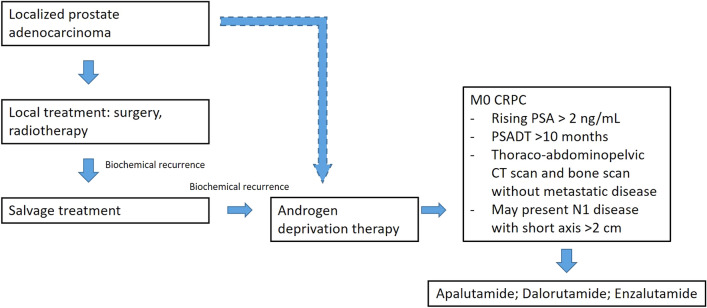
Prostate carcinoma is a highly prevalent biologically and clinically diverse disease, generally associated with a consistent elevation of prostate-specific antigen levels. Castration-resistant prostate cancer represents a heterogeneous clinical setting that ranges from patients with an asymptomatic prostate-specific antigen elevation after hormone blockade failure and good performance status to patients with significant debilitating symptoms and rapidly progressive disease, leading to death. Nonmetastatic castration-resistant prostate cancer is a transient disease stage defined over specific criteria established within a sensitive time period. The majority of the patients with nonmetastatic castration-resistant prostate cancer will eventually develop metastatic lesions, associated with prostate cancer-specific morbidity and mortality. However, progression to metastatic disease is a heterogeneous process still not fully understood, with studies suggesting that younger age, high Gleason score (> 7), high prostate-specific antigen levels, reduced prostate-specific antigen doubling time (< 6 months), and a rapid alkaline phosphatase rise as potentially associated factors. Although the nonmetastatic castration-resistant prostate cancer treatment landscape has substantially evolved in recent years, the disease heterogeneity makes treatment decisions for this population challenging in the effort to achieve a balance between the risk of disease progression and the toxicity of new treatments in patients who often have associated comorbidities, yet are generally asymptomatic. The present article addresses the current main challenges in nonmetastatic castration-resistant prostate cancer management, including in diagnosis, owing to the development of new imaging modalities with a direct impact in disease detection, prognostic classification, as a result of the traditionally oversimplified definition of disease aggressiveness (mainly based on prostate-specific antigen doubling time), and patient selection for the most adequate treatment.
前列腺癌是一种高度普遍的生物学和临床多样化疾病,通常与前列腺特异性抗原水平的持续升高有关。去势抵抗性前列腺癌代表了一种异质的临床环境,范围从激素阻断失败后无症状前列腺特异性抗原升高和良好表现状态的患者到有明显虚弱症状和快速进展疾病导致死亡的患者。非转移性去势抵抗性前列腺癌是一个定义明确的疾病阶段,根据在敏感时间段内建立的特定标准进行定义。大多数非转移性去势抵抗性前列腺癌患者最终会发展为转移性病变,与前列腺癌特异性发病率和死亡率相关。然而,进展为转移性疾病是一个尚未完全理解的异质过程,研究表明,年龄较小、高 Gleason 评分(>7)、高前列腺特异性抗原水平、前列腺特异性抗原倍增时间缩短(<6 个月)和碱性磷酸酶快速升高可能与潜在相关因素有关。尽管近年来非转移性去势抵抗性前列腺癌的治疗领域有了很大的发展,但由于疾病的异质性,对于这一人群的治疗决策仍然具有挑战性,需要在疾病进展的风险和新治疗方法的毒性之间取得平衡,因为这些患者通常伴有合并症,但通常无症状。本文讨论了非转移性去势抵抗性前列腺癌管理中的当前主要挑战,包括诊断方面的挑战,这是由于新的成像模式的发展,这些模式对疾病的检测具有直接影响,以及预后分类方面的挑战,这是由于疾病侵袭性的传统定义过于简单化(主要基于前列腺特异性抗原倍增时间)。还讨论了患者选择最适当的治疗方法的挑战。