Heart and Vascular Center, Brigham and Women's Hospital, Harvard Medical School, Boston, MA - EUA.
Departamento de Medicina, Universidade Federal de Santa Catarina, Florianópolis, SC - Brasil.
Arq Bras Cardiol. 2022 Jul;119(1):87-94. doi: 10.36660/abc.20210477.
Catheter ablation is a well-established therapy for rhythm control in patients who are refractory or intolerant to anti-arrhythmic drugs (AAD). Less is known about the efficacy of catheter ablation compared with AAD as a first-line strategy for rhythm control in atrial fibrillation (AF).
We aimed to perform a systematic review and meta-analysis of catheter ablation vs. AAD in patients naïve to prior rhythm control therapies.
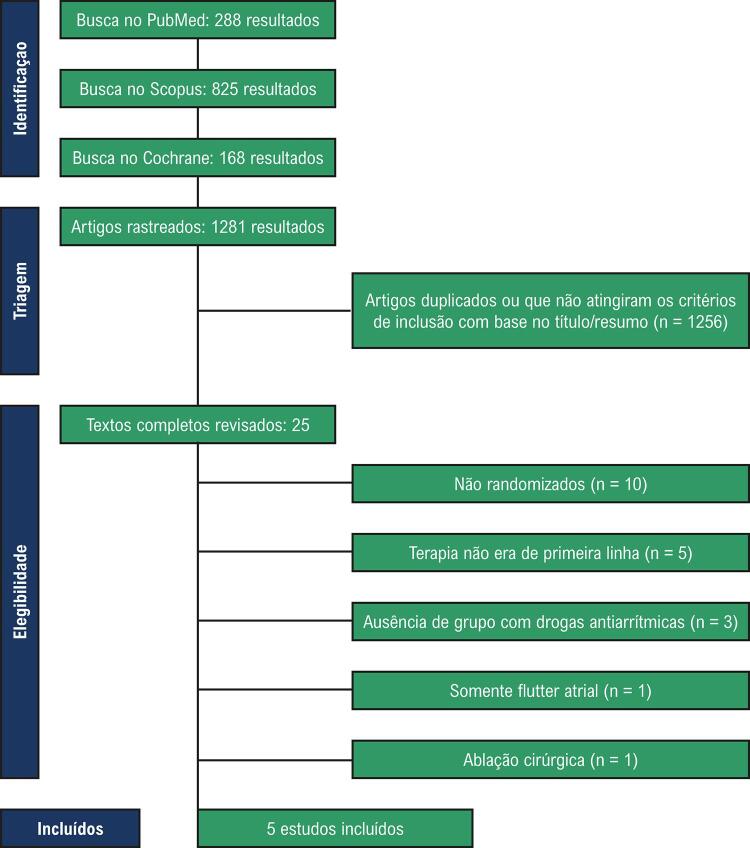
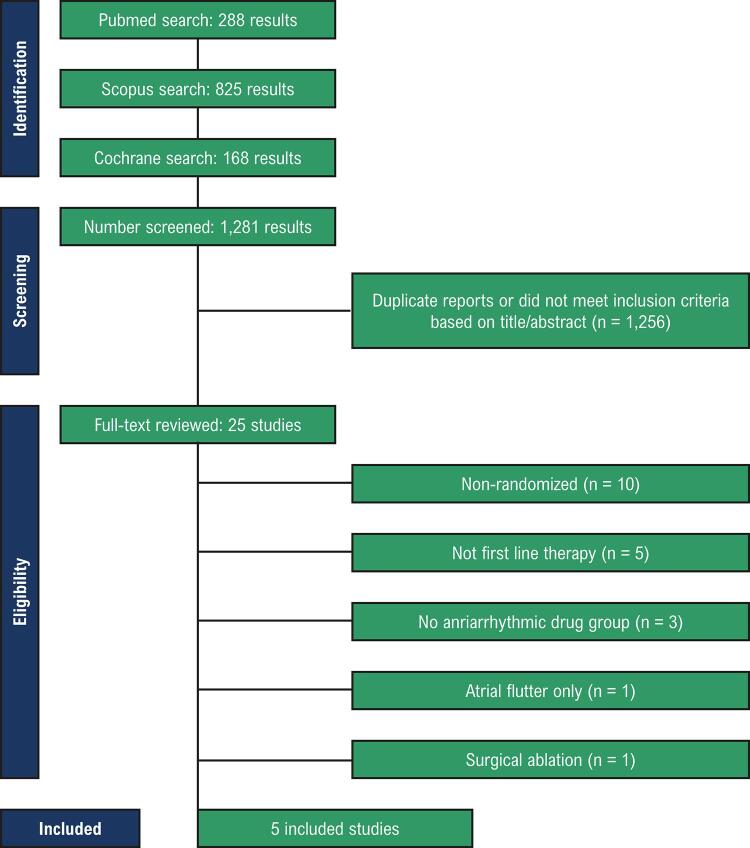
PubMed, EMBASE, and Cochrane databases were searched for randomized controlled trials that compared catheter ablation to AAD for initial rhythm control in symptomatic AF and reported the outcomes of (1) recurrent atrial tachyarrhythmias (ATs); (2) symptomatic AF; (3) hospitalizations; and (4) symptomatic bradycardia. Heterogeneity was examined with I2statistics. P values of < 0.05 were considered statistically significant.
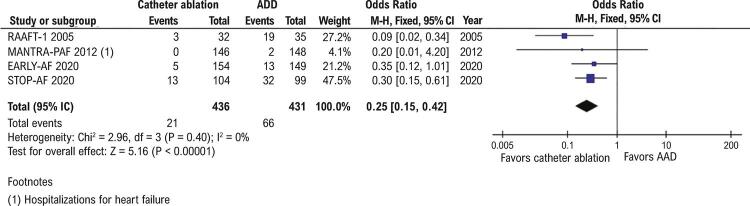
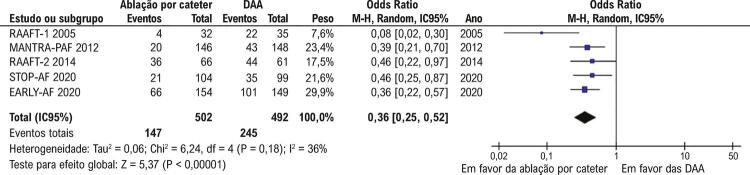
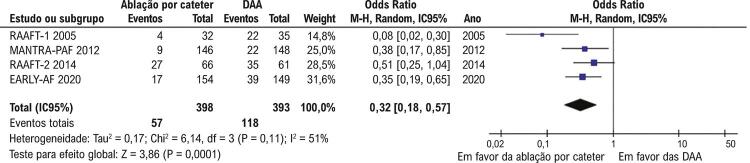
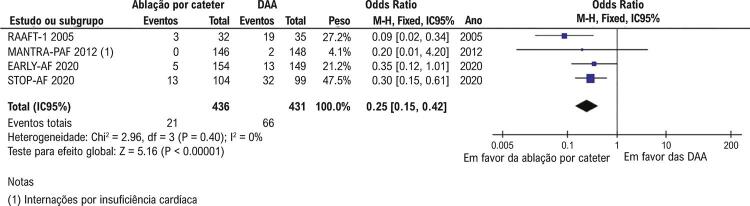
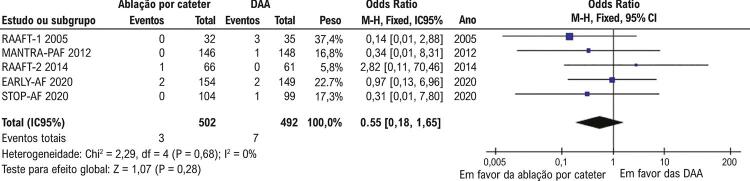
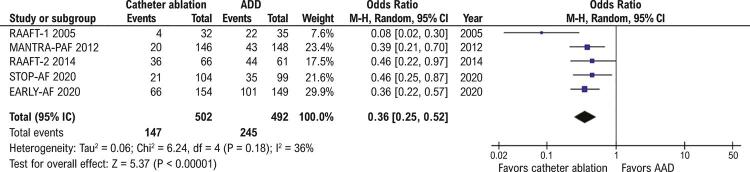
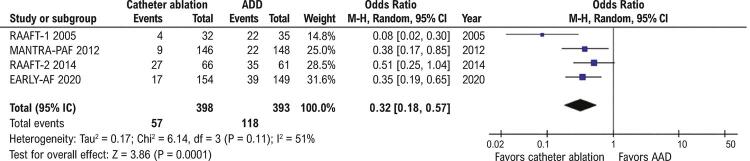
We included five trials with 994 patients, of whom 502 (50.5%) underwent catheter ablation. Mean follow-up ranged from one to five years. Recurrences of AT (OR 0.36; 95% CI 0.25-0.52; p<0.001) and symptomatic AF (OR 0.32; 95% CI 0.18-0.57; p<0.001), and hospitalizations (OR 0.25; 95% CI 0.15-0.42; p<0.001) were significantly less frequent in patients treated with catheter ablation compared with AAD. Symptomatic bradycardia was not significantly different between groups (OR 0.55; 95% CI 0.18-1.65; p=0.28). Significant pericardial effusions or tamponade occurred in eight of 464 (1.7%) patients in the catheter ablation group.
These findings suggest that catheter ablation has superior efficacy to AAD as an initial rhythm control strategy in patients with symptomatic AF.
导管消融术是一种成熟的治疗方法,适用于对抗心律失常药物(AAD)不耐受或无效的节律控制患者。与 AAD 作为心房颤动(AF)节律控制的一线策略相比,导管消融术的疗效知之甚少。
我们旨在对既往节律控制治疗无效的患者中导管消融术与 AAD 进行系统评价和荟萃分析。
我们检索了 PubMed、EMBASE 和 Cochrane 数据库中比较导管消融术与 AAD 治疗有症状 AF 初始节律控制的随机对照试验,并报告了(1)复发性房性心动过速(AT);(2)有症状的 AF;(3)住院;和(4)有症状的心动过缓的结果。用 I2 统计检验异质性。P 值<0.05 被认为具有统计学意义。
我们纳入了 5 项包含 994 例患者的试验,其中 502 例(50.5%)接受了导管消融术。平均随访时间为 1 至 5 年。与 AAD 相比,接受导管消融术的患者 AT 复发(OR 0.36;95% CI 0.25-0.52;p<0.001)和有症状的 AF(OR 0.32;95% CI 0.18-0.57;p<0.001)以及住院(OR 0.25;95% CI 0.15-0.42;p<0.001)的发生率显著降低。两组间有症状的心动过缓无显著差异(OR 0.55;95% CI 0.18-1.65;p=0.28)。导管消融组有 8 例(1.7%)患者发生心包积液或心脏压塞。
这些发现表明,在有症状的 AF 患者中,导管消融术作为初始节律控制策略的疗效优于 AAD。