Eating Disorders Clinical and Research Program, Massachusetts General Hospital, Boston, Massachusetts.
Department of Medicine, Harvard Medical School, Boston, Massachusetts.
J Clin Psychiatry. 2022 Jul 11;83(5):21m14111. doi: 10.4088/JCP.21m14111.
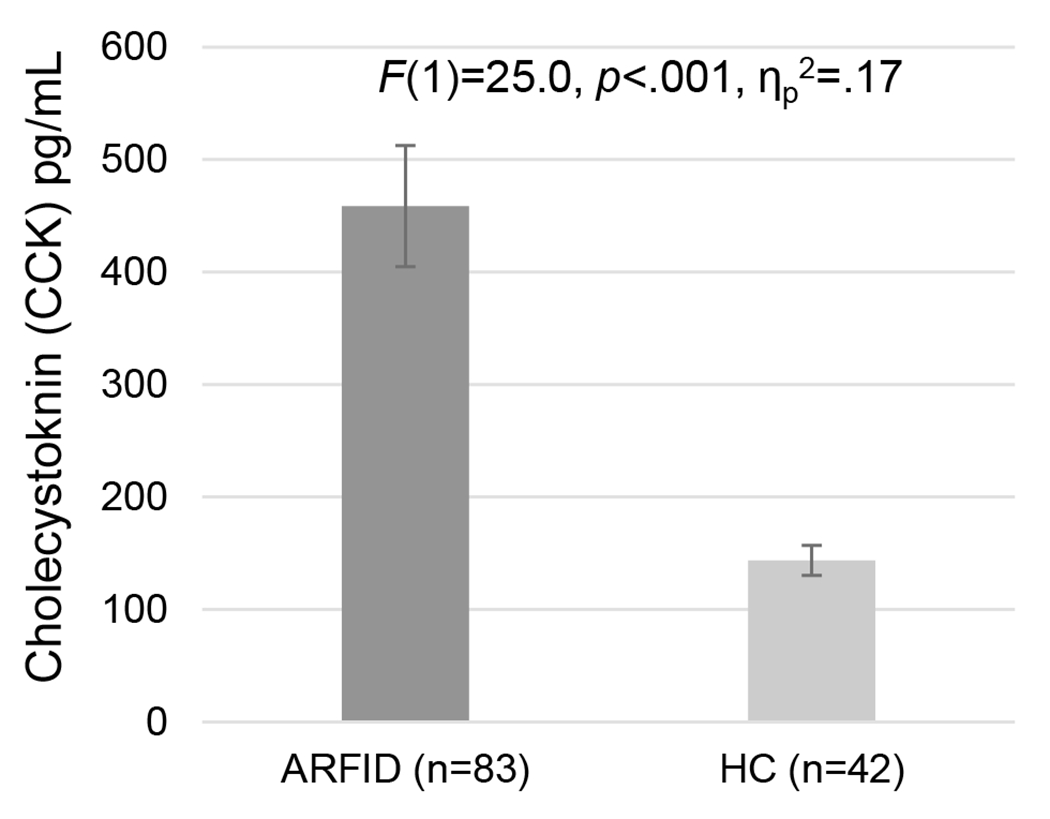
Avoidant/restrictive food intake disorder (ARFID) is characterized by food avoidance or dietary restriction not primarily motivated by body weight/shape concerns. Individuals with ARFID can report early satiation, post-prandial fullness, and high intermeal satiety, but whether these symptoms are related to differences in the biology underlying appetite regulation is unknown. In male and female children and adolescents, we hypothesized that fasting levels of cholecystokinin (CCK), a satiety hormone, would be elevated in participants with ARFID (full or subthreshold) versus healthy controls (HCs). Within the ARFID group, we also explored the relations of CCK with weight status, subjective appetite ratings, and ARFID severity and phenotypes. A total of 125 participants (83 with full/subthreshold ARFID (per ) and 42 HCs, aged 10.2-23.7 years; 61% female; July 2014-December 2019) underwent fasting blood draws for CCK, completed self-report measures assessing subjective state and trait appetite ratings, and completed a semistructured interview assessing ARFID severity. Fasting CCK was higher in those with full/subthreshold ARFID versus HCs with a large effect ( = 25.0, < .001, η = 0.17), controlling for age, sex, and body mass index (BMI) percentile. Within the ARFID group, CCK was not significantly related to BMI percentile, subjective appetite ratings, or ARFID characteristic measures. CCK may contribute to etiology and/or maintenance of ARFID, as children and adolescents with heterogeneous presentations of avoidant/restrictive eating appear to show elevated fasting levels compared to healthy youth. Further research is needed to understand relations between CCK and appetite, weight, and eating behavior in ARFID.
回避/限制型食物摄入障碍(ARFID)的特征是对食物的回避或饮食限制,其主要动机不是体重/体型问题。ARFID 患者可能会报告早饱、餐后饱胀和高餐间饱腹感,但这些症状是否与食欲调节的生物学基础的差异有关尚不清楚。在男性和女性儿童和青少年中,我们假设 ARFID(完全或亚阈值)参与者的空腹胆囊收缩素(CCK)水平升高,与健康对照组(HCs)相比。在 ARFID 组中,我们还探讨了 CCK 与体重状况、主观食欲评分以及 ARFID 严重程度和表型的关系。共有 125 名参与者(83 名有完全/亚阈值 ARFID(每)和 42 名 HCs,年龄 10.2-23.7 岁;61%为女性;2014 年 7 月至 2019 年 12 月)接受了空腹采血以检测 CCK,完成了评估主观状态和特质食欲评分的自我报告测量,并完成了评估 ARFID 严重程度的半结构化访谈。与 HCs 相比,完全/亚阈值 ARFID 参与者的空腹 CCK 水平更高,差异具有统计学意义( = 25.0, < .001,η = 0.17),调整了年龄、性别和体重指数(BMI)百分位。在 ARFID 组中,CCK 与 BMI 百分位、主观食欲评分或 ARFID 特征测量均无显著相关性。CCK 可能有助于 ARFID 的病因和/或维持,因为表现出回避/限制性进食的异质儿童和青少年与健康青少年相比,空腹水平似乎升高。需要进一步研究以了解 ARFID 中 CCK 与食欲、体重和进食行为之间的关系。