Department of Chemistry, Massachusetts Institute of Technology, Cambridge, Massachusetts 02139, United States.
J Am Chem Soc. 2022 Jul 27;144(29):13184-13195. doi: 10.1021/jacs.2c03195. Epub 2022 Jul 13.
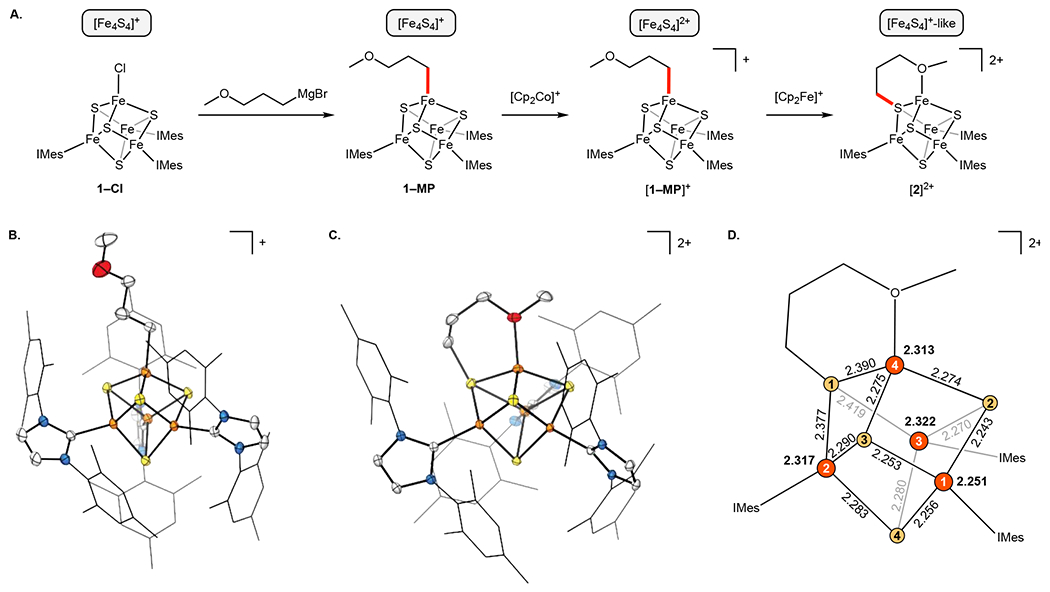
Synthetic [FeS] clusters with Fe-R groups (R = alkyl/benzyl) are shown to release organic radicals on an [FeS]-R/[FeS] redox couple, the same that has been proposed for a radical-generating intermediate in the superfamily of radical -adenosyl-l-methionine (SAM) enzymes. In attempts to trap the immediate precursor to radical generation, a species in which the alkyl group has migrated from Fe to S is instead isolated. This S-alkylated cluster is a structurally faithful model of intermediates proposed in a variety of functionally diverse S transferase enzymes and features an "[FeS]-like" core that exists as a physical mixture of = 1/2 and 7/2 states. The latter corresponds to an unusual, valence-localized electronic structure as indicated by distortions in its geometric structure and supported by computational analysis. Fe-to-S alkyl group migration is (electro)chemically reversible, and the preference for Fe S alkylation is dictated by the redox state of the cluster. These findings link the organoiron and organosulfur chemistry of Fe-S clusters and are discussed in the context of metalloenzymes that are proposed to make and break Fe-S and/or C-S bonds during catalysis.
具有 Fe-R 基团(R = 烷基/苄基)的合成 [FeS] 簇在 [FeS]-R/[FeS] 氧化还原偶联体上释放有机自由基,这与在超家族的自由基 - 腺苷基 -L-甲硫氨酸(SAM)酶中提出的自由基生成中间体相同。在试图捕获自由基生成的直接前体时,分离出的是烷基从 Fe 迁移到 S 的物种。这种 S-烷基化簇是各种功能多样的 S 转移酶中提出的中间体的结构忠实模型,其特征为“[FeS] 样”核心,作为 = 1/2 和 7/2 状态的物理混合物存在。后者对应于一种不寻常的、价局部化的电子结构,这由其几何结构的变形和计算分析来支持。Fe 到 S 的烷基迁移是(电)化学可逆的,并且对 Fe-S 烷基化的偏好由簇的氧化还原状态决定。这些发现将 Fe-S 簇的有机铁和有机硫化学联系起来,并在提出在催化过程中形成和断裂 Fe-S 和/或 C-S 键的金属酶的背景下进行了讨论。