Emergency Center, Fuwai Hospital, National Center for Cardiovascular Diseases, National Clinical Research Center of Cardiovascular Diseases, Chinese Academy of Medical Sciences and Peking Union Medical College, Beijing, China.
Department of Cardiology and Institute of Vascular Medicine, Peking University Third Hospital, NHC Key Laboratory of Cardiovascular Molecular Biology and Regulatory Peptides, Key Laboratory of Molecular Cardiovascular Science, Ministry of Education. Beijing Key Laboratory of Cardiovascular Receptors Research, Beijing, China.
Front Cell Infect Microbiol. 2022 Jun 27;12:884298. doi: 10.3389/fcimb.2022.884298. eCollection 2022.
Accumulating evidence has indicated that persistent human cytomegalovirus (HCMV) infection is associated with several cardiovascular diseases including atherosclerosis and coronary artery disease. However, whether there is a causal association between the level of anti-HCMV immune response and the risk of cardiovascular diseases remains unknown.
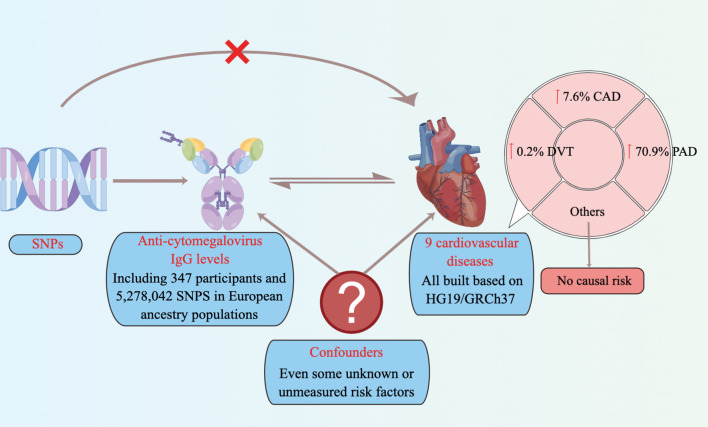
Single-nucleotide polymorphisms associated with anti-cytomegalovirus immunoglobulin (Ig) G levels were used as instrumental variables to estimate the causal effect of anti-cytomegalovirus IgG levels on 9 cardiovascular diseases (including atrial fibrillation, coronary artery disease, hypertension, heart failure, peripheral artery disease, pulmonary embolism, deep vein thrombosis of the lower extremities, rheumatic valve diseases, and non-rheumatic valve diseases). For each cardiovascular disease, Mendelian randomization (MR) analyses were performed. Inverse variance-weighted meta-analysis (IVW) with a random-effects model was used as a principal analysis. In addition to this, the weighted median approach and MR-Egger method were used for further sensitivity analysis.
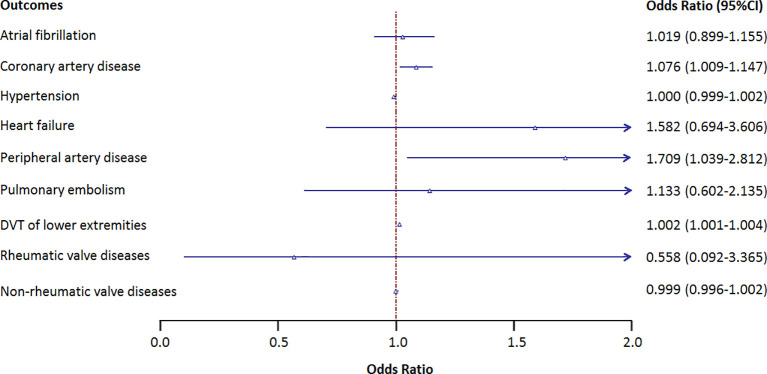
In the IVW analysis, genetically predicted anti-cytomegalovirus IgG levels were suggestively associated with coronary artery disease with an odds ratio (OR) of 1.076 [95% CI, 1.009-1.147; p = 0.025], peripheral artery disease (OR 1.709; 95% CI, 1.039-2.812; p = 0.035), and deep vein thrombosis (OR 1.002; 95% CI, 1.000-1.004; p = 0.025). In the further analysis, similar causal associations were obtained from weighted median analysis and MR-Egger analysis with lower precision. No notable heterogeneities and horizontal pleiotropies were observed (p > 0.05).
CONCLUSIONS/INTERPRETATION: Our findings first provide direct evidence that genetic predisposition of anti-cytomegalovirus IgG levels increases the risk of coronary artery disease, peripheral artery disease, and deep vein thrombosis.
越来越多的证据表明,持续性人类巨细胞病毒(HCMV)感染与多种心血管疾病有关,包括动脉粥样硬化和冠状动脉疾病。然而,抗巨细胞病毒免疫反应水平与心血管疾病风险之间是否存在因果关系尚不清楚。
将与抗巨细胞病毒免疫球蛋白(IgG)水平相关的单核苷酸多态性用作工具变量,以估计抗巨细胞病毒 IgG 水平对 9 种心血管疾病(包括心房颤动、冠状动脉疾病、高血压、心力衰竭、外周动脉疾病、肺栓塞、下肢深静脉血栓形成、风湿性瓣膜病和非风湿性瓣膜病)的因果效应。对每种心血管疾病进行孟德尔随机化(MR)分析。使用随机效应模型的逆方差加权荟萃分析(IVW)作为主要分析。此外,还使用加权中位数方法和 MR-Egger 方法进行了进一步的敏感性分析。
在 IVW 分析中,遗传预测的抗巨细胞病毒 IgG 水平与冠状动脉疾病呈显著相关,比值比(OR)为 1.076 [95%置信区间(CI),1.009-1.147;p = 0.025]、外周动脉疾病(OR 1.709;95%CI,1.039-2.812;p = 0.035)和深静脉血栓形成(OR 1.002;95%CI,1.000-1.004;p = 0.025)。在进一步的分析中,从加权中位数分析和 MR-Egger 分析中获得了相似的因果关联,但精度较低。未观察到明显的异质性和水平偏倚(p > 0.05)。
结论/解释:我们的研究结果首次提供了直接证据,表明抗巨细胞病毒 IgG 水平的遗传倾向增加了患冠状动脉疾病、外周动脉疾病和深静脉血栓形成的风险。