Lara-Reyna Samuel, Caseley Emily A, Topping Joanne, Rodrigues François, Jimenez Macias Jorge, Lawler Sean E, McDermott Michael F
Institute of Microbiology and Infection University of Birmingham Birmingham UK.
School of Biomedical Sciences, Faculty of Biological Sciences University of Leeds Leeds UK.
Clin Transl Immunology. 2022 Jul 7;11(7):e1404. doi: 10.1002/cti2.1404. eCollection 2022.
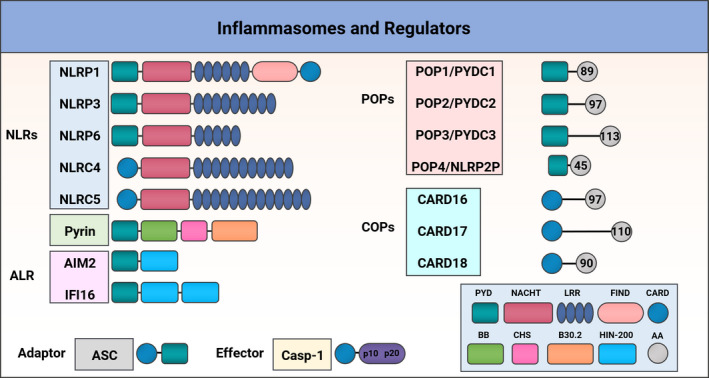
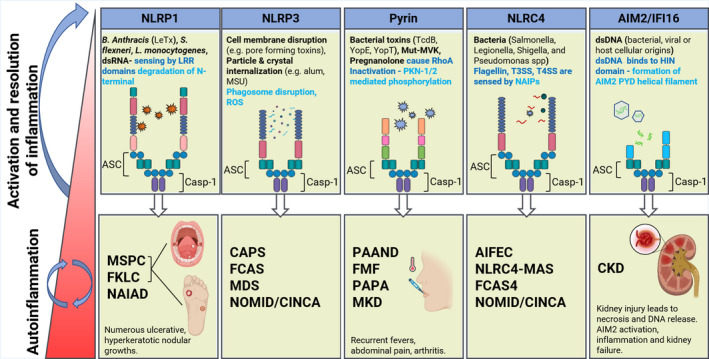
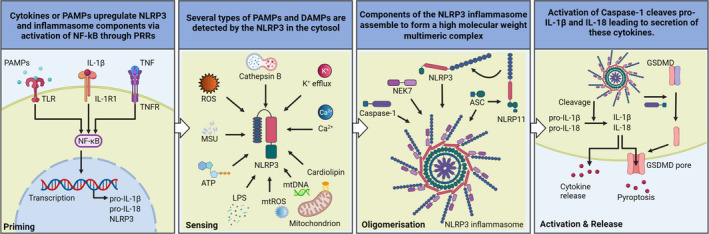
Inflammasomes are assembled by innate immune sensors that cells employ to detect a range of danger signals and respond with pro-inflammatory signalling. Inflammasomes activate inflammatory caspases, which trigger a cascade of molecular events with the potential to compromise cellular integrity and release the IL-1β and IL-18 pro-inflammatory cytokines. Several molecular mechanisms, working in concert, ensure that inflammasome activation is tightly regulated; these include NLRP3 post-translational modifications, ubiquitination and phosphorylation, as well as single-domain proteins that competitively bind to key inflammasome components, such as the CARD-only proteins (COPs) and PYD-only proteins (POPs). These diverse regulatory systems ensure that a suitable level of inflammation is initiated to counteract any cellular insult, while simultaneously preserving tissue architecture. When inflammasomes are aberrantly activated can drive excessive production of pro-inflammatory cytokines and cell death, leading to tissue damage. In several autoinflammatory conditions, inflammasomes are aberrantly activated with subsequent development of clinical features that reflect the degree of underlying tissue and organ damage. Several of the resulting disease complications may be successfully controlled by anti-inflammatory drugs and/or specific cytokine inhibitors, in addition to more recently developed small-molecule inhibitors. In this review, we will explore the molecular processes underlying the activation of several inflammasomes and highlight their role during health and disease. We also describe the detrimental effects of these inflammasome complexes, in some pathological conditions, and review current therapeutic approaches as well as future prospective treatments.
炎性小体由天然免疫传感器组装而成,细胞利用这些传感器来检测一系列危险信号,并通过促炎信号作出反应。炎性小体激活炎性半胱天冬酶,后者触发一系列分子事件,这些事件有可能损害细胞完整性并释放白细胞介素-1β(IL-1β)和白细胞介素-18(IL-18)促炎细胞因子。几种协同作用的分子机制确保炎性小体的激活受到严格调控;这些机制包括NLRP3的翻译后修饰、泛素化和磷酸化,以及竞争性结合关键炎性小体成分的单结构域蛋白,如仅含CARD的蛋白(COPs)和仅含PYD的蛋白(POPs)。这些多样的调节系统确保引发适当水平的炎症以对抗任何细胞损伤,同时保持组织结构。当炎性小体异常激活时,会导致促炎细胞因子过度产生和细胞死亡,从而导致组织损伤。在几种自身炎症性疾病中,炎性小体异常激活,随后出现反映潜在组织和器官损伤程度的临床特征。除了最近开发的小分子抑制剂外,一些由此产生的疾病并发症可以通过抗炎药物和/或特定细胞因子抑制剂成功控制。在这篇综述中,我们将探讨几种炎性小体激活的分子过程,并强调它们在健康和疾病中的作用。我们还描述了这些炎性小体复合物在某些病理情况下的有害影响,并综述了当前的治疗方法以及未来的前瞻性治疗。