Department of Medical Images, Hematology, and Oncology, Ribeirão Preto Medical School, University of São Paulo, 3900 Bandeirantes Avenue, Ribeirão Preto, São Paulo, 14040-900, Brazil.
Department of Experimental Hematology, University of Groningen, 9718 BG, Groningen, The Netherlands.
Sci Rep. 2024 Oct 12;14(1):23882. doi: 10.1038/s41598-024-74168-z.
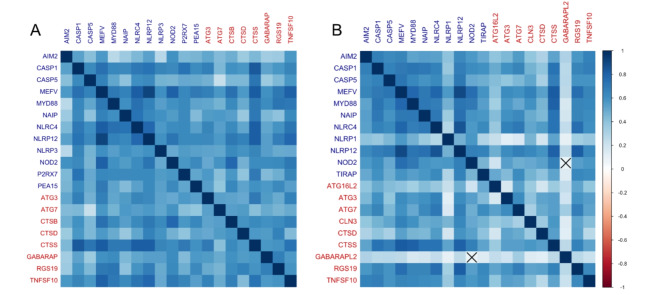
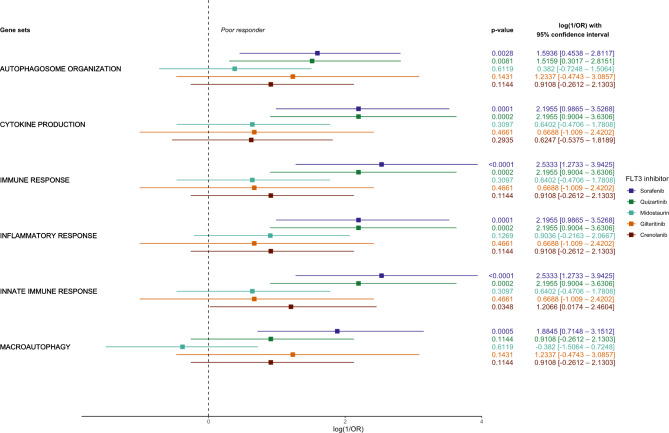
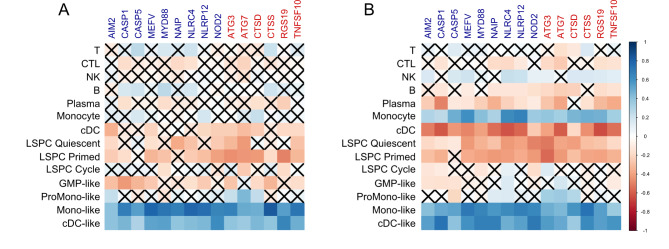
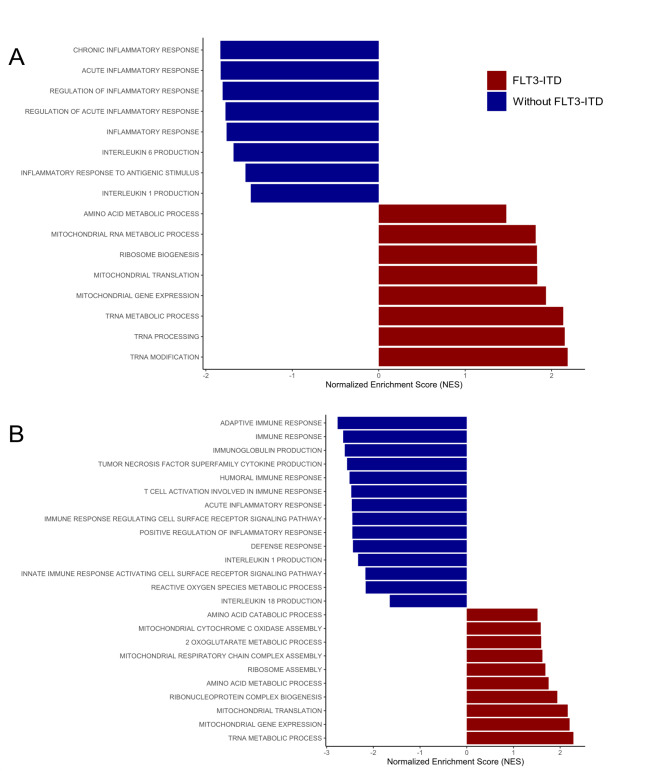
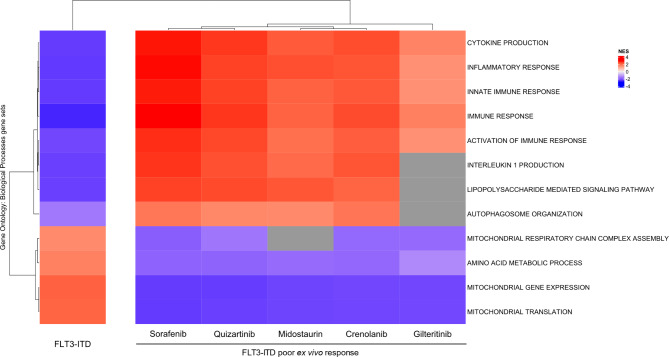
Beyond its clinical diversity and severity, acute myeloid leukemia (AML) is known for its complex molecular background and for rewiring biological processes to aid disease onset and maintenance. FLT3 mutations are among the most recurring molecular entities that cooperatively drive AML, and their inhibition is a critical molecularly oriented therapeutic strategy. Despite being a promising avenue, it still faces challenges such as intrinsic and acquired drug resistance, which led us to investigate whether and how autophagy and inflammasome interact and whether this interaction could be leveraged to enhance FLT3 inhibition as a therapeutic strategy. We observed a strong and positive correlation between the expression of key genes associated with autophagy and the inflammasome. Gene set enrichment analysis of the FLT3-ITD samples and their ex vivo response to five different FLT3 inhibitors revealed a common molecular signature compatible with autophagy and inflammasome activation across all poor responders. Inflammasome activation was also shown to strongly increase the likelihood of a poor ex vivo response to the FLT3 inhibitors quizartinib and sorafenib. These findings reveal a distinct molecular pattern within FLT3-ITD AML samples that underscores the necessity for further exploration into how approaching these supportive parallel yet altered pathways could improve therapeutic strategies.
除了临床表现的多样性和严重性外,急性髓系白血病 (AML) 还因其复杂的分子背景以及重新布线的生物学过程而闻名,这些过程有助于疾病的发生和维持。FLT3 突变是最常见的协同驱动 AML 的分子实体之一,其抑制是一种关键的分子靶向治疗策略。尽管这是一条很有前途的途径,但它仍然面临着内在和获得性耐药等挑战,这促使我们研究自噬和炎症小体是否相互作用,以及这种相互作用是否可以被利用来增强作为治疗策略的 FLT3 抑制。我们观察到与自噬和炎症小体相关的关键基因的表达之间存在强烈的正相关性。FLT3-ITD 样本的基因集富集分析及其对五种不同的 FLT3 抑制剂的体外反应表明,所有不良反应者之间存在一种共同的分子特征,与自噬和炎症小体的激活兼容。炎症小体的激活也强烈增加了对 FLT3 抑制剂 quizartinib 和 sorafenib 的体外不良反应的可能性。这些发现揭示了 FLT3-ITD AML 样本中的一个独特的分子模式,强调了需要进一步探索如何针对这些支持性但平行的改变途径来改善治疗策略。