Centro de Biología Molecular Severo Ochoa UAM-CSIC, Centro de Diagnóstico de Enfermedades Moleculares (CEDEM), CIBERER, IdiPaz, Universidad Autónoma de Madrid, Madrid, Spain.
Department of Biochemistry and Molecular Biology, University of Southern Denmark, Odense, Denmark.
Nucleic Acid Ther. 2022 Oct;32(5):378-390. doi: 10.1089/nat.2021.0066. Epub 2022 Jul 12.
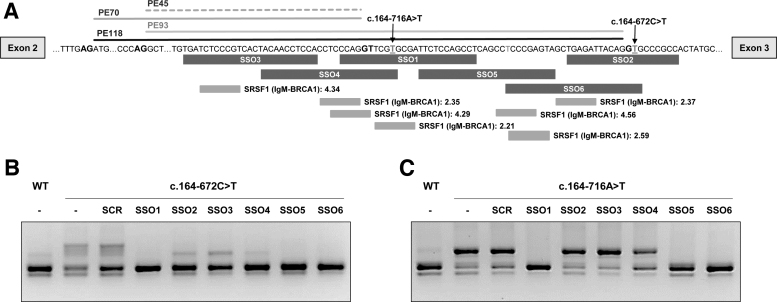
We report two new 6-pyruvoyl-tetrahydropterin synthase splicing variants identified through genomic sequencing and transcript analysis in a patient with tetrahydrobiopterin deficiency, presenting with hyperphenylalaninemia and monoamine neurotransmitter deficiency. Variant c.243 + 3A>G causes exon 4 skipping. The deep-intronic c.164-672C>T variant creates a potential 5' splice site that leads to the inclusion of four overlapping pseudoexons, corresponding to exonizations of an antisense short interspersed nuclear element repeat sequence. Two of the identified pseudoexons have been reported previously, activated by different deep-intronic variants, and were also detected at residual levels in control cells. Interestingly, the predominant pseudoexon is nearly identical to a disease causing activated pseudoexon in the gene, with the same 3' and 5' splice sites. Splice switching antisense oligonucleotides (SSOs) were designed to hybridize with splice sites and/or predicted binding sites for regulatory splice factors. Different SSOs corrected the aberrant pseudoexon inclusion, both in minigenes and in fibroblasts from patients carrying the new variant c.164-672C>T or the previously described c.164-716A>T. With SSO treatment PTPS protein was recovered, illustrating the therapeutic potential of the approach, for patients with different pseudoexon activating variants in the region. In addition, the natural presence of pseudoexons in the wild type context suggests the possibility of applying the antisense strategy in patients with hypomorphic variants with the purpose of upregulating their expression to increase overall protein and activity.
我们通过基因组测序和转录分析在一名四氢生物蝶呤缺乏症患者中发现了两个新的 6-丙酮酰四氢蝶呤合酶剪接变异体,该患者表现为高苯丙氨酸血症和单胺神经递质缺乏。变异 c.243 + 3A>G 导致外显子 4 跳跃。深内含子 c.164-672C>T 变异体创建了一个潜在的 5'剪接位点,导致四个重叠的假外显子被包含在内,对应于反义短散布核元件重复序列的外显子化。两个已鉴定的假外显子以前曾被报道过,被不同的深内含子变异体激活,并且在对照细胞中也以残留水平检测到。有趣的是,主要的假外显子与基因中导致疾病的激活假外显子几乎相同,具有相同的 3'和 5'剪接位点。设计了剪接转换反义寡核苷酸 (SSO) 与剪接位点和/或调节剪接因子的预测结合位点杂交。不同的 SSO 纠正了异常的假外显子包含,无论是在 minigene 中还是在携带新变异 c.164-672C>T 或以前描述的 c.164-716A>T 的患者的成纤维细胞中。用 SSO 处理后,PTPS 蛋白得到恢复,说明了该方法在该区域具有不同的假外显子激活变异体的患者中的治疗潜力。此外,野生型背景中假外显子的自然存在表明,反义策略有可能应用于低功能变体的患者,目的是上调其表达以增加整体蛋白和活性。