Institute of Cardiovascular Regeneration, Goethe University Frankfurt, Frankfurt, Germany.
Faculty for Biological Sciences, Goethe University Frankfurt, Frankfurt, Germany.
Basic Res Cardiol. 2022 Jul 14;117(1):35. doi: 10.1007/s00395-022-00941-8.
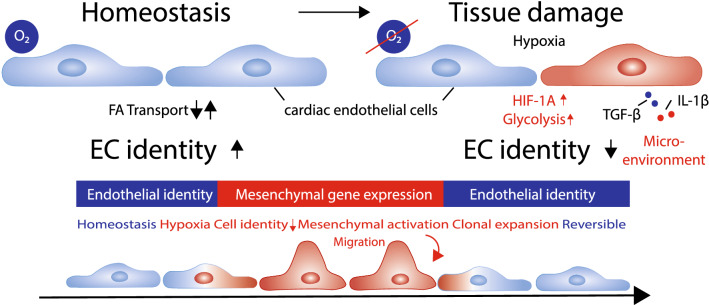
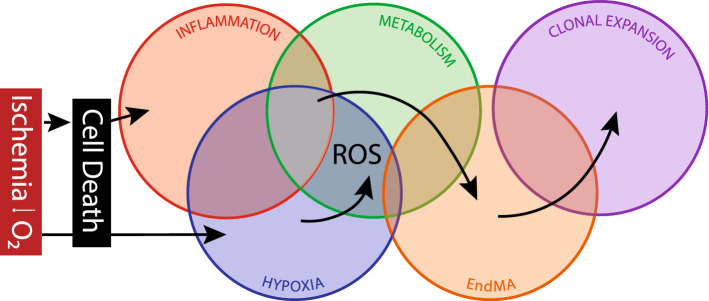
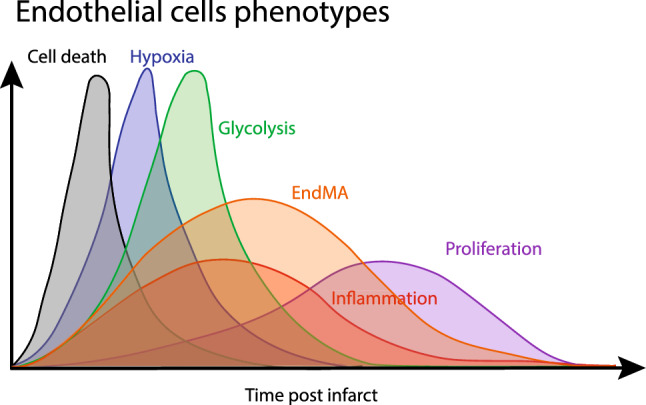
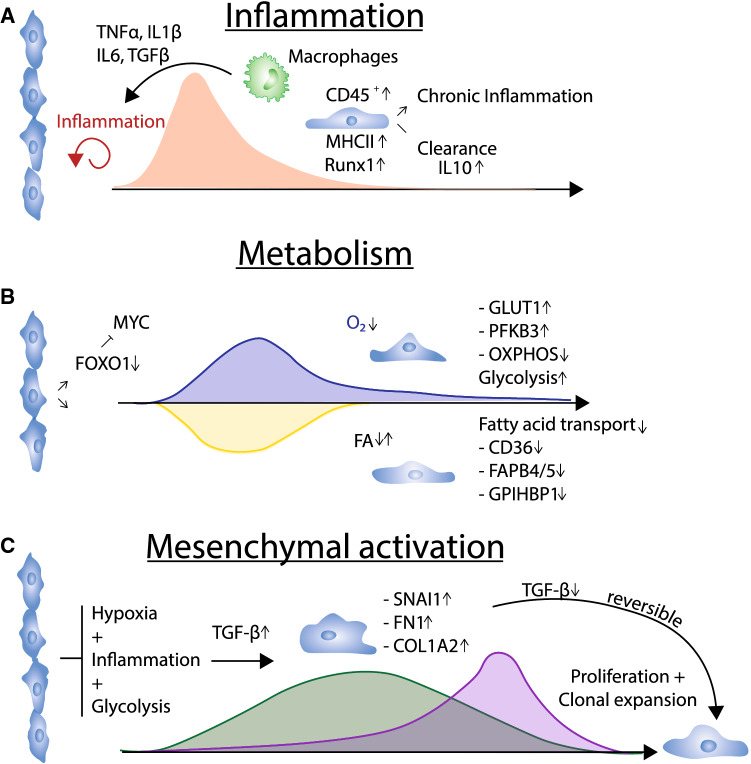
Myocardial injury as induced by myocardial infarction results in tissue ischemia, which critically incepts cardiomyocyte death. Endothelial cells play a crucial role in restoring oxygen and nutrient supply to the heart. Latest advances in single-cell multi-omics, together with genetic lineage tracing, reveal a transcriptional and phenotypical adaptation to the injured microenvironment, which includes alterations in metabolic, mesenchymal, hematopoietic and pro-inflammatory signatures. The extent of transition in mesenchymal or hematopoietic cell lineages is still debated, but it is clear that several of the adaptive phenotypical changes are transient and endothelial cells revert back to a naïve cell state after resolution of injury responses. This resilience of endothelial cells to acute stress responses is important for preventing chronic dysfunction. Here, we summarize how endothelial cells adjust to injury and how this dynamic response contributes to repair and regeneration. We will highlight intrinsic and microenvironmental factors that contribute to endothelial cell resilience and may be targetable to maintain a functionally active, healthy microcirculation.
心肌损伤由心肌梗死引起,导致组织缺血,这对心肌细胞死亡至关重要。内皮细胞在恢复心脏的氧气和营养供应方面起着至关重要的作用。单细胞多组学的最新进展,加上遗传谱系追踪,揭示了对损伤微环境的转录和表型适应,包括代谢、间充质、造血和促炎特征的改变。间充质或造血细胞谱系的转变程度仍有争议,但很明显,几种适应性表型变化是短暂的,内皮细胞在损伤反应消退后会恢复到原始细胞状态。内皮细胞对急性应激反应的这种弹性对于防止慢性功能障碍很重要。在这里,我们总结了内皮细胞如何适应损伤,以及这种动态反应如何有助于修复和再生。我们将重点介绍有助于内皮细胞恢复活力的内在和微环境因素,这些因素可能是靶向治疗的目标,以维持功能活跃、健康的微循环。