The Newcastle upon Tyne Hospitals NHS Foundation Trust, Northern Medical Physics and Clinical Engineering, Newcastle, United Kingdom.
Translational and Clinical Research Institute, Newcastle University, Newcastle, United Kingdom.
PLoS One. 2022 Jul 14;17(7):e0271117. doi: 10.1371/journal.pone.0271117. eCollection 2022.
PFO closure is a percutaneous intervention, which aims to reduce risk of recurrent stroke by preventing paradoxical embolism. The objective of this study was to measure procedural safety and longer-term effectiveness of PFO closure in a UK setting.
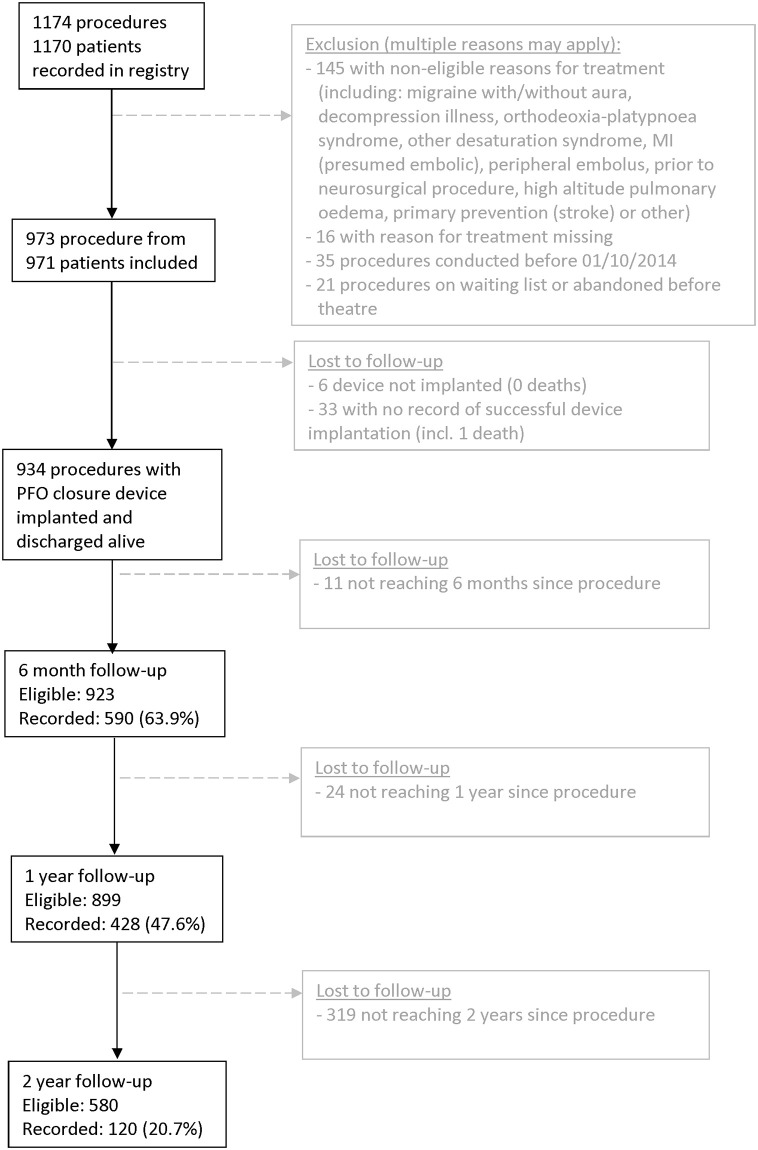
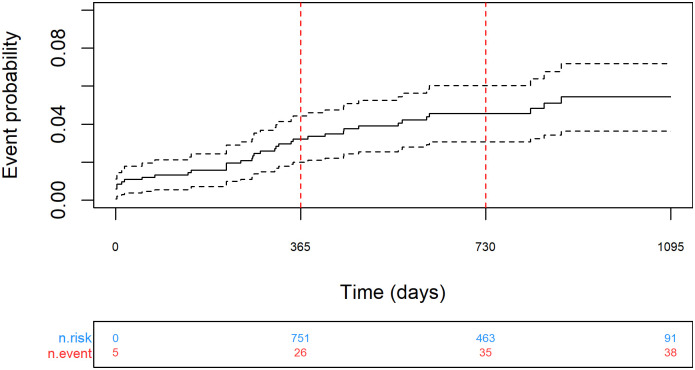
Prospective registry data from patients with cryptogenic stroke eligible for PFO closure were collected for up to 2 years and linked to routine data sources for additional follow-up. Outcomes of interest included procedural success rate, health related quality of life, and longer-term death and neurological event rates. A total of 973 PFO closure procedures in 971 patients were included in analysis. Successful device implantation was achieved in 99.4 [95% CI 98.6 to 99.8]% of procedures, with one in-hospital death. During median follow-up of 758 (Q1:Q3 527:968) days, 33 patients experienced a subsequent neurological event, 76% of which were ischaemic in origin. Neurological event rate was 2.7 [95%CI 1.6 to 3.9]% at 1-year (n = 751) and 4.1 [95% CI 2.6 to 5.5]% at 2-years (n = 463) using Kaplan-Meier analysis. Improvements in patient quality of life (utility and visual analogue scale) were observed at 6-weeks and 6-months follow-up.
Our observational study demonstrates that PFO closure for prevention of recurrent stroke is a relatively safe procedure but in routine clinical practice is associated with a slightly higher risk of recurrent neurological events than in randomised trials. We hypothesize that our study enrolled unselected patients with higher baseline risk, who were excluded from randomised trials, but who may benefit from a similar relative reduction in risk from the intervention.
卵圆孔未闭(PFO)封堵术是一种经皮介入治疗,旨在通过预防反常栓塞来降低复发性卒中的风险。本研究的目的是在英国环境下评估 PFO 封堵术的程序安全性和长期有效性。
前瞻性登记了适合接受 PFO 封堵术的隐源性卒中患者的数据,随访时间最长达 2 年,并与常规数据来源进行了关联以进行额外的随访。主要研究终点包括手术成功率、健康相关生活质量以及长期死亡率和神经事件发生率。共纳入 971 例患者的 973 例 PFO 封堵术,其中 99.4%(95%CI 98.6%至 99.8%)的患者手术成功,1 例院内死亡。中位随访 758 天(IQR 527-968 天)期间,33 例患者发生了后续的神经事件,其中 76%为缺血性事件。采用 Kaplan-Meier 分析,1 年(n=751)和 2 年(n=463)时的神经事件发生率分别为 2.7%(95%CI 1.6%至 3.9%)和 4.1%(95%CI 2.6%至 5.5%)。6 周和 6 个月时观察到患者生活质量(效用和视觉模拟评分)改善。
本观察性研究表明,PFO 封堵术预防复发性卒中相对安全,但在常规临床实践中,与随机试验相比,其复发性神经事件风险略高。我们推测,我们的研究纳入了随机试验排除的基线风险较高的未选择患者,但他们可能从干预中获得类似的相对风险降低获益。