Max Planck Institute for Psycholinguistics, Nijmegen, the Netherlands.
Donders Institute for Brain, Cognition, and Behaviour, Radboud University, Nijmegen, the Netherlands.
PLoS Biol. 2022 Jul 14;20(7):e3001713. doi: 10.1371/journal.pbio.3001713. eCollection 2022 Jul.
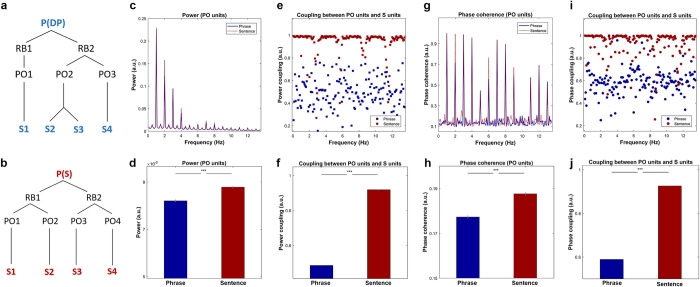
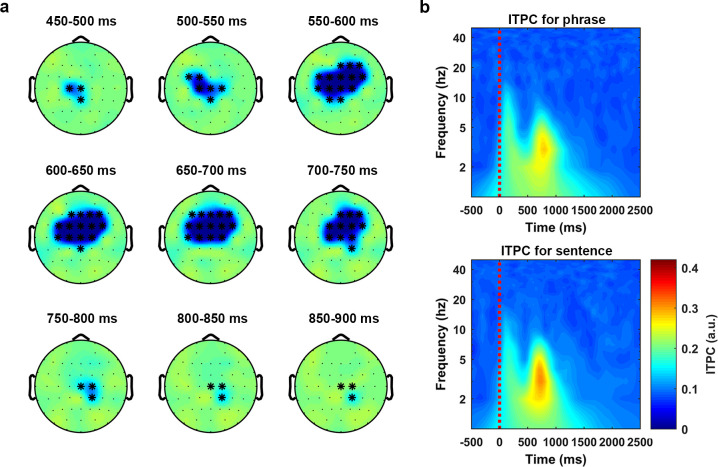
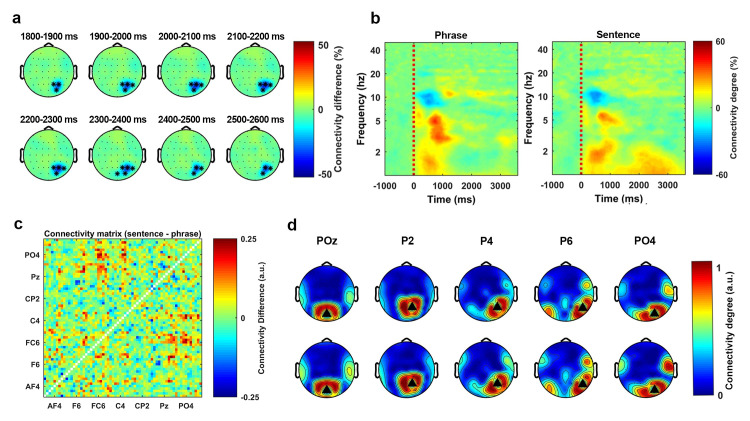
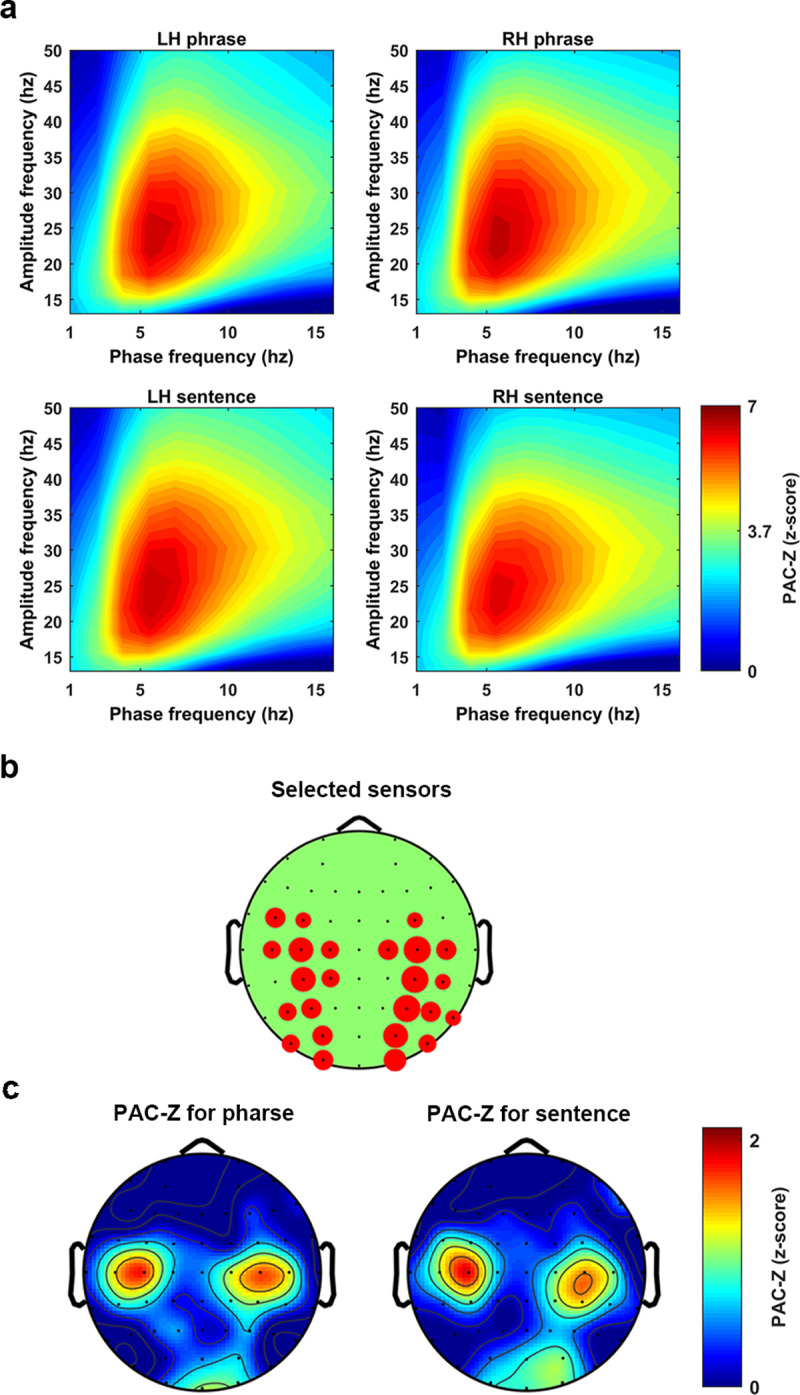
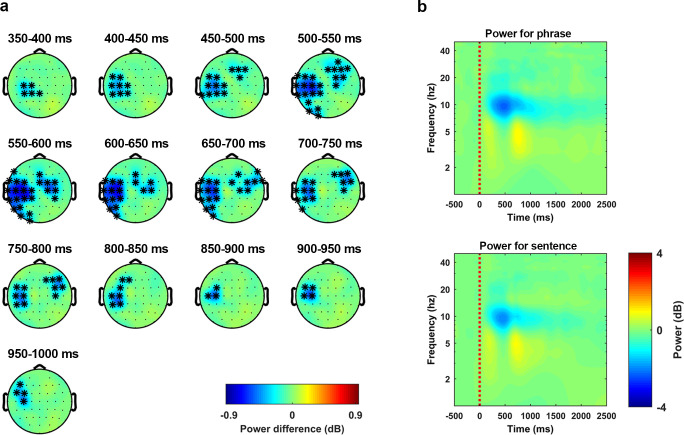
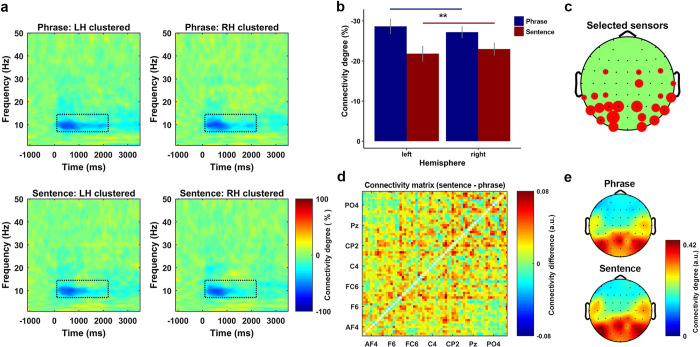
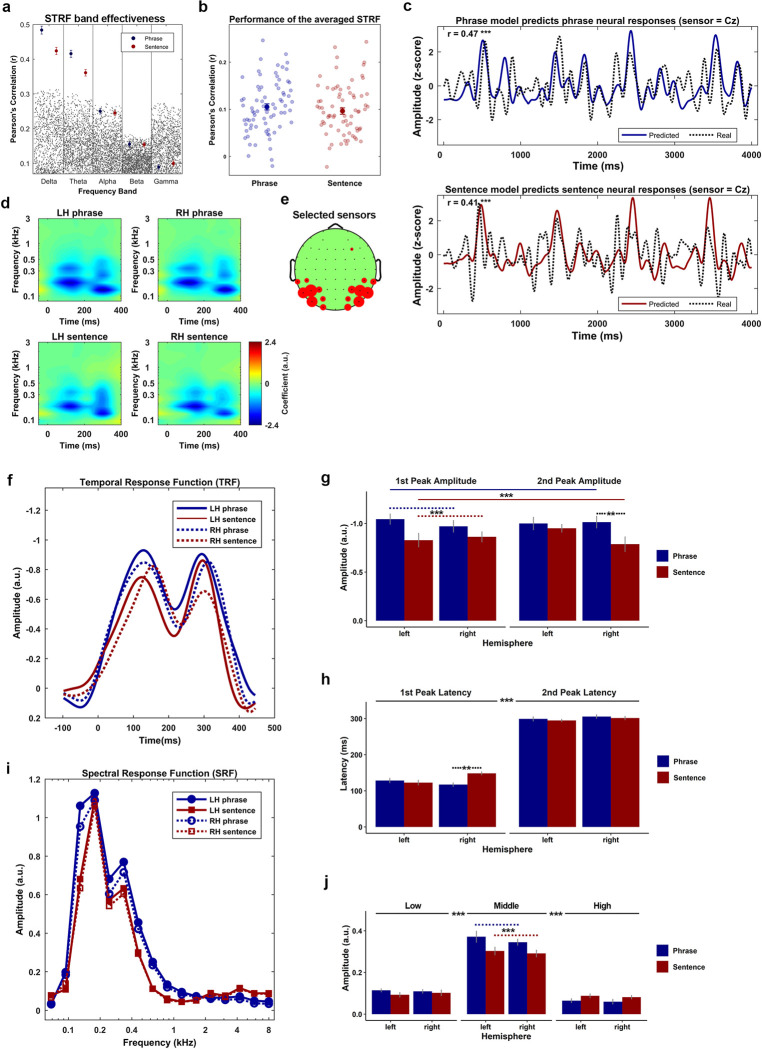
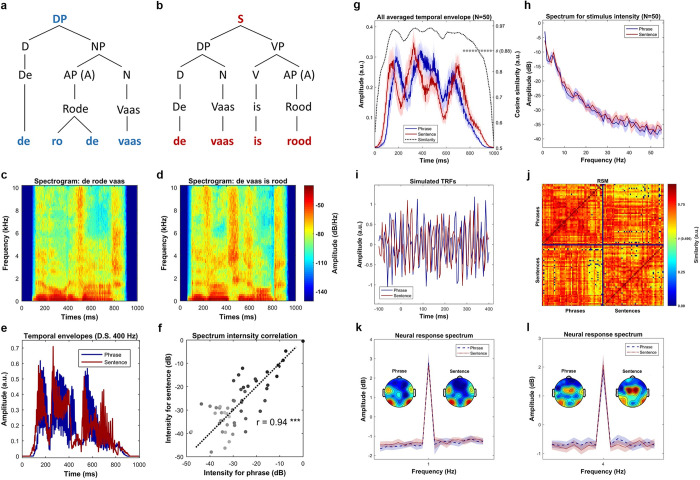
Human language stands out in the natural world as a biological signal that uses a structured system to combine the meanings of small linguistic units (e.g., words) into larger constituents (e.g., phrases and sentences). However, the physical dynamics of speech (or sign) do not stand in a one-to-one relationship with the meanings listeners perceive. Instead, listeners infer meaning based on their knowledge of the language. The neural readouts of the perceptual and cognitive processes underlying these inferences are still poorly understood. In the present study, we used scalp electroencephalography (EEG) to compare the neural response to phrases (e.g., the red vase) and sentences (e.g., the vase is red), which were close in semantic meaning and had been synthesized to be physically indistinguishable. Differences in structure were well captured in the reorganization of neural phase responses in delta (approximately <2 Hz) and theta bands (approximately 2 to 7 Hz),and in power and power connectivity changes in the alpha band (approximately 7.5 to 13.5 Hz). Consistent with predictions from a computational model, sentences showed more power, more power connectivity, and more phase synchronization than phrases did. Theta-gamma phase-amplitude coupling occurred, but did not differ between the syntactic structures. Spectral-temporal response function (STRF) modeling revealed different encoding states for phrases and sentences, over and above the acoustically driven neural response. Our findings provide a comprehensive description of how the brain encodes and separates linguistic structures in the dynamics of neural responses. They imply that phase synchronization and strength of connectivity are readouts for the constituent structure of language. The results provide a novel basis for future neurophysiological research on linguistic structure representation in the brain, and, together with our simulations, support time-based binding as a mechanism of structure encoding in neural dynamics.
人类语言在自然界中脱颖而出,是一种生物信号,它使用结构化系统将小的语言单位(如单词)的含义组合成更大的成分(如短语和句子)。然而,言语(或手语)的物理动态与听众感知到的意义之间并没有一一对应的关系。相反,听众根据他们对语言的了解来推断意义。这些推断所基于的感知和认知过程的神经读出仍然知之甚少。在本研究中,我们使用头皮脑电图(EEG)来比较短语(例如,红色花瓶)和句子(例如,花瓶是红色的)的神经反应,这两个短语在语义上非常接近,并且已经被合成得无法区分。在 delta(约 2 Hz)和 theta 频段(约 2 到 7 Hz)的神经相位反应重新组织中,以及在 alpha 频段(约 7.5 到 13.5 Hz)的功率和功率连接变化中,结构差异得到了很好的捕捉。与计算模型的预测一致,句子比短语表现出更多的功率、更多的功率连接和更多的相位同步。发生了 theta-伽马相位幅度耦合,但在这两种句法结构之间没有差异。光谱时频响应函数(STRF)建模揭示了短语和句子的不同编码状态,超过了神经反应的声学驱动。我们的研究结果提供了一个全面的描述,说明大脑如何在神经反应的动态中对语言结构进行编码和分离。它们表明,相位同步和连接强度是语言组成结构的读出。该结果为未来大脑中语言结构表示的神经生理学研究提供了一个新的基础,并且与我们的模拟一起支持基于时间的绑定作为神经动力学中结构编码的机制。