Center for RNA Biology, The Ohio State University, Columbus, Ohio, USA; Department of Chemistry and Biochemistry, The Ohio State University, Columbus, Ohio, USA.
Center for RNA Biology, The Ohio State University, Columbus, Ohio, USA; Department of Horticulture and Crop Science and Center for Applied Plant Sciences, The Ohio State University, Columbus, Ohio, USA.
J Biol Chem. 2022 Sep;298(9):102255. doi: 10.1016/j.jbc.2022.102255. Epub 2022 Jul 12.
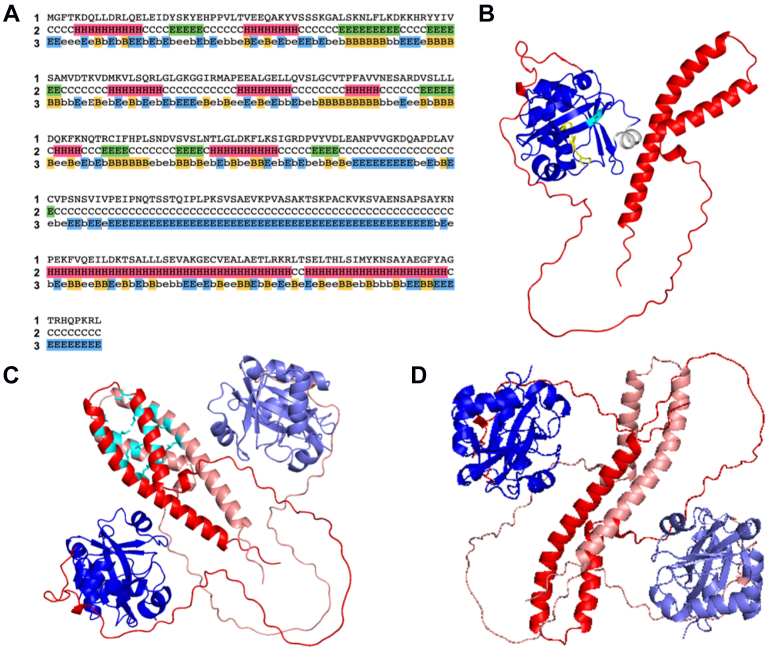
Faithful translation of the genetic code is critical for the viability of all living organisms. The trans-editing enzyme ProXp-ala prevents Pro to Ala mutations during translation by hydrolyzing misacylated Ala-tRNA that has been synthesized by prolyl-tRNA synthetase. Plant ProXp-ala sequences contain a conserved C-terminal domain (CTD) that is absent in other organisms; the origin, structure, and function of this extra domain are unknown. To characterize the plant-specific CTD, we performed bioinformatics and computational analyses that provided a model consistent with a conserved α-helical structure. We also expressed and purified wildtype Arabidopsis thaliana (At) ProXp-ala in Escherichia coli, as well as variants lacking the CTD or containing only the CTD. Circular dichroism spectroscopy confirmed a loss of α-helical signal intensity upon CTD truncation. Size-exclusion chromatography with multiangle laser-light scattering revealed that wildtype At ProXp-ala was primarily dimeric and CTD truncation abolished dimerization in vitro. Furthermore, bimolecular fluorescence complementation assays in At protoplasts support a role for the CTD in homodimerization in vivo. The deacylation rate of Ala-tRNA by At ProXp-ala was also significantly reduced in the absence of the CTD, and kinetic assays indicated that the reduction in activity is primarily due to a tRNA binding defect. Overall, these results broaden our understanding of eukaryotic translational fidelity in the plant kingdom. Our study reveals that the plant-specific CTD plays a significant role in substrate binding and canonical editing function. Through its ability to facilitate protein-protein interactions, we propose the CTD may also provide expanded functional potential for trans-editing enzymes in plants.
忠实翻译遗传密码对于所有生物体的生存能力至关重要。ProXp-ala 转编辑酶通过水解由脯氨酰-tRNA 合成酶合成的错误酰化的 Ala-tRNA 来防止 Pro 到 Ala 突变。植物 ProXp-ala 序列含有保守的 C 端结构域 (CTD),而其他生物体中不存在;这个额外结构域的起源、结构和功能尚不清楚。为了表征植物特异性 CTD,我们进行了生物信息学和计算分析,提供了一个与保守α-螺旋结构一致的模型。我们还在大肠杆菌中表达和纯化了野生型拟南芥 (At) ProXp-ala 以及缺失 CTD 或仅含有 CTD 的变体。圆二色性光谱证实 CTD 截断导致α-螺旋信号强度丧失。多角度激光散射的尺寸排阻色谱表明,野生型 At ProXp-ala 主要是二聚体,并且 CTD 截断在体外消除了二聚化。此外,在 At 原生质体中的双分子荧光互补测定支持 CTD 在体内同源二聚化中的作用。在没有 CTD 的情况下,At ProXp-ala 对 Ala-tRNA 的脱酰基率也显著降低,动力学测定表明活性降低主要是由于 tRNA 结合缺陷。总的来说,这些结果拓宽了我们对植物王国中真核翻译保真度的理解。我们的研究表明,植物特异性 CTD 在底物结合和经典编辑功能中起着重要作用。通过促进蛋白质-蛋白质相互作用的能力,我们提出 CTD 也可能为植物中转编辑酶提供扩展的功能潜力。