Wangler Julian, Jansky Michael
Zentrum für Allgemeinmedizin und Geriatrie, Universitätsmedizin Mainz, Mainz, Germany.
Z Gastroenterol. 2023 Apr;61(4):381-389. doi: 10.1055/a-1852-9822. Epub 2022 Jul 14.
In primary care, elevated liver values are often an incidental finding. In addition to observing symptoms, it is crucial for an effective clarification which liver values are included as indicators and when patients are referred for further diagnostics. It also depends on regular cooperation between general practitioner and specialist care level. So far, there has been a lack of reliable studies for German-speaking countries on the status quo with regard to the clarification of (unclear) elevated liver values in primary care. This overview article compresses the balance of an exploratory series of studies, the aim of which was to take stock of the general practitioner's diagnostics of (unclear) elevated liver values. Starting points for optimizing GP care are derived from the results.
Between 2017 and 2021, four written surveys of general practitioners and gastroenterological specialists were carried out in different federal states. The present study review discusses the overall findings in a condensed manner at a higher level, but also deals with specific findings.
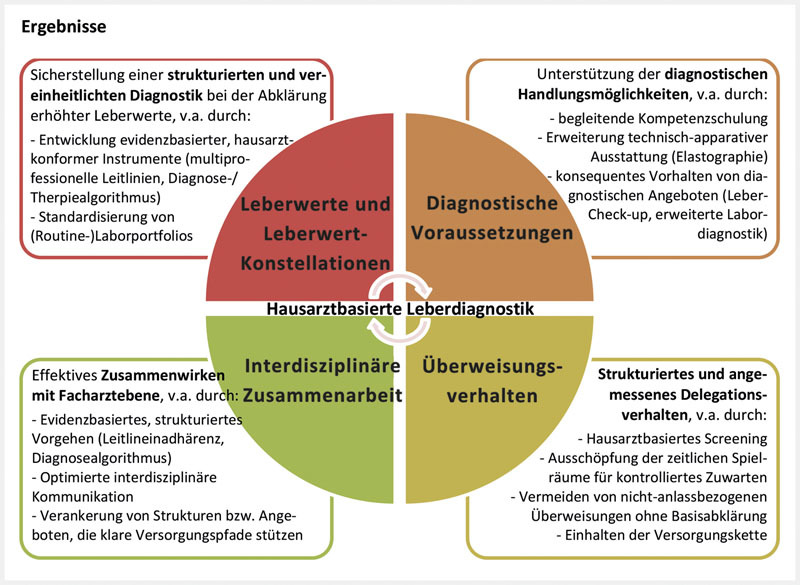
When it comes to clarifying elevated liver values, there are various challenges and problems in general practitioner care. For example, GPs use widely different liver-associated laboratory parameters (95% γ-GT, 65% AST, 63% ALT) that are bundled in different clusters. In the case of elevated liver values, the majority of general practitioners prefer to wait in a controlled manner (66%), but often make use of direct and early referrals to specialists in everyday practice due to diagnostic uncertainties (40%). When working with gastroenterological specialists, there are various interface problems, which, among other things, are associated with the GP's preliminary clarification and the time of referral. Both GPs and specialists see the introduction of a structured, evidence-based diagnostic algorithm as an important approach for improving early detection and better coordination between the levels of care (80% respective 85%).
It makes sense to take measures that contribute to the professionalization and standardization of general practitioner diagnostics and better structure cooperation with gastroenterological specialists. These include, for example, a broader range of training and advanced training formats, the development of a validated diagnostic pathway or the permanent establishment of a liver value-associated blood test as part of the check-up. The development of a well-founded GP-based guideline for the detection and handling of elevated liver values also appears advisable.
在初级医疗保健中,肝功能指标升高常常是偶然发现的。除了观察症状外,明确哪些肝功能指标作为指标以及何时将患者转诊进行进一步诊断对于有效诊断至关重要。这还取决于全科医生与专科护理层面之间的定期合作。到目前为止,对于德语国家初级医疗保健中(不明原因的)肝功能指标升高的现状,缺乏可靠的研究。这篇综述文章总结了一系列探索性研究的情况,其目的是评估全科医生对(不明原因的)肝功能指标升高的诊断。从研究结果中得出了优化全科医疗保健的切入点。
2017年至2021年期间,在不同联邦州对全科医生和胃肠病学专家进行了四项书面调查。本研究综述以浓缩的方式在更高层面讨论了总体研究结果,同时也涉及具体研究结果。
在明确肝功能指标升高方面,全科医疗保健存在各种挑战和问题。例如,全科医生使用广泛不同的肝脏相关实验室参数(95%的γ-谷氨酰转移酶、65%的天冬氨酸氨基转移酶、63%的丙氨酸氨基转移酶),这些参数被归为不同类别。在肝功能指标升高的情况下,大多数全科医生倾向于以可控的方式等待(66%),但由于诊断存在不确定性,在日常实践中他们也经常直接且尽早地将患者转诊给专科医生(40%)。在与胃肠病学专家合作时,存在各种衔接问题,其中包括与全科医生的初步诊断以及转诊时间有关的问题。全科医生和专科医生都认为引入结构化的、基于证据的诊断算法是改善早期检测和不同护理层面之间更好协调的重要方法(分别为80%和85%)。
采取有助于全科医生诊断专业化和标准化以及更好地构建与胃肠病学专家合作的措施是有意义的。这些措施包括,例如,更广泛的培训和进修形式、制定经过验证的诊断路径或作为体检一部分长期开展与肝功能指标相关的血液检测。制定基于全科医生的、有充分依据的检测和处理肝功能指标升高的指南似乎也是可取的。