Department of Otolaryngology Head & Neck Surgery, West China Hospital, Sichuan University, 37 E Guoxue Alley, Chengdu, Sichuan, 610041, People's Republic of China.
BMC Med Educ. 2022 Jul 14;22(1):542. doi: 10.1186/s12909-022-03612-3.
Clinical skill training (CST) is indispensable for first-year surgical residents. It can usually be carried out through video-based flipped learning (FL) within a web-based learning environment. However, we found that residents lack the process of reflection, blindly imitating results in losing interest and passion for learning in the traditional teaching pattern. The teaching method of "spot the difference" (SDTM), which is based on the fundamentals of the popular game of "spot the difference," is designed to improve students' participation and reflective learning during skill training. This study aimed to evaluate this novel educational model's short-term and long-term effectiveness for surgical residents in China.
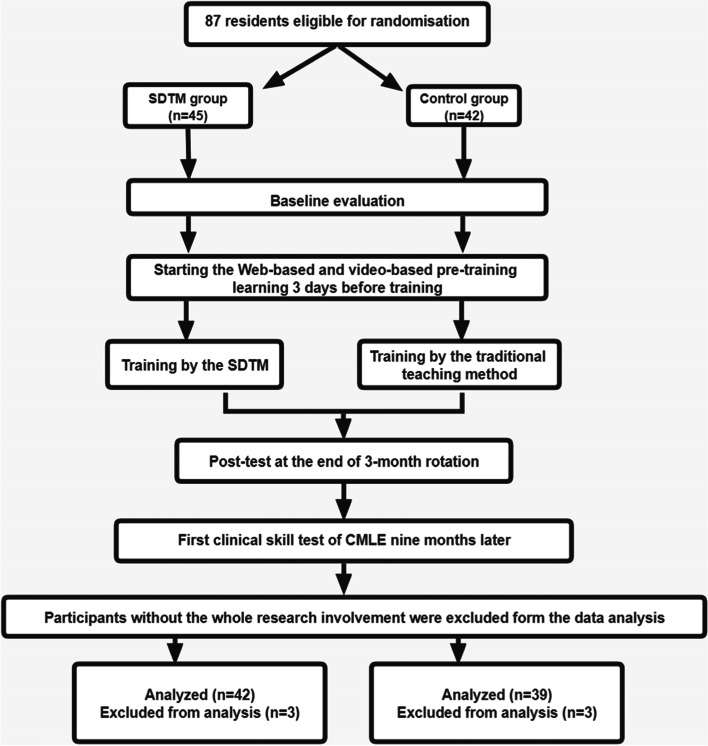
First-year residents who required a three-month rotation in the head and neck surgery department were recruited to participate in a series of CSTs. They were randomized into SDTM and traditional FL (control) groups. Clinical skill performance was assessed with validated clinical skill scoring criteria. Evaluations were conducted by comparing the scores that contain departmental rotation skill examinations and the first China medical licensing examination (CMLE) performance on practical skills. In addition, two-way subjective evaluations were also implemented as a reference for the training results. Training effects were assessed using t tests, Mann-Whitney-Wilcoxon tests, chi-square tests, and Cohen' s effect size (d). The Cohen' s d value was considered to be small (<0.2), medium (0.2-0.8), or large (>0.8).
The SDTM group was significantly superior to the control group in terms of after-department skill examination (t=2.179, p<0.05, d=0.5), taking medical history (t=2.665, p<0.05, d=0.59), and CMLE performance on practical skill (t=2.103, p<0.05, d=0.47). The SDTM members rated the curriculum more highly than the control on the items relating to interestingness and participation (p < 0.05) with large effect sizes (d >0.8). There were no significant differences between the two groups on clinical competence (t=0.819, p=0.415, d=0.18), the first-time pass rate for CMLE (χ2 =1.663, p=0.197, d=0.29), and short-term operational skills improvement (t=1.747, p=0.084, d=0.39).
SDTM may be an effective method for enhancing residents' clinical skills, and the effect is significant both short- and long-term. The improvement effect seemed to be more significant in the peer-involved SDTM than training alone. However, despite positive objective results, SDTM still risks student learning burnout.
ISRCTN registry, ISRCTN10598469 , 02/04/2022,retrospectively registered.
临床技能培训(CST)对于第一年的外科住院医师来说是必不可少的。它通常可以通过基于网络的学习环境中的基于视频的翻转学习(FL)来进行。然而,我们发现住院医师缺乏反思过程,盲目模仿导致他们对传统教学模式的学习失去兴趣和热情。“找出不同”(SDTM)的教学方法是基于广受欢迎的“找出不同”游戏的基础设计的,旨在提高学生在技能培训过程中的参与度和反思学习能力。本研究旨在评估这种新的教育模式对中国外科住院医师的短期和长期效果。
需要在头颈外科部门进行为期三个月轮转的第一年住院医师被招募参加一系列 CST。他们被随机分为 SDTM 和传统 FL(对照组)组。临床技能表现采用经过验证的临床技能评分标准进行评估。通过比较部门轮转技能考试和第一次中国医师资格考试(CMLE)实践技能成绩来评估临床技能表现。此外,还进行了双向主观评估,作为培训结果的参考。使用 t 检验、Mann-Whitney-Wilcoxon 检验、卡方检验和 Cohen' s 效应量(d)来评估培训效果。Cohen' s d 值被认为是小(<0.2)、中(0.2-0.8)或大(>0.8)。
SDTM 组在部门后技能考试(t=2.179,p<0.05,d=0.5)、采集病史(t=2.665,p<0.05,d=0.59)和 CMLE 实践技能考试成绩(t=2.103,p<0.05,d=0.47)方面明显优于对照组。SDTM 组成员对课程的趣味性和参与性评价更高(p<0.05),具有较大的效应量(d>0.8)。两组在临床能力(t=0.819,p=0.415,d=0.18)、CMLE 首次通过率(χ2=1.663,p=0.197,d=0.29)和短期操作技能提高方面(t=1.747,p=0.084,d=0.39)无显著差异。
SDTM 可能是一种提高住院医师临床技能的有效方法,其效果无论是短期还是长期都是显著的。在涉及同伴参与的 SDTM 中,改善效果似乎更为明显。然而,尽管客观结果积极,但 SDTM 仍存在学生学习倦怠的风险。
ISRCTN 注册中心,ISRCTN8469,2022 年 4 月 2 日,回顾性注册。