Triolo Federico, Saadeh Marguerita, Sjöberg Linnea, Fratiglioni Laura, Welmer Anna-Karin, Calderón-Larrañaga Amaia, Dekhtyar Serhiy
Aging Research Center, Department of Neurobiology, Care Sciences and Society, Karolinska Institutet and Stockholm University, Solna, Sweden.
Innov Aging. 2022 Jun 9;6(5):igac041. doi: 10.1093/geroni/igac041. eCollection 2022.
The coronavirus disease 2019 (COVID-19) pandemic, as well as the measures intended to limit its spread, have likely affected older adults' depressive burden. Good physical functioning and a rich social network may benefit older adults' mental health. We examined whether pre-pandemic physical functioning and social network were associated with depressive burden during the first wave of the COVID-19 pandemic in Stockholm, Sweden.
A telephone assessment of depressive burden using the symptoms of sadness, anxiety, worrying, reduced sleep, and reduced appetite was conducted in May-September 2020 in 930 older adults from the Swedish National Study on Aging and Care in Kungsholmen (SNAC-K), an ongoing population-based study. Objective measures of gait speed, muscle strength, and balance; and self-reports of social connections and support were collected in 2016-2019. Logistic models were adjusted for sociodemographic, clinical, lifestyle, and pandemic-related factors (loneliness, change in physical and social engagement, and experience of death due to COVID-19).
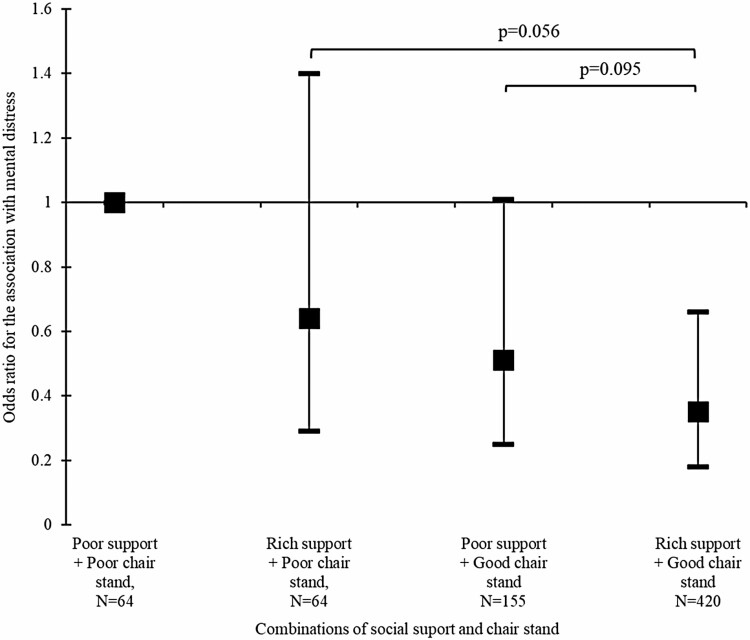
Only good muscle strength (odds ratio [OR]: 0.53; 95% confidence interval [CI]: 0.32-0.85; ref: poor strength, ≥17 s) and rich social support (OR: 0.67; 95% CI: 0.45-0.99; ref: poor support) exhibited an independent association with depressive burden, even after accounting for pandemic-related factors. A combination of good muscle strength and rich social support were associated with the greatest reduction in depressive burden (OR: 0.35; 95% CI: 0.18-0.66; ref: poor social support and poor muscle strength).
Prepandemic social support and muscle strength could supply older adults with resilience against the depressive burden associated with the COVID-19 pandemic.
2019年冠状病毒病(COVID-19)大流行以及旨在限制其传播的措施,可能影响了老年人的抑郁负担。良好的身体功能和丰富的社交网络可能有益于老年人的心理健康。我们研究了在瑞典斯德哥尔摩COVID-19大流行第一波期间,大流行前的身体功能和社交网络是否与抑郁负担相关。
2020年5月至9月,对来自瑞典 Kungsholmen 地区老龄化与护理全国性研究(SNAC-K)的930名老年人进行了电话评估,使用悲伤、焦虑、担忧、睡眠减少和食欲减退等症状来评估抑郁负担,该研究是一项正在进行的基于人群的研究。在2016 - 2019年收集了步态速度、肌肉力量和平衡的客观测量数据,以及社交联系和支持的自我报告。逻辑模型针对社会人口统计学、临床、生活方式和与大流行相关的因素(孤独感、身体和社交活动的变化以及因COVID-19导致的死亡经历)进行了调整。
即使在考虑了与大流行相关的因素后,只有良好的肌肉力量(优势比[OR]:0.53;95%置信区间[CI]:0.32 - 0.85;对照:力量差,≥17秒)和丰富的社会支持(OR:0.67;95% CI:0.45 - 0.99;对照:支持差)与抑郁负担呈现独立关联。良好的肌肉力量和丰富的社会支持相结合与抑郁负担的最大程度降低相关(OR:0.35;95% CI:0.18 - 0.66;对照:社会支持差且肌肉力量差)。
大流行前的社会支持和肌肉力量可以为老年人提供抵御与COVID-19大流行相关的抑郁负担的恢复力。