Department of Allied Health Sciences, 66971University of Sargodha, Sargodha, Pakistan.
Department of Biochemistry, 66920University of Veterinary and Animal Sciences, Lahore, (Jhang Campus) Pakistan.
Int J Immunopathol Pharmacol. 2022 Jan-Dec;36:3946320221115316. doi: 10.1177/03946320221115316.
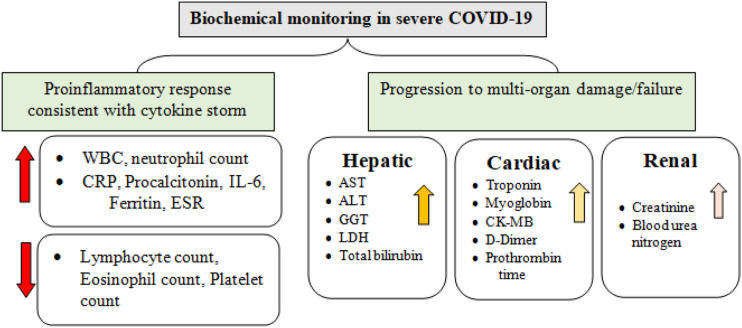
COVID-19, a novel coronavirus disease, has provoked a variety of health and safety concerns, and socioeconomic challenges around the globe. The laboratory diagnosis of SARS-CoV-2 was quickly established utilizing nucleic acid amplification techniques (NAAT) after the disease causing virus has been identified, and its genetic sequence has been determined. In addition to NAAT, serological tests based on antibodies testing against SARS-CoV-2 were introduced for diagnostic and epidemiologic studies. Other biochemical investigations include monitoring of peripheral blood cells count, platelets/lymphocyte ratio, coagulation profile, cardiac, and inflammatory markers such as cytokines storm are also crucial in combating COVID-19 pandemic. Further, accurate and reliable laboratory results for SARS-CoV-2 play very important role in the initiation of early treatment and timely management of COVID-19 patients, provide support in clinical decision-making process to control infection, and detection of asymptomatic cases. The Task Force on Coronavirus-19 constituted by International Federation of Clinical Chemistry and Laboratory Medicine (IFCC) has recognized informational framework for epidemiology, pathogenesis, and recommended the PCR-based analysis, serological and biochemical assays for analysis, monitoring, and management of disease. This literature review provides an overview of the currently used diagnostic techniques in clinical laboratories for the diagnosis, treatment monitoring, and management of COVID-19 patients. We concluded that each assays differ in their performance characteristics and the utilization of multiple techniques is necessary for the accurate diagnosis and management of SARS-CoV-2 infection.
新型冠状病毒病(COVID-19)引发了全球范围内的各种健康和安全问题,以及社会经济挑战。在确定致病病毒并确定其遗传序列后,迅速利用核酸扩增技术(NAAT)建立了对 SARS-CoV-2 的实验室诊断。除了 NAAT 外,还引入了基于针对 SARS-CoV-2 的抗体检测的血清学检测,用于诊断和流行病学研究。其他生化研究包括监测外周血细胞计数、血小板/淋巴细胞比值、凝血谱、心脏和炎症标志物(如细胞因子风暴),在对抗 COVID-19 大流行方面也至关重要。此外,SARS-CoV-2 的准确可靠的实验室结果在启动 COVID-19 患者的早期治疗和及时管理中起着非常重要的作用,为控制感染和检测无症状病例提供了临床决策过程的支持。国际临床化学和实验室医学联合会(IFCC)成立的冠状病毒-19 工作组已经认识到用于流行病学、发病机制的信息框架,并推荐基于 PCR 的分析、血清学和生化分析用于分析、监测和管理疾病。本文综述了目前临床实验室用于诊断、治疗监测和管理 COVID-19 患者的诊断技术。我们得出结论,每种检测方法在性能特征上有所不同,需要多种技术的联合使用,以实现 SARS-CoV-2 感染的准确诊断和管理。