GEOMAR Helmholtz Centre for Ocean Research Kiel, Kiel, Germany.
National Oceanography Centre, European Way, Southampton, SO14 3ZH, UK.
Sci Data. 2022 Jul 15;9(1):414. doi: 10.1038/s41597-022-01491-3.
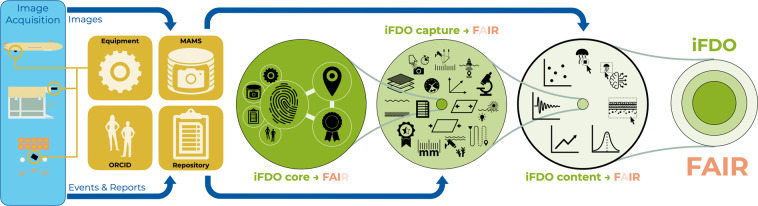
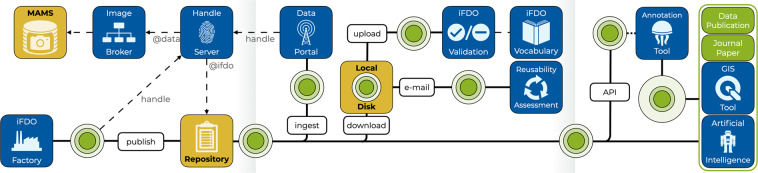
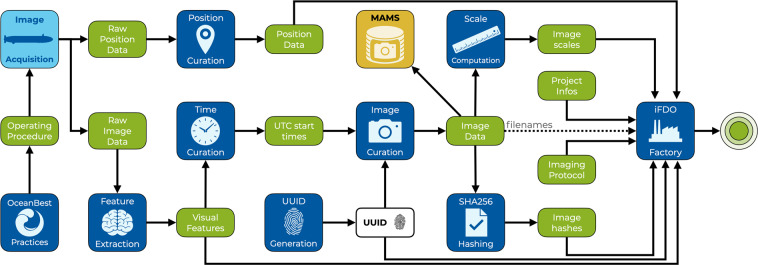
Underwater images are used to explore and monitor ocean habitats, generating huge datasets with unusual data characteristics that preclude traditional data management strategies. Due to the lack of universally adopted data standards, image data collected from the marine environment are increasing in heterogeneity, preventing objective comparison. The extraction of actionable information thus remains challenging, particularly for researchers not directly involved with the image data collection. Standardized formats and procedures are needed to enable sustainable image analysis and processing tools, as are solutions for image publication in long-term repositories to ascertain reuse of data. The FAIR principles (Findable, Accessible, Interoperable, Reusable) provide a framework for such data management goals. We propose the use of image FAIR Digital Objects (iFDOs) and present an infrastructure environment to create and exploit such FAIR digital objects. We show how these iFDOs can be created, validated, managed and stored, and which data associated with imagery should be curated. The goal is to reduce image management overheads while simultaneously creating visibility for image acquisition and publication efforts.
水下图像被用于探索和监测海洋栖息地,生成具有异常数据特征的大型数据集,这些特征排除了传统的数据管理策略。由于缺乏普遍采用的数据标准,从海洋环境中收集的图像数据的异质性不断增加,从而无法进行客观比较。因此,提取可操作的信息仍然具有挑战性,特别是对于那些不直接参与图像数据收集的研究人员来说。需要标准化的格式和程序,以支持可持续的图像分析和处理工具,以及用于长期存储库中图像发布的解决方案,以确保数据的重复使用。FAIR 原则(可查找、可访问、可互操作、可重用)为实现这些数据管理目标提供了一个框架。我们建议使用图像 FAIR 数字对象(iFDO),并展示了创建和利用此类 FAIR 数字对象的基础环境。我们展示了如何创建、验证、管理和存储这些 iFDO,以及应该策展与图像相关的数据。目标是在减少图像管理开销的同时,同时提高图像采集和发布工作的可见度。