Medical Physics Unit, IRCCS Istituto Romagnolo per lo Studio dei Tumori (IRST) "Dino Amadori", Meldola, Italy.
Scientific Directorate, IRCCS Istituto Romagnolo per lo Studio dei Tumori (IRST) "Dino Amadori", Meldola, Italy.
Sci Data. 2022 Jul 15;9(1):412. doi: 10.1038/s41597-022-01535-8.
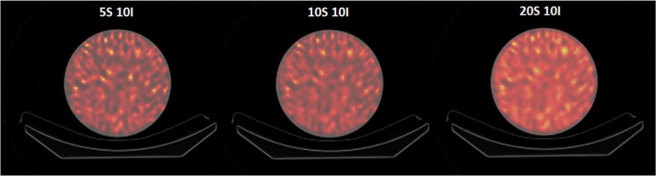
In a clinical contest, it is common to use dedicated phantoms to perform quality assurance test to check the performance of a SPECT system. Some of these phantoms are also used to calibrate the system for dosimetric evaluation of patients undergoing radiometabolic cancer therapy. In this work, a 3D-OSEM reconstructed Lu SPECT dataset of a homogeneous cylindrical phantom is described. This dataset was acquired to investigate the variation of the SPECT calibration factor, counts convergence, noise and uniformity by varying the number of subsets and iterations. In particular, the dataset is composed of images reconstructed using five different numbers of subsets and sixteen different numbers of iterations, for a total of 80 different configurations. The dataset is suitable for comparison with other reconstruction algorithms (e.g. FBP, MLEM, etc.) and radionuclides (e.g. technetium, yttrium). In regards to the uniformity issue, the same dataset allows the user to perform radiomic investigations on the influence of the border effect on the reconstructed images.
在临床竞赛中,通常使用专用的体模来进行质量保证测试,以检查 SPECT 系统的性能。其中一些体模还用于对接受放射性代谢癌症治疗的患者进行剂量学评估的系统校准。在这项工作中,描述了一个同质圆柱形体模的 3D-OSEM 重建 Lu SPECT 数据集。该数据集是为了通过改变子集数量和迭代次数来研究 SPECT 校准因子、计数收敛、噪声和均匀性的变化而采集的。特别是,该数据集由使用五个不同子集数量和十六个不同迭代次数重建的图像组成,共有 80 种不同的配置。该数据集适用于与其他重建算法(例如 FBP、MLEM 等)和放射性核素(例如锝、钇)进行比较。至于均匀性问题,同一数据集允许用户对重建图像的边界效应对其的影响进行放射组学研究。