Translational Research Center in Onco-Hematology, Faculty of Medicine, University of Geneva, Geneva, Switzerland.
Swiss Cancer Center Léman, Geneva and Lausanne, Switzerland.
BMC Cancer. 2022 Jul 15;22(1):772. doi: 10.1186/s12885-022-09820-w.
Reshaping the tumor microenvironment by novel immunotherapies represents a key strategy to improve cancer treatment. Nevertheless, responsiveness to these treatments is often correlated with the extent of T cell infiltration at the tumor site. Remarkably, microsatellite stable rectal cancer is characterized by poor T cell infiltration and, therefore, does not respond to immune checkpoint blockade. To date, the only available curative option for these patients relies on extensive surgery. With the aim to broaden the application of promising immunotherapies, it is necessary to develop alternative approaches to promote T cell infiltration into the tumor microenvironment of these tumors. In this regard, recent evidence shows that radiotherapy has profound immunostimulatory effects, hinting at the possibility of combining it with immunotherapy. The combination of long-course chemoradiotherapy and immune checkpoint inhibition was recently shown to be safe and yielded promising results in rectal cancer, however short-course radiotherapy and immune checkpoint inhibition have never been tested in these tumors.
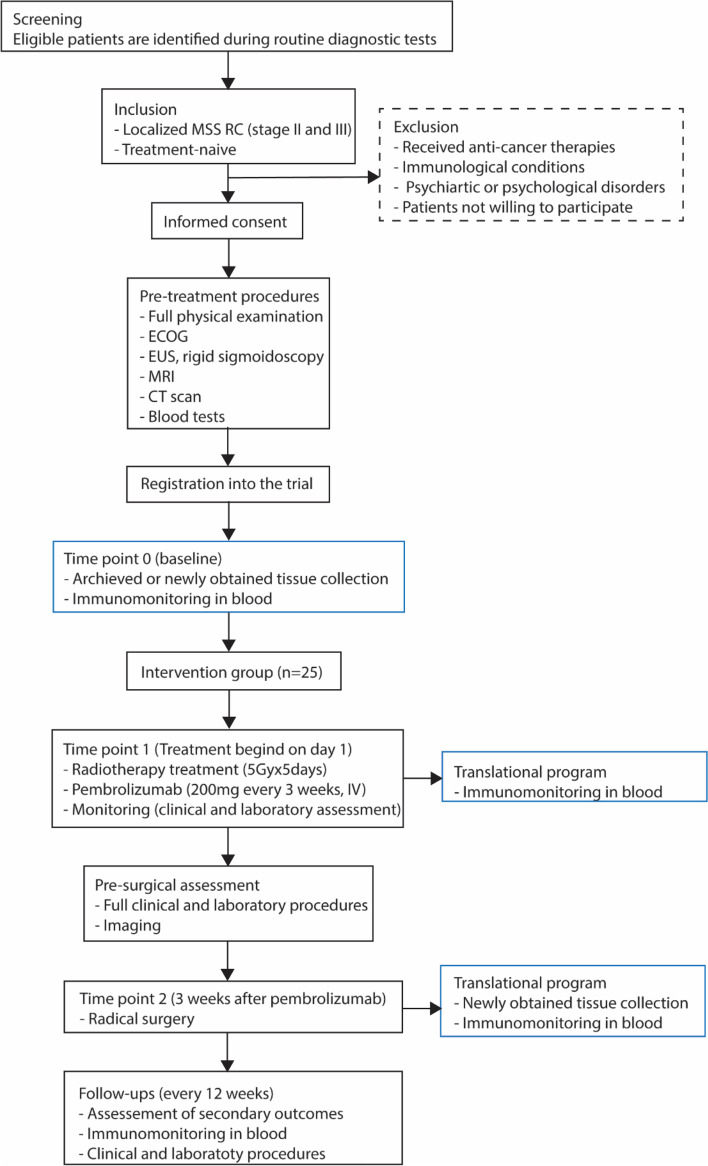
Our clinical trial investigates the clinical and biological impact of combining pembrolizumab with short-course radiotherapy in the neo-adjuvant treatment of localized rectal cancer. This phase II non-randomized study will recruit 25 patients who will receive short-course preoperative radiotherapy (5 Gy × 5 days) and four injections of pembrolizumab starting on the same day and on weeks 4, 7 and 10. Radical surgery will be performed three weeks after the last pembrolizumab injection. Our clinical trial includes an extensive translational research program involving the transcriptomic and proteomic analysis of tumor and blood samples throughout the course of the treatment.
Our study is the first clinical trial to combine short-course radiotherapy and immune checkpoint inhibition in rectal cancer, which could potentially result in a major breakthrough in the treatment of this cancer. Additionally, the translational research program will offer insights into immunological changes within the tumor and blood and their correlation with patient outcome. Taken together, our work will help optimizing future treatment combinations and, possibly, better selecting patients.
This study was registered with www.
gov : NCT04109755 . Registration date: June, 2020.
通过新型免疫疗法重塑肿瘤微环境是改善癌症治疗的关键策略。然而,这些治疗的反应性通常与肿瘤部位 T 细胞浸润的程度相关。值得注意的是,微卫星稳定的直肠癌的特点是 T 细胞浸润不良,因此对免疫检查点阻断无反应。迄今为止,这些患者唯一可行的治愈选择依赖于广泛的手术。为了扩大有前途的免疫疗法的应用,有必要开发替代方法来促进这些肿瘤肿瘤微环境中的 T 细胞浸润。在这方面,最近的证据表明放射治疗具有深远的免疫刺激作用,暗示了将其与免疫疗法联合使用的可能性。长程放化疗和免疫检查点抑制联合最近被证明在直肠癌中是安全的,并取得了有希望的结果,然而短程放疗和免疫检查点抑制从未在这些肿瘤中进行过测试。
我们的临床试验研究了在局部直肠癌的新辅助治疗中联合使用派姆单抗和短程放疗的临床和生物学影响。这项 II 期非随机研究将招募 25 名患者,他们将接受短程术前放疗(5 Gy×5 天)和 4 次派姆单抗注射,从同一天开始,分别在第 4、7 和 10 周进行。最后一次派姆单抗注射后三周将进行根治性手术。我们的临床试验包括一个广泛的转化研究计划,涉及整个治疗过程中肿瘤和血液样本的转录组和蛋白质组分析。
我们的研究是首例在直肠癌中联合短程放疗和免疫检查点抑制的临床试验,这可能会在治疗这种癌症方面取得重大突破。此外,转化研究计划将提供对肿瘤和血液内免疫变化及其与患者预后相关性的深入了解。总的来说,我们的工作将有助于优化未来的治疗组合,并可能更好地选择患者。
本研究在 www. 上注册。
gov:NCT04109755。注册日期:2020 年 6 月。