Breast Imaging fellow 2017-2018, Former University of Ottawa, Now Annecy, France.
Breast Imaging fellow 2016-2017, Former University of Ottawa, Now Dubai, United Arab Emirates.
BMC Cancer. 2022 Jul 15;22(1):774. doi: 10.1186/s12885-022-09792-x.
Abbreviated breast MRI (A-MRI) substantially reduces the image acquisition and reading times and has been reported to have similar diagnostic accuracy as a full diagnostic protocol but has not been evaluated prospectively with respect to impact on psychological distress in women with a prior history of breast cancer (PHBC). This study aimed to determine if surveillance mammography (MG) plus A-MRI reduced psychological distress and if A-MRI improved cancer detection rates (CDR) as compared to MG alone.
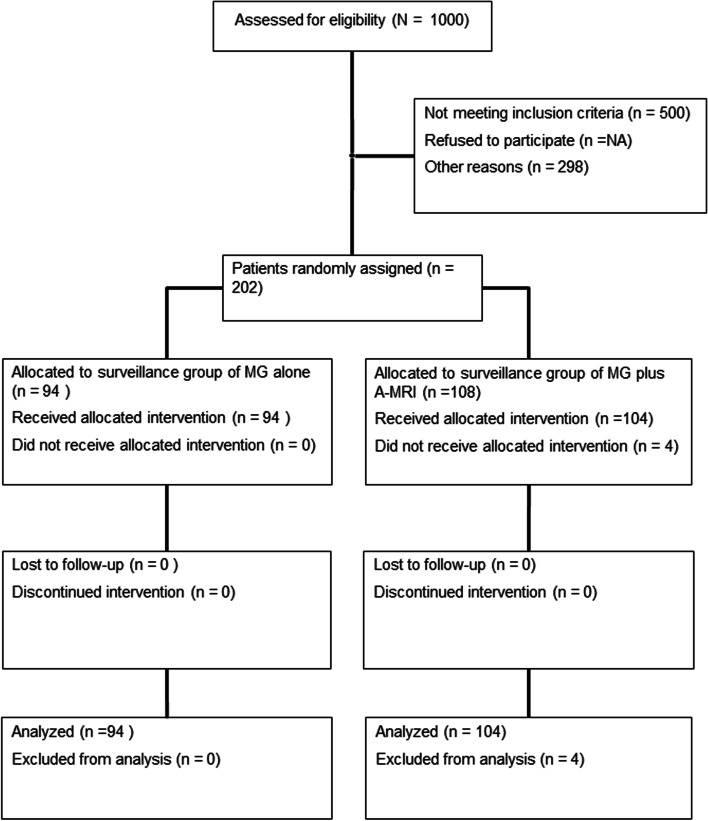
This prospective controlled trial of parallel design was performed at a tertiary cancer center on asymptomatic women with PHBC who were randomized into two groups: routine surveillance with MG or intervention of MG plus A-MRI in a 1:1 ratio. Primary outcome was anxiety measured by four validated questionnaires at three different time-points during the study. Other parameters including CDR and positive predictive value for biopsy (PPV3) were compared between imaging modalities of MG and A-MRI. Tissue diagnoses or 1 year of follow-up were used to establish the reference standard. Linear mixed models were used to analyze anxiety measures and Fisher's exact test to compare imaging outcomes.
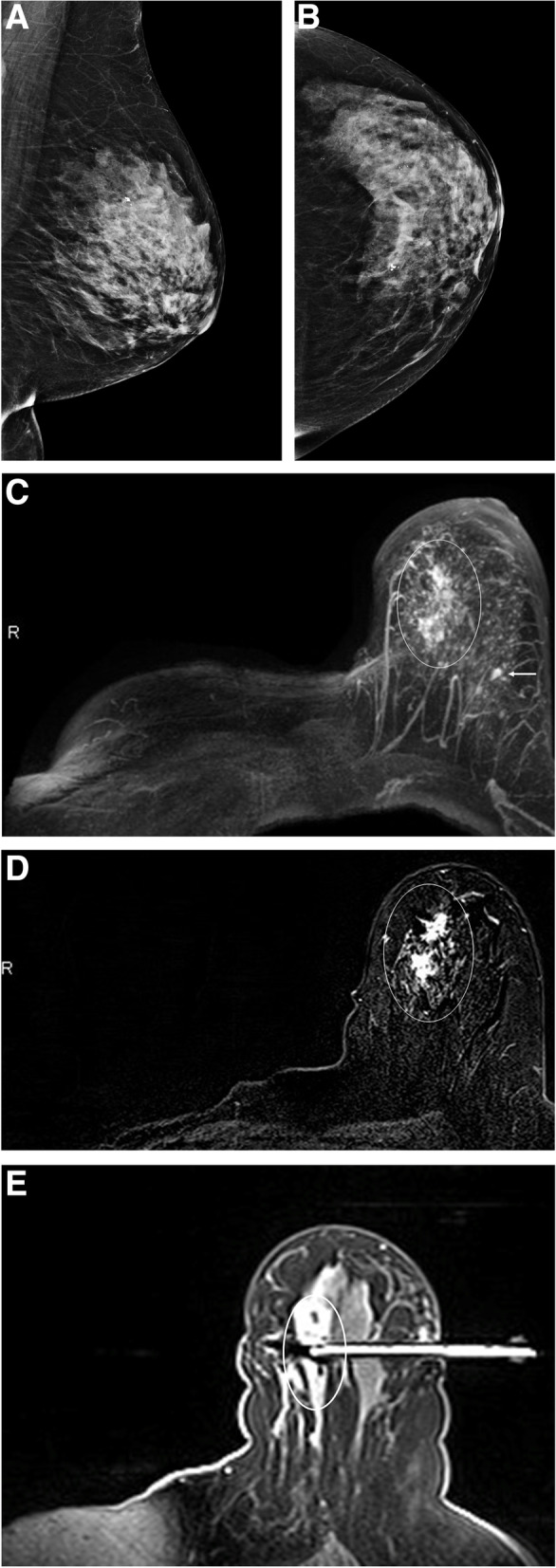
One hundred ninety-eight patients were allocated to either MG alone (94) or MG plus A-MRI (104). No significant group difference emerged for improvement in trait anxiety, worry and perceived health status (all Time-by-surveillance group interaction ps > .05). There was some advantage of A-MRI in reducing state anxiety at Time 2 (p < .05). Anxiety scores in all questionnaires were similarly elevated in both groups (50.99 ± 4.6 with MG alone vs 51.73 ± 2.56 with MG plus A-MRI, p > 0.05) and did not change over time. A-MRI detected 5 invasive cancers and 1 ductal carcinoma in situ (DCIS), and MG detected 1 DCIS. A-MRI had higher incremental CDR (48/1000(5/104) vs MG 5/1000(1/198, p = 0.01)) and higher biopsy rates (19.2% (20/104) vs MG 2.1% (2/94), p < 0.00001) with no difference in PPV3 (A-MRI 28.6% (6/21) vs MG 16.7% (1/6, p > .05).
There was no significant impact of A-MRI to patient anxiety or perceived health status. Compared to MG alone, A-MRI had significantly higher incremental cancer detection in PHBC. Despite a higher rate of biopsies, A-MRI had no demonstrable impact on anxiety, worry, and perceived health status.
ClinicalTrials.gov ( NCT02244593 ). Prospectively registered on Sept. 14, 2014.
缩短式乳腺磁共振成像(A-MRI)可大幅减少图像采集和阅读时间,且已证实其诊断准确性与完整诊断方案相当,但尚未前瞻性评估其对有乳腺癌病史(PHBC)女性的心理困扰的影响。本研究旨在确定与单独进行乳腺 X 线摄影术(MG)相比,MG 联合 A-MRI 是否能降低心理困扰,以及 A-MRI 是否能提高癌症检出率(CDR)。
本前瞻性对照平行设计试验在一家三级癌症中心进行,纳入了无症状、有 PHBC 的女性,按 1:1 比例随机分为两组:MG 常规监测组或 MG 联合 A-MRI 干预组。主要结局为在研究的三个不同时间点通过四个经验证的问卷评估焦虑。比较 MG 和 A-MRI 两种影像学方法的 CDR 和活检的阳性预测值(PPV3)等其他参数。组织诊断或 1 年随访用于建立参考标准。采用线性混合模型分析焦虑测量值,采用 Fisher 确切检验比较影像学结果。
198 例患者被分配至 MG 单独组(94 例)或 MG 联合 A-MRI 组(104 例)。两组在特质焦虑、担忧和感知健康状况的改善方面均无显著差异(所有时间-监测组交互作用 P 值均>0.05)。A-MRI 在第 2 时间点降低状态焦虑方面具有一定优势(P<0.05)。所有问卷的焦虑评分在两组中均相似升高(MG 单独组为 50.99±4.6,MG 联合 A-MRI 组为 51.73±2.56,P>0.05),且随时间无变化。A-MRI 检出 5 例浸润性癌和 1 例导管原位癌(DCIS),MG 检出 1 例 DCIS。A-MRI 的 CDR 增量更高(48/1000(5/104)vs MG 5/1000(1/198,P=0.01)),活检率更高(19.2%(20/104)vs MG 2.1%(2/94),P<0.00001),PPV3 无差异(A-MRI 28.6%(6/21)vs MG 16.7%(1/6,P>0.05))。
A-MRI 对患者焦虑或感知健康状况没有显著影响。与单独 MG 相比,A-MRI 在 PHBC 中具有更高的增量癌症检出率。尽管活检率较高,但 A-MRI 对焦虑、担忧和感知健康状况没有明显影响。
ClinicalTrials.gov(NCT02244593)。于 2014 年 9 月 14 日前瞻性注册。