Department of International Public Health, Liverpool School of Tropical Medicine, Pembroke Place, L3 5QA, Liverpool, UK.
Infectious Diseases Institute, Makerere University, Kampala, Uganda.
BMC Pregnancy Childbirth. 2022 Jul 15;22(1):566. doi: 10.1186/s12884-022-04896-5.
Many women in sub-Saharan Africa initiate antenatal care (ANC) late in pregnancy, undermining optimal prevention of mother-to-child-transmission (PMTCT) of HIV. Questions remain about whether and how late initiation of ANC in pregnancy is related to adherence to antiretroviral therapy (ART) in the era of national dolutegravir roll-out.
This study employed a qualitative design involving individual interviews and focus group discussions conducted between August 2018 and March 2019. We interviewed 37 pregnant and lactating women living with HIV selected purposively for early or late presentation to ANC from poor urban communities in South Africa and Uganda. Additionally, we carried out seven focused group discussions involving 67 participants in both countries. Data were analysed thematically in NVivo12.
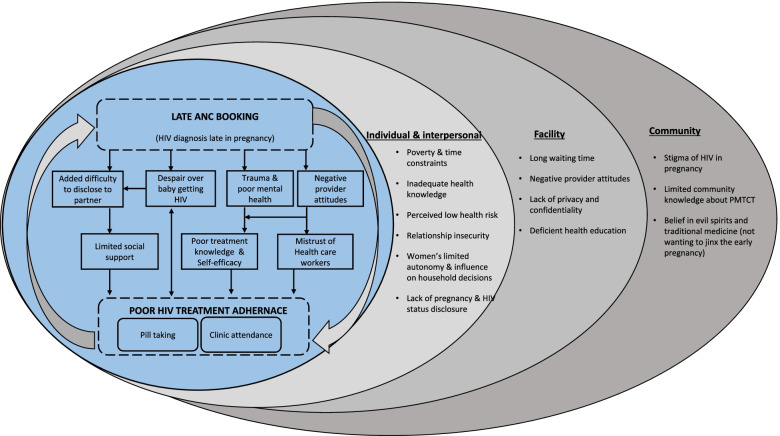
Women described common underlying factors influencing both late ANC initiation and poor ART adherence in South Africa and Uganda. These included poverty and time constraints; inadequate health knowledge; perceived low health risk; stigma of HIV in pregnancy; lack of disclosure; and negative provider attitudes. Most late ANC presenters reported relationship problems, lack of autonomy and the limited ability to dialogue with their partners to influence household decisions on health and resource allocation. Perception of poor privacy and confidentiality in maternity clinics was rife among women in both study settings and compounded risks associated with early disclosure of pregnancy and HIV. Women who initiated ANC late and were then diagnosed with HIV appeared to be more susceptible to poor ART adherence. They were often reprimanded by health workers for presenting late which hampered their participation in treatment counselling and festered provider mistrust and subsequent disengagement in care. Positive HIV diagnosis in late pregnancy complicated women's ability to disclose their status to significant others which deprived them of essential social support for treatment adherence. Further, it appeared to adversely affect women's mental health and treatment knowledge and self-efficacy.
We found clear links between late initiation of ANC and the potential for poor adherence to ART based on common structural barriers shaping both health seeking behaviours, and the adverse impact of late HIV diagnosis on women's mental health and treatment knowledge and efficacy. Women who present late are a potential target group for better access to antiretrovirals that are easy to take and decrease viral load rapidly, and counselling support with adherence and partner disclosure. A combination of strengthened health literacy, economic empowerment, improved privacy and patient-provider relationships as well as community interventions that tackle inimical cultural practices on pregnancy and unfair gender norms may be required.
撒哈拉以南非洲的许多妇女在妊娠晚期才开始接受产前护理 (ANC),从而破坏了艾滋病毒母婴传播 (PMTCT) 的最佳预防效果。在全国推广多拉韦林的时代,人们仍然不清楚妊娠晚期开始 ANC 是否以及如何与抗逆转录病毒治疗 (ART) 的依从性相关。
本研究采用定性设计,于 2018 年 8 月至 2019 年 3 月期间进行了个人访谈和焦点小组讨论。我们从南非和乌干达的贫困城市社区中,有针对性地选择了 37 名妊娠和哺乳期的艾滋病毒感染者,她们在 ANC 中被归类为早期或晚期就诊者。此外,我们在这两个国家还进行了 7 次焦点小组讨论,参与者共 67 人。在 NVivo12 中对数据进行了主题分析。
妇女们描述了在南非和乌干达,既影响晚期 ANC 就诊,又影响 ART 依从性差的共同潜在因素。这些因素包括贫困和时间限制;健康知识不足;认为健康风险低;怀孕时的 HIV 耻辱感;缺乏披露;以及提供者的消极态度。大多数晚期 ANC 就诊者报告存在人际关系问题、缺乏自主权,以及与伴侣就健康和资源分配进行对话的能力有限,从而影响家庭决策。在这两个研究环境中,产妇诊所隐私和保密性差的观念普遍存在,并且与怀孕和 HIV 早期披露相关的风险增加。那些晚期才开始 ANC 并随后被诊断为 HIV 的妇女似乎更容易不依从 ART。卫生工作者经常因为她们就诊太晚而训斥她们,这阻碍了她们参与治疗咨询,并加剧了提供者的不信任和随后的护理脱失。妊娠晚期 HIV 阳性诊断使妇女难以向重要他人披露其病情,从而剥夺了她们获得治疗依从所需的重要社会支持。此外,这似乎对妇女的心理健康和治疗知识及自我效能产生了不利影响。
我们发现 ANC 晚期就诊与 ART 依从性差之间存在明确的联系,因为共同的结构性障碍既影响了寻求医疗保健的行为,也对 HIV 晚期诊断对妇女心理健康和治疗知识及自我效能的不利影响。晚期就诊的妇女是一个潜在的目标群体,她们可能需要更好地获得易于服用且能迅速降低病毒载量的抗逆转录病毒药物,以及有关依从性和伴侣披露的咨询支持。可能需要加强健康素养、经济赋权、改善隐私和医患关系,以及开展解决妊娠和不公平性别规范方面有害文化习俗的社区干预措施。