Schmid Benjamin, Ansbro Éimhín, Raju Emmanuel, Willis Ruth, Shabila Nazar, Perel Pablo
Centre for Global Chronic Conditions, London School of Hygiene and Tropical Medicine, London, UK.
Department of Non-Communicable Disease Epidemiology, Faculty of Epidemiology and Population Health, London School of Hygiene and Tropical Medicine, Keppel Street, London, WC1E 7HT, UK.
Confl Health. 2022 Jul 15;16(1):40. doi: 10.1186/s13031-022-00474-w.
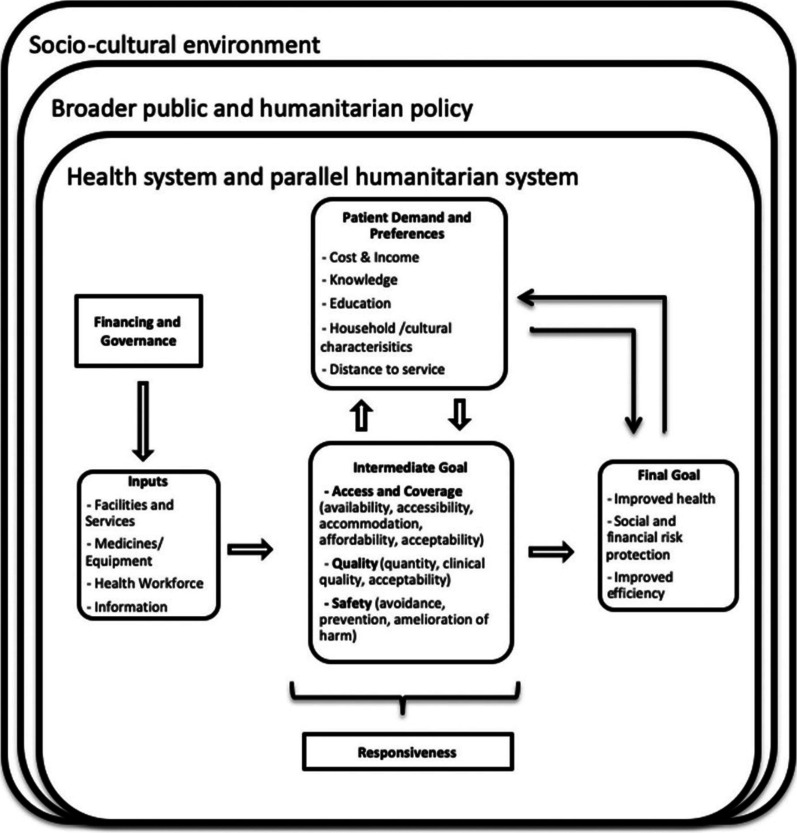
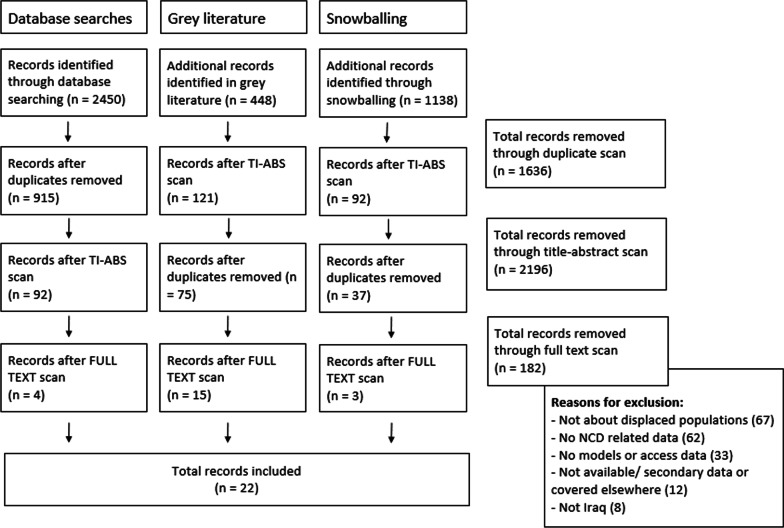
Non-communicable diseases (NCDs) are the leading cause of death and disability globally. Their importance in humanitarian settings is increasingly recognised, but evidence about how best to address NCDs in these setting is limited. This scoping review aimed to explore models of NCD care for displaced populations in Iraq, in order to build evidence to design context adapted models of care. A search of key databases (Medline, Embase, Scopus, EconLit, Global Health, Web of Science, and the Iraqi Academic Scientific Journals) was conducted and complemented with grey literature and snowballing searches. Documents were included if they referred to models of NCD care for displaced populations. We synthesised the data using a conceptual model of care framework. The findings were reported according to the PRISMA guidelines for scoping reviews. We identified 4036 documents of which 22 were eligible for inclusion. Only six documents were peer-reviewed studies with most being internal reports, commentaries, or press releases. Of the 14 documents that reported on their methods, most applied quantitative approaches (n = 7), followed by mixed-methods (n = 5) and qualitative approaches (n = 2). Only one document reported on outcome data and none applied longitudinal study designs. Documents generally described individual framework dimensions, mostly centring around medicines, facility-based services, and selected access dimensions. Most dimensions had few or no references. The most common model for displaced populations in Iraq was primary-level centred care that complemented or supported existing-mostly tertiary-public health system structures. Additionally, private facilities played an important role and were frequently accessed by displaced populations in most settings. Quality of care, particularly patient-perceived quality, emerged as a critical factor for designing context-adapted models of NCD care. This review also identified a strong regionality of NCD care, particularly in terms of access rates and barriers. We concluded that there is a scarcity of evidence on the effectiveness of models of NCD care for displaced populations in Iraq, calling for capacity building initiatives focused on implementation research and evaluation.
非传染性疾病(NCDs)是全球死亡和残疾的主要原因。它们在人道主义环境中的重要性日益得到认可,但关于如何在这些环境中最好地应对非传染性疾病的证据有限。本范围审查旨在探索伊拉克流离失所人群的非传染性疾病护理模式,以便为设计适合当地情况的护理模式提供证据。我们检索了关键数据库(Medline、Embase、Scopus、EconLit、Global Health、Web of Science和伊拉克学术科学期刊),并辅以灰色文献和滚雪球搜索。如果文献提及流离失所人群的非传染性疾病护理模式,则将其纳入。我们使用护理框架的概念模型对数据进行了综合。研究结果根据范围审查的PRISMA指南进行报告。我们共识别出4036份文献,其中22份符合纳入标准。只有6份文献为同行评审研究,大多数是内部报告、评论或新闻稿。在14份报告了研究方法的文献中,大多数采用定量方法(n = 7),其次是混合方法(n = 5)和定性方法(n = 2)。只有一份文献报告了结果数据,且没有文献采用纵向研究设计。文献通常描述了各个框架维度,大多围绕药品、基于设施的服务以及选定的获取维度。大多数维度几乎没有或没有参考文献。伊拉克流离失所人群最常见的护理模式是以初级护理为中心,对现有的——大多是三级公共卫生系统结构起到补充或支持作用。此外,私立医疗机构发挥了重要作用,在大多数情况下,流离失所人群经常前往就诊。护理质量,尤其是患者感知的质量,成为设计适合当地情况的非传染性疾病护理模式的关键因素。本综述还发现非传染性疾病护理存在很强的地域性,尤其是在获取率和障碍方面。我们得出结论,关于伊拉克流离失所人群非传染性疾病护理模式有效性的证据匮乏,需要开展侧重于实施研究和评估的能力建设举措。