School of Population Medicine and Public Health, Chinese Academy of Medical Sciences and Peking Union Medical College, Beijing, China.
Institute of Pharmaceutical and Medical Devices Supervision, National Medical Products Administration-Chinese Academy of Medical Sciences, Beijing, China.
Respir Res. 2022 Jul 15;23(1):188. doi: 10.1186/s12931-022-02096-5.
Assessing the humoral immunity of patients with underlying diseases after being infected with SARS-CoV-2 is essential for adopting effective prevention and control strategies. The purpose of this study is to analyze the seroprevalence of people with underlying diseases and the dynamic change features of anti-SARS-CoV-2 antibodies.
We selected 100 communities in Wuhan using the probability-proportional-to-size sampling method. From these 100 communities, we randomly selected households according to a list provided by the local government. Individuals who have lived in Wuhan for at least 14 days since December 2019 and were ≥ 40 years old were included. From April 9-13, 2020, community staff invited all selected individuals to the community healthcare center in batches by going door-to-door or telephone. All participants completed a standardized electronic questionnaire simultaneously. Finally, 5 ml of venous blood was collected from all participants. Blood samples were tested for the presence of pan-immunoglobulins, IgM, IgA, and IgG antibodies against SARS-CoV-2 nucleocapsid protein and neutralising antibodies were assessed. During the period June 11-13, 2020 and October 9-December 5, 2020, all family members of a positive family and matched negative families were followed up twice.
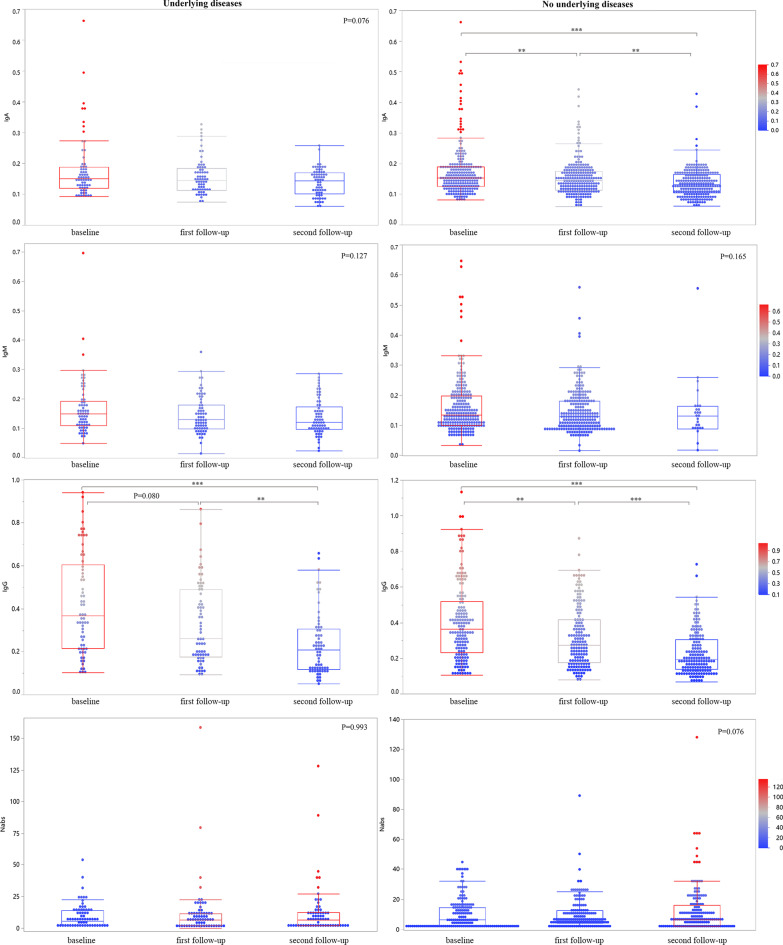
The seroprevalence of anti-SARS-CoV-2 antibodies in people with underlying diseases was 6.30% (95% CI [5.09-7.52]), and that of people without underlying diseases was 6.12% (95% CI [5.33-6.91]). A total of 313 people were positive for total antibodies at baseline, of which 97 had underlying disease. At the first follow-up, a total of 212 people were positive for total antibodies, of which 66 had underlying disease. At the second follow-up, a total of 238 people were positive for total antibodies, of which 68 had underlying disease. A total of 219 participants had three consecutive serum samples with positive total antibodies at baseline. The IgG titers decreased significantly with or without underlying diseases (P < 0.05) within the 9 months at least, while the neutralizing antibody titer remained stable. The titer of asymptomatic patients was lower than that of symptomatic patients (baseline, P = 0.032, second follow-up, P = 0.018) in the underlying diseases group.
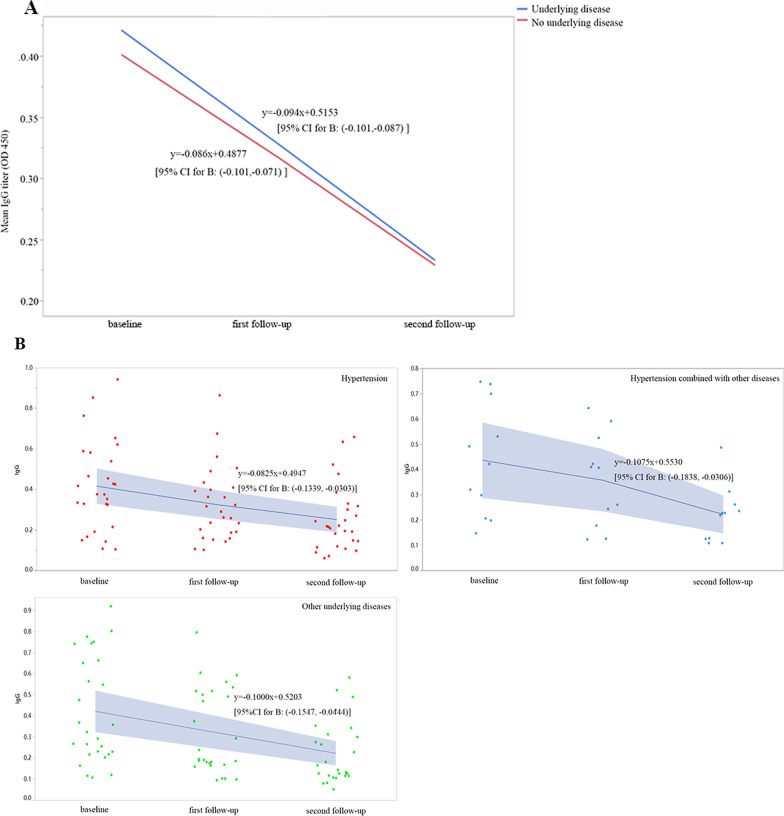
Our research focused on the serological changes of people with and without underlying diseases in a state of single natural infection. Regardless of the underlying diseases, the IgG titer decreased significantly over time, while there was no significant difference in the decline rate of IgG between with and without underlying diseases. Moreover, the neutralizing antibody titer remained relatively stable within the 9 months at least.
评估患有基础疾病的患者在感染 SARS-CoV-2 后的体液免疫对于采取有效的预防和控制策略至关重要。本研究旨在分析患有基础疾病人群的血清阳性率和抗 SARS-CoV-2 抗体的动态变化特征。
我们采用概率比例规模抽样方法选择了武汉市的 100 个社区。从这些 100 个社区中,我们根据当地政府提供的名单随机选择家庭。自 2019 年 12 月以来,在武汉居住至少 14 天且年龄≥40 岁的个人均被纳入研究。2020 年 4 月 9 日至 13 日,社区工作人员通过挨家挨户或电话的方式分批邀请所有选定的个人到社区医疗中心。所有参与者同时完成标准化的电子问卷。最后,从所有参与者中采集 5ml 静脉血。检测血液样本中是否存在 pan-immunoglobulins、针对 SARS-CoV-2 核衣壳蛋白的 IgM、IgA 和 IgG 抗体以及中和抗体。2020 年 6 月 11 日至 13 日和 2020 年 10 月 9 日至 12 月 5 日期间,对所有阳性家庭和匹配的阴性家庭的所有家庭成员进行了两次随访。
患有基础疾病人群的抗 SARS-CoV-2 抗体血清阳性率为 6.30%(95%CI[5.09-7.52]),无基础疾病人群的血清阳性率为 6.12%(95%CI[5.33-6.91])。基线时共有 313 人总抗体阳性,其中 97 人患有基础疾病。在第一次随访时,共有 212 人总抗体阳性,其中 66 人患有基础疾病。在第二次随访时,共有 238 人总抗体阳性,其中 68 人患有基础疾病。基线时有 219 名参与者连续三次血清总抗体阳性。至少在 9 个月内,无论是否患有基础疾病,IgG 滴度均显著下降(P<0.05),而中和抗体滴度保持稳定。基础疾病组中无症状患者的 IgG 滴度低于有症状患者(基线时,P=0.032,第二次随访时,P=0.018)。
本研究关注了在单一自然感染状态下患有和不患有基础疾病人群的血清学变化。无论是否患有基础疾病,IgG 滴度随时间显著下降,而患有和不患有基础疾病的 IgG 滴度下降率无显著差异。此外,中和抗体滴度至少在 9 个月内保持相对稳定。