Department of Cellular and Molecular Neuropathology, Juntendo University Graduate School of Medicine, Tokyo, Japan.
College of Liberal Arts and Science, Kitasato University, Sagamihara, Japan.
J Comp Neurol. 2022 Dec;530(17):2977-2993. doi: 10.1002/cne.25389. Epub 2022 Jul 17.
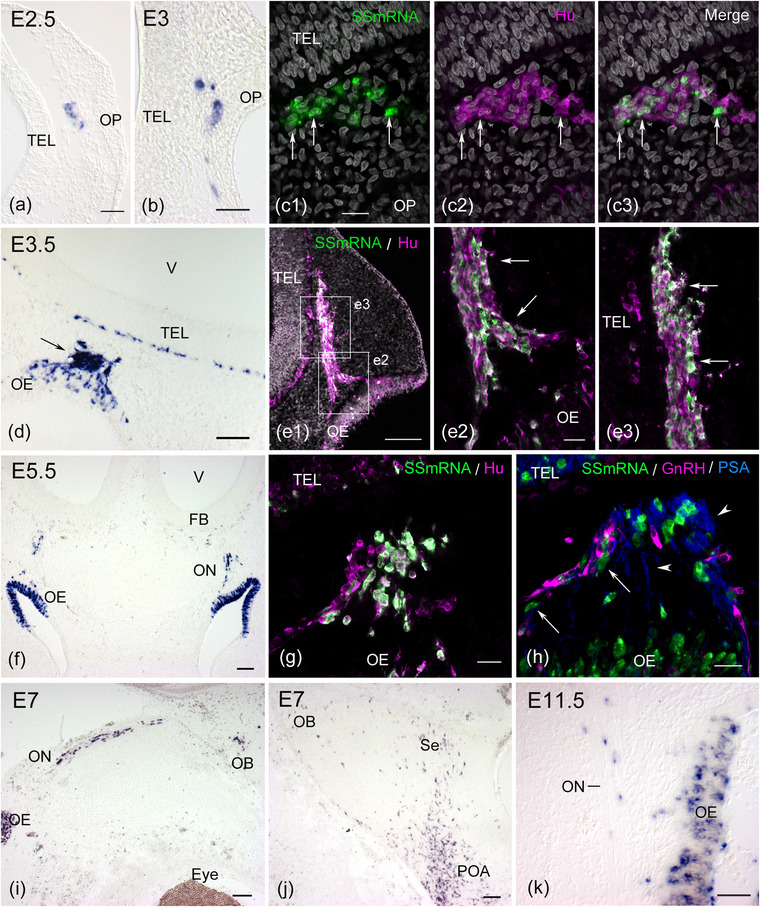
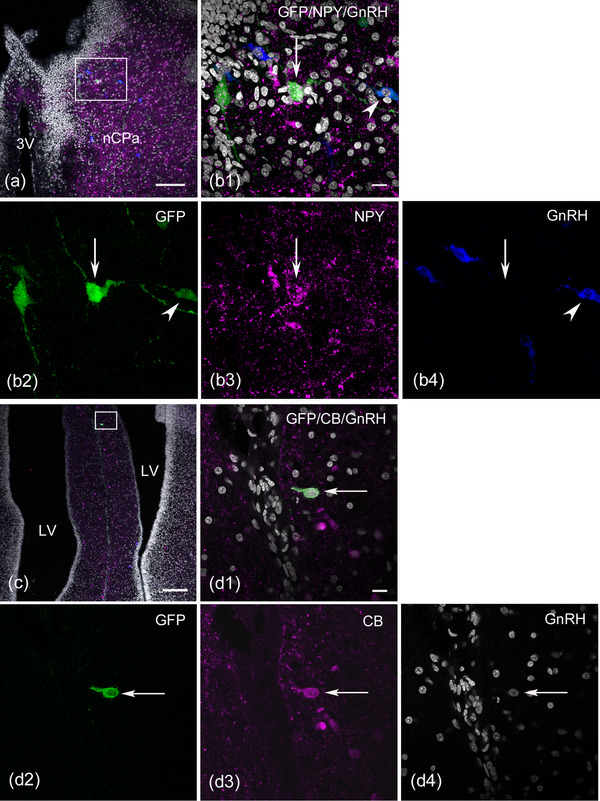
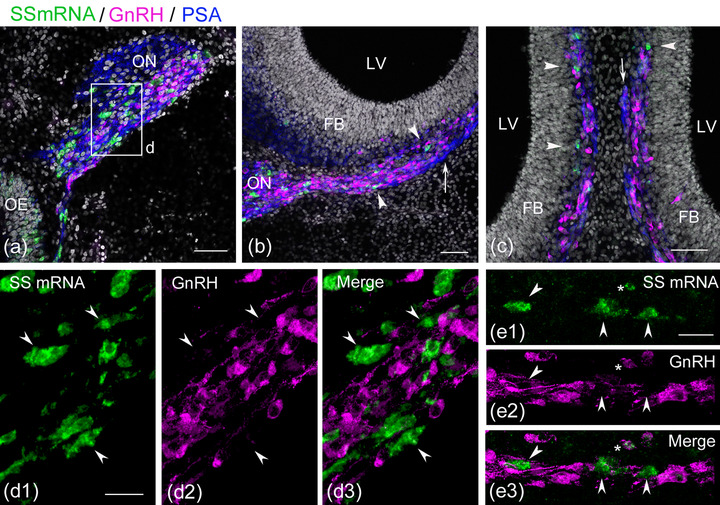
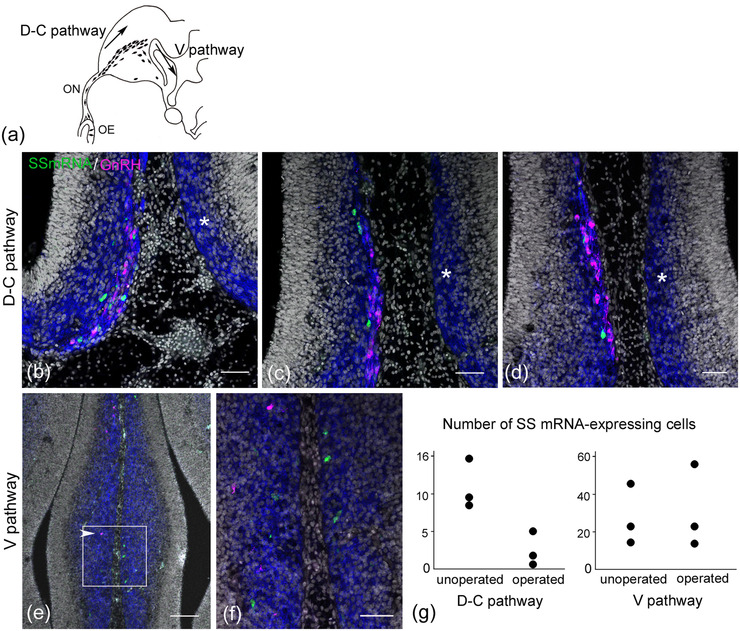
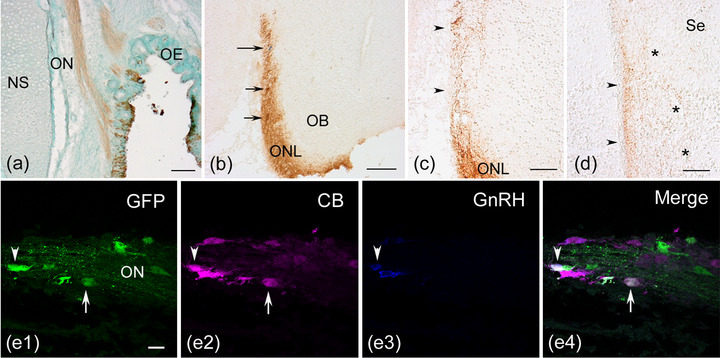
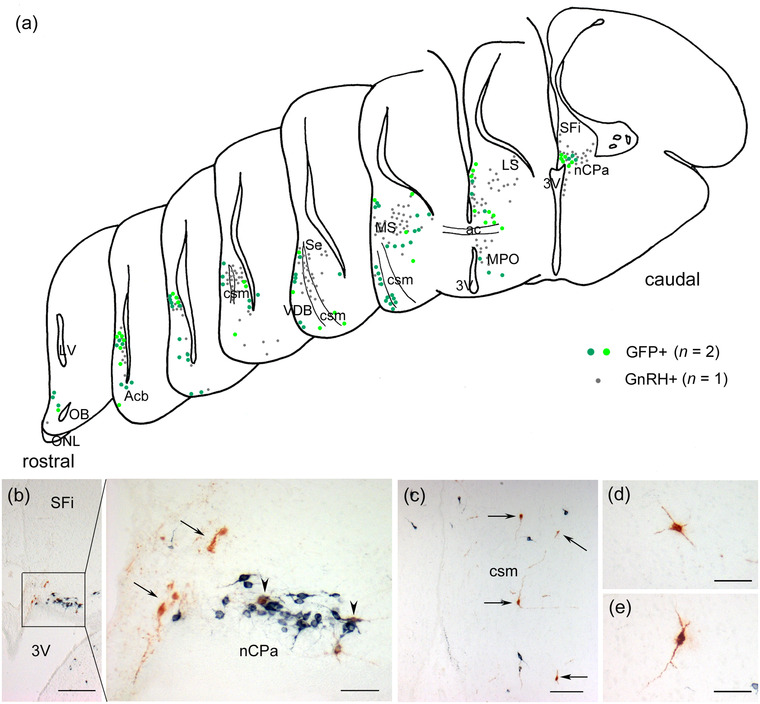
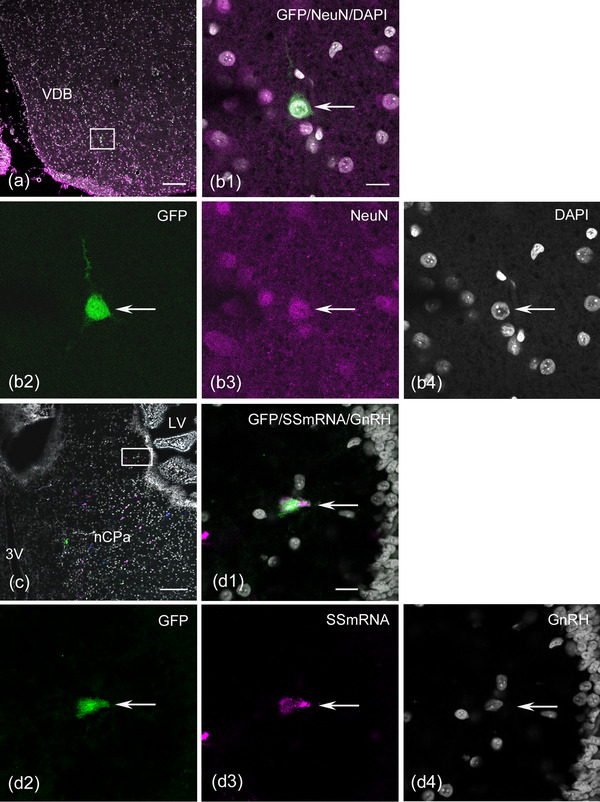
The olfactory placode (OP) of vertebrates generates several classes of migrating cells, including hypothalamic gonadotropin-releasing hormone (GnRH)-producing neurons, which play essential roles in the reproduction system. Previous studies using OP cell labeling have demonstrated that OP-derived non-GnRH cells enter the developing forebrain; however, their final fates and phenotypes are less well understood. In chick embryos, a subpopulation of migratory cells from the OP that is distinct from GnRH neurons transiently expresses somatostatin (SS). We postulated that these cells are destined to develop into brain neurons. In this study, we examined the expression pattern of SS mRNA in the olfactory-forebrain region during development, as well as the destination of OP-derived migratory cells, including SS mRNA-expressing cells. Utilizing the Tol2 genomic integration system to induce long-term fluorescent protein expression in OP cells, we found that OP-derived migratory cells labeled at embryonic day (E) 3 resided in the olfactory nerve and medial forebrain at E17-19. A subpopulation of green fluorescent protein (GFP)-labeled GnRH neurons that remained in the olfactory nerve was considered to comprise terminal nerve neurons. In the forebrain, GFP-labeled cells showed a distribution pattern similar to that of GnRH neurons. A large proportion of GFP-labeled cells expressed the mature neuronal marker NeuN. Among the GFP-labeled cells, the percentage of GnRH neurons was low, while the remaining GnRH-negative neurons either expressed SS mRNA, neuropeptide Y, or calbindin D-28k or did not express any of them. These results indicate that a diverse population of OP-derived neuronal cells, other than GnRH neurons, integrates into the chick medial forebrain.
脊椎动物的嗅基板(OP)产生几类迁移细胞,包括下丘脑促性腺激素释放激素(GnRH)产生神经元,它们在生殖系统中发挥重要作用。先前使用 OP 细胞标记的研究表明,OP 衍生的非 GnRH 细胞进入发育中的前脑;然而,它们的最终命运和表型了解较少。在鸡胚中,来自 OP 的迁移细胞的亚群与 GnRH 神经元不同,它们暂时表达生长抑素(SS)。我们假设这些细胞注定要发育成脑神经元。在这项研究中,我们检查了发育过程中嗅觉-前脑区域中 SS mRNA 的表达模式,以及包括 SS mRNA 表达细胞在内的 OP 衍生迁移细胞的去向。利用 Tol2 基因组整合系统诱导 OP 细胞中的长期荧光蛋白表达,我们发现 E3 天标记的 OP 衍生迁移细胞位于 E17-19 天的嗅神经和中脑。留在嗅神经中的一小部分绿色荧光蛋白(GFP)标记的 GnRH 神经元被认为包括终神经神经元。在前脑,GFP 标记的细胞表现出与 GnRH 神经元相似的分布模式。很大一部分 GFP 标记的细胞表达成熟神经元标记物 NeuN。在 GFP 标记的细胞中,GnRH 神经元的比例较低,而其余的 GnRH 阴性神经元要么表达 SS mRNA、神经肽 Y 或钙结合蛋白 D-28k,要么不表达任何这些物质。这些结果表明,除 GnRH 神经元外,OP 衍生的神经元细胞的多样性群体整合到鸡的中脑中。