Szkitsak Juliane, Karius Andre, Hofmann Christian, Fietkau Rainer, Bert Christoph, Speer Stefan
Department of Radiation Oncology, Universitätsklinikum Erlangen, Friedrich-Alexander-Universität Erlangen-Nürnberg, Erlangen, Germany.
Comprehensive Cancer Center Erlangen-EMN (CCC ER-EMN), Erlangen, Germany.
Phys Imaging Radiat Oncol. 2022 Jun 24;23:85-91. doi: 10.1016/j.phro.2022.06.007. eCollection 2022 Jul.
BACKGROUND & PURPOSE: Four-dimensional computed tomography (4DCT) scans are standardly used for radiotherapy planning of tumors subject to respiratory motion. Based on online analysis and automatic adaption of scan parameters to the patient's individual breathing pattern, a new breathing-controlled 4DCT (i4DCT) algorithm attempts to counteract irregular breathing and thus prevent artifacts. The aim of this study was to perform an initial quality assurance for i4DCT.
MATERIAL & METHODS: To validate the i4DCT algorithm, phantom measurements were performed to evaluate geometric accuracy (diameter, volume, eccentricity), image quality (dose-normalized contrast-noise-ratio, CT number accuracy), and correct representation of motion amplitude of simulated tumor lesions. Furthermore, the impact of patient weight and resulting table flexion on the measurements was investigated. Static three-dimensional CT (3DCT) scans were used as ground truth.
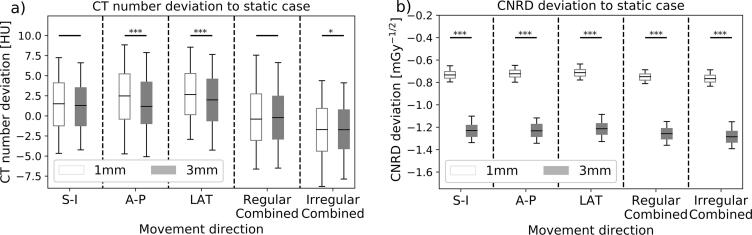
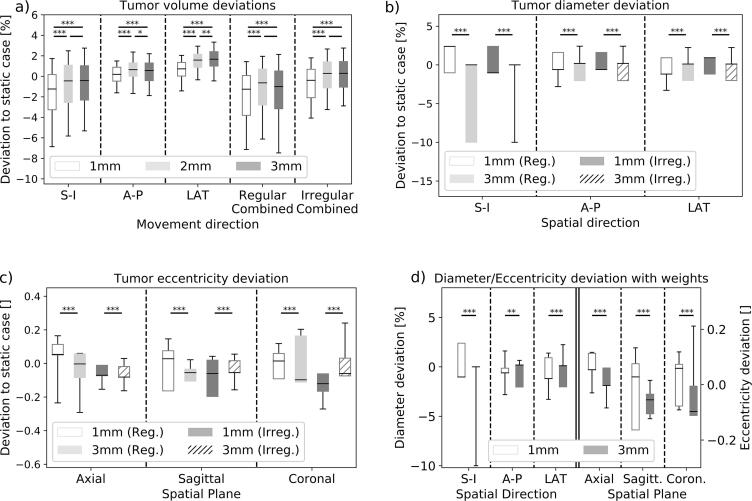
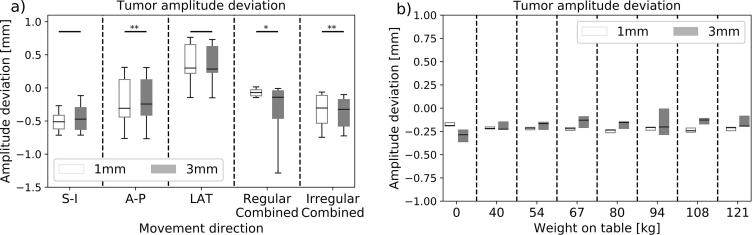
The median volume deviation magnitude between 4DCT and 3DCT was < 2% (<0.2 cm). The volume differences ranged from -8% (-1.0 cm) to 3% (0.4 cm). Median tumor diameter deviation magnitudes were < 2% (<0.7 mm) for regular and < 3.5% (<1.0 mm) for irregular breathing. For eccentricity, a median deviation magnitude of < 0.05 for regular and < 0.08 for irregular breathing curves was found. The respiratory amplitude was represented with a median accuracy of < 0.5 mm. CT numbers and dose-normalized contrast-noise-ratio showed no clinically relevant difference between 4DCT and 3DCT. Table flexion proved to have no clinically relevant impact on geometric accuracy.
The breathing-controlled algorithm provides in general good results regarding image quality, geometric accuracy, and correct depiction of motion amplitude for regular and irregular breathing.
四维计算机断层扫描(4DCT)常用于对受呼吸运动影响的肿瘤进行放射治疗计划。基于对扫描参数的在线分析以及根据患者个体呼吸模式进行自动调整,一种新的呼吸控制4DCT(i4DCT)算法试图抵消不规则呼吸并防止伪影。本研究的目的是对i4DCT进行初步质量保证。
为验证i4DCT算法,进行了体模测量,以评估几何精度(直径、体积、偏心率)、图像质量(剂量归一化对比噪声比、CT值准确性)以及模拟肿瘤病变运动幅度的正确表示。此外,研究了患者体重及由此导致的检查床弯曲对测量的影响。静态三维CT(3DCT)扫描用作对照标准。
4DCT与3DCT之间的体积偏差中位数幅度<2%(<0.2 cm)。体积差异范围为-8%(-1.0 cm)至3%(0.4 cm)。规则呼吸时肿瘤直径偏差中位数幅度<2%(<0.7 mm),不规则呼吸时<3.5%(<1.0 mm)。对于偏心率,规则呼吸曲线的中位数偏差幅度<0.05,不规则呼吸曲线<0.08。呼吸幅度的表示中位数精度<0.5 mm。4DCT与3DCT之间的CT值及剂量归一化对比噪声比无临床相关差异。检查床弯曲对几何精度无临床相关影响。
对于规则和不规则呼吸,呼吸控制算法在图像质量、几何精度以及运动幅度的正确描绘方面总体上取得了良好结果。